Gay Washington Teen Dies in Response to Cyber- and School Bullying

Rafael "Rafa" Morelos, 14-year-old openly gay middle school student took his own life because of incessant bullying.
Cashmere, Washington – New light is being shed on the bullycide of a 14-year-old gay boy, victimized online and in school because of his sexual orientation. Rafael Morelos, a student at Cashmere Middle School, hanged himself from an irrigation bridge not far from his home on January 29, a cold Sunday in central Washington state. His older brother found his lifeless body. The small agricultural community of 3,060 east of Seattle continues to be in mourning because of his loss. It is another community that believed anti-gay bullying just didn’t happen among people of stolid, conservative values like them. Rafael’s suicide has dispelled that illusion.
By all accounts, Rafael was a boy who was easy to like. He had been out and open about his homosexuality, and had overcome depressive bouts that had caused him to cut himself. But conservative attitudes, especially among school counselors, made it difficult for Rafa (as his friends called him) and other gay students to find a professional they could trust.
School and town officials still do not want to say that anti-gay bullying played a major role in Rafael’s death. But scores of his classmates told his mother that the bullying was incessant. Huffington Post reports that the school locker room was a place of painful conflict for Rafael. Quoting the Wentachee World, Huffpo highlights a couple of witnesses to some of the worst incidents of harassment and physical violence. One friend said, “He told me he got shoved and punched in the face in P.E. in the locker room at Cashmere.” Another added, “He was tired of people saying that his little brothers would follow in his footsteps and be gay, too.” Another friend said that the harassment extended to the internet. A bully set up a Facebook page just so she could taunt Rafael online for being gay. His mother Malinda Morelos told Q13 Fox News that she knew he was not acting as if he felt up to par, but she had no idea that he was being bullied for being gay at school. After a candlelight vigil attended by over 100 youth and others, she said, “He never told me nothing. He did not tell me he was being bullied. He had a dark side inside him that he never told me his feelings anymore. I thought it was just him being a teenager, and I just didn’t know why.”
The Seattle Times says a person from a nearby town collected over 750 signatures for a Change.org petition calling upon Cashmere school officials to enforce their zero tolerance policy on anti-gay bullying. LGBTQ advocates from around the nation are pressing local and state officials for action to prevent other senseless bullycides. On April 7, the Seattle Men’s Chorus, known for its many gay members, will give a benefit concert in Rafael’s memory. The concert will be preceded by a program on diversity and tolerance. Cashmere Schools Superintendent Glenn Johnson told the Times: “The bottom line is we lost a kid — and that’s of concern no matter what the reason is. The reality is that we take that very seriously and we want to get better as a community,” Superintendent Johnson continued. “We need to learn and heal together.”
His mother is left with her memories and a journal retrieved from his school locker where he spoke lovingly about his friends and a special person in his life. On his iPod, Rafa left a short, poignant goodbye shortly before he died: “Sawwy, guys, but I love you guys.” As his mother said to mourners at the candlelight vigil in memory of her dear son, “Sometimes he acted strong but, inside, he was dying little by little.”
Gay Ohio Teen in Coma After Post-Bullying Suicide Attempt

Austin Rodriguez, 15, overdosed on prescription pills because of incessant bullying due to his sexual orientation.
Wellsville, Ohio – An openly gay 15-year-old is struggling for his life in a coma after high school bullying drove him to attempt suicide. The Advocate reports that Austin Rodriguez, student at Wellsville High School, collapsed on the kitchen floor in front of his mother after swallowing over 100 pills because he faced concentrated ridicule and harassment for being gay. According to WFMJ TV, Rodriguez seemed lethargic to his mother last Friday evening, and then fell at her feet to the kitchen floor from taking a massive overdose of his own prescription drug. She rushed him to a local hospital for treatment, where doctors then helicoptered him to Akron Children’s Hospital where he remains in a medically induced coma to protect his life. Because of the extent of the damage to his lungs from the overdose, Rodriguez is in critical condition, but his doctors are guardedly optimistic that he will recover.
His mother is appealing to the Wellsville High School administration and to other schools in the Ohio Valley to change its policies toward LGBT students like her son. In an interview for WFMJ, Bonnie Rodriguez said she had no idea her introverted, quiet son was being bullied to the degree he was until school friends came forward “out of the woodwork” to tell her stories of fear and pain after Austin was hospitalized. In the last eight months Austin had come out to her, and she said she shares a loving, “honest” relationship with her son. “I actually didn’t know how bad it was for him in school until he actually did this,” Mrs. Rodriguez said. “And until friends came out of the woodwork saying we knew Austin was going through this, we thought he was handling it a lot better. We didn’t know what to do.” Mrs. Rodriguez went on to say that Austin was happy and relieved at first because coming out to her had gone so well, but later he fell into a depression she was unable to get to the bottom of. Now she knows the bullying at school was behind much of her son’s desperation, and he was unwilling to talk about it because he didn’t want to seem weak.
Schoolmates harassed Austin cruelly, forcing an already introverted boy to feel like an outcast. His mother told reporters the extent of the bullying her son had to endure: “It was electronic, it was face to face bullying, they were hiding his gym clothes because they didn’t want him changing in the locker room with them,” she said. “They didn’t want him to eat by them, or in the school lunchroom.” Mrs. Rodriguez hopes that no other family has to undergo what hers has to face, and her calls for action are beginning to be heard. WTRF TV reports that the Wellsville High administration is investigating the situation that led Austin to attempt suicide. There is no Gay Straight Alliance (GSA) at Wellsville High, but administrators now say they are open to the establishment of one. Students say that Austin was bullied constantly because is came out as gay. They also say that the school is not doing enough to address the problem of anti-gay bullying. Principal Linda Rolley is fielding their complaints as the investigation proceeds. Meanwhile, the next few days are crucial for Austin’s physical recovery. The culture of harassment and violence that led to this hateful outcome, however, remains intact throughout schools in the Akron area.
Hollywood Hate Crime Suggests City Unsafe for Gays

All is not well for gays in the City of the Stars.
Hollywood, California – Police are investigating a severe beating at one of the busiest corners in Hollywood this Sunday. According to CBS 2 News, three men approached a lone, 39-year-old Hispanic man at the corner of North Caheunga Boulevard and Yucca Street, asking him if he was gay. When he said “yes,” the men attacked him so brutally that he lost consciousness. They only stopped their assault when other people arrived on the scene, and moved in to help the victim. The victim took a cab to the hospital where he was treated and released. Police have only a vague description of the attackers. There has been no evidence to suggest there was a racial/ethnic dimension to the assault. This appears to be a gay bashing, plain and simple, and police in the Hollywood Division of the LAPD are investigating it as such.
The attack took place around 1:30 am in the heart of Hollywood, a location where people have felt safe for years. For a man to be assaulted so blatantly raises security concerns for residents. Area resident Daniela Castro told CBS 2 reporters that she was shocked and disgusted that such a hate crime took place in her neighborhood. “I hate that people have to think that way,” she said. “People need to be more open-minded.” Noting that she walks through the same intersection to and from acting classes, Castro said, “I really hope they get caught. If they keep doing that to people, it’s just not right.”
The gay community in the Hollywood area is on high alert already. In October, a series of gay bashings took place in West Hollywood, according to the Los Angeles Times. Authorities downplayed the anti-gay attacks at that time, reassuring the community that there was no evidence that the fall attacks were related to each other, and that there was apparently no upsurge in anti-gay violence in the city. Now, with this disturbing gay bashing taking place in the heart of the city, gay activists are calling for immediate investigation and action to protect the large LGBTQ community.
Gay Panic Murder of Homeless Disabled Man in Connecticut

Matthew O'Brien-Veader, on trial for the brutal murder of a homeless disabled man he believed made a sexual advance toward him.
Waterbury, Connecticut – Police officials say that a Waterbury man savagely murdered a homeless disabled man living in the same abandoned factory because of an alleged sexual advance. Matthew O’Brien-Veader, 23, took shelter in the derelict warehouse along with his alleged victim, 39-year-old Joed Olivera, in June 2009. During his sleep, O’Brien-Veader believed that the older disabled man attempted to have sex with him, and flew into a homophobic rage, according to the Republican American. Police arrested O’Brien-Veader June 12, 2009, and charged him with the grisly murder. He was bound over for trial in superior court, which finally began in Waterbury this week after a series of delays.
Court documents say that O’Brien-Veader attempted to throw Olivera down a flight of stairs, beat Olivera with his own pair of crutches until they shattered, and then repeatedly stabbed him with a dagger before throwing Olivera’s body through a jagged hole in the floor to the room below. Others in the factory found Olivera’s body atop a jagged pile of junk, covered with a piece of plywood. One man who saw the mangled body of the homeless victim was so disturbed by the scene that he testified in in Waterbury Superior Court Tuesday to running out of the building and smoking marijuana to calm his nerves. O’Brien-Veader’s friend, Jason Benoit, testified that O’Brien-Veader had a deep aversion to LGBTQ people, and had told him that all gay people should be rounded up and dropped on a deserted island. According to the Hartford Courant, the defendant could receive a life sentence if found guilty.
O’Brien-Veader sat quietly beside his attorney as the case, postponed until over two years after the homicide, unfolded in the Waterbury courtroom. By invoking the gay panic defense, suggesting that the victim was responsible for his own murder, the defense hopes to cloud the minds of jurors enough to lighten the sentence, should their client be found guilty. The recent King-McInerney gay killing in Oxnard, California gave the gay panic defense new life in American courts. Defense attorneys for McInerney, a teen who confessed to the execution-style shooting of his teenaged gay classmate, Larry King, in front of a room full of witnesses, argued that unwanted sexual advances pushed McInerney to pull the trigger. The ploy succeeded in reducing the conviction from murder to manslaughter. O’Brien-Veader’s defense team is hoping that enough residual heterosexism and homophobia exists in jurors to bring a similar result for their client.
Ricky Martin Criticizes Move to Drop Gay Protections from Puerto Rico Law
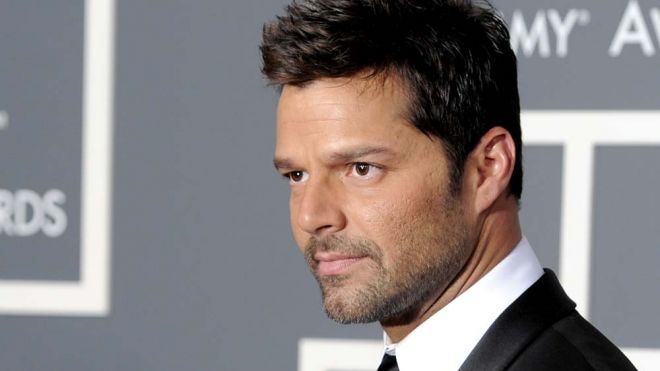
Ricky Martin speaks out against change in Puerto Rican penal code (AP photo).
Ricky Martin, Latino Superstar, blasted politicians in his home commonwealth of Puerto Rico for seeking to remove gay people from legal protection from bias-motivated hate crimes, according to Fox News Latino. Martin posted a strong statement on his website blog denouncing the move. In part, he said:
“I am very saddened by the turn the discussion on criminal law has taken in Puerto Rico that proposes to eliminate the aggravating in cases where crimes are committed by prejudice against the victim.” Martin went on to say, “They ought to do their homework and review the Universal Declaration of Human Rights a bit…which says that everyone – all citizens – are equal before the law and have, without distinction, the right to equal protection under the law.”
Martin’s opposition to the change in Puerto Rico’s hate crimes law comes at a time when the numbers of anti-gay and transgender hate crimes are reaching epidemic proportions. His voice will help amplify the protests of local LGBT and Dominican activists who are fighting the passage of the amendment in the legislature. In March 2010, Martin came out openly as a gay man, ending years of speculation by the public. On his website, he said, “I am proud to say that I am a fortunate homosexual man. I am very blessed to be who I am.” After years of declining to comment on his sexual orientation, Martin said, “These years in silence and reflection made me stronger and reminded me that acceptance has to come from within, and that this kind of truth gives me the power to conquer emotions I didn’t even know existed.” Now the father of two young sons , Matteo and Valentino, who were born of a surrogate mother in 2008, Martin took citizenship in Spain in 2011, where he intends to marry his lover. Though he could be married in certain states in the U.S., he has said he wishes to marry in Spain to acknowledge the work of LGBT rights advocates and Prime Minister Zapatero there.
One of the motivators Martin says moved him to come out publicly as a gay man was the gruesome murder of Jorge Steven López Mercado in 2009. The gay teen was abducted, dismembered, beheaded, and his remains were left burning along a rural road in central Puerto Rico. The savagery of the killing awoke the consciences of many on the Island besides Martin, though the numbers of violent attacks against LGBT Puerto Ricans has continued to rise. López Mercado’s murderer has been convicted, and is serving a 99-year sentence.
Gay Hate Crimes in Puerto Rico? Not Any More?
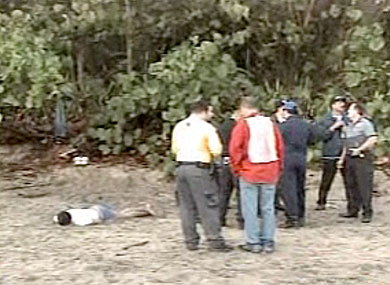
Police view the corpse of murdered gay Puerto Rican, Ezequiel Crespo Hernández, in April 2011 (EDGE photo).
San Juan, Puerto Rico – Puerto Rico’s lawmakers are poised to remove LGBT people from hate crimes protection status with the stroke of a pen. Although at least 18 LGBT Puerto Ricans have been murdered in hate crimes since 2009, Edge Boston reports that the territory’s Senate passed a bill last month removing LGBT people from protected categories under the hate crimes law that has been on the books since 2004. The exclusion effort now goes on to the House of Representatives for a vote this week in a special legislative session called by Gov. Luis Fortuño.
Outraged by the increasing number of anti-gay hate crimes, local LGBT activists demanded investigations in June. The Advocate reports that the grisly murder and dismemberment of Jorge Steven López Mercado, a gay teen, ignited the protests that officials were not investigating anti-gay violence under the territory’s hate crimes law. Recently, the strangulation of gay Ezequiel Crespo Hernández, 22, on a public beach in Camuy, and a gas station assault on transgender woman Francheska González so brutal that it punctured her breast implant, intensified the call for justice to be done. Three more LGBT Puerto Ricans, Alejandro Torres Torres, Karlota Gómez Sánchez and Ramón “Moncho” Salgado, were also found dead within a three-day period in June. “It seems they have declared open hunting season against lesbian, gay, bisexual, transgender and transsexual people,” Pedro Julio Serrano, founder of the gay rights group Puerto Rico for Everyone, said to the Associated Press. In response to rising criticism, Puerto Rico’s Attorney General directed an investigation into the application of the hate crimes law. Opponents of the LGBT community responded by quietly acting to remove queer folk from the penal code’s protection.
The penal code revision is drawing criticism from legislators and activists alike. The Advocate says Representative Héctor Ferrer and Sen. Eduardo Bhatia are among the most outspoken critics of the change. Ferrer, speaking at a press conference on Sunday, said, “To eliminate these groups as protected categories is to invite the commission of hate crimes in Puerto Rico. It is a setback in the country’s public policy.” Bhatia added his voice, saying, “In an advanced society, this is dangerous for society.” After the proposed amendment removing LGBTs from hate crimes protection, the only categories of persons who would be protected by the law in Puerto Rico would be political affiliation, age, and disability.
Activist Serrano told EDGE, “Basically they took out the communities hardest hit by hate crimes in Puerto Rico out of the hate crimes statute,” Serrano told EDGE, referring the LGBT community and Dominicans who come to the island for work. “It’s an outrage and now we’re calling upon the House to restore this to where it should be.” Protests and marches against the provision are planned this week throughout island. Serrano, referring to adversaries of the LGBT community, added, “They’re trying to do it under the radar and that’s how it went for a while. Under our watch, we’re not going to let this happen.”
Alleged Butcher of Richard Hernandez Wins Mistrial for Meds Excuse

Seth Winder
Denton, Texas – For the second time in a history of delays and postponements, Richard Hernandez’s alleged murderer was ruled “incompetent to stand trial” on November 18 by a Denton County judge. Seth Winder, 31, was ruled unable to assist in his own defense by District Judge Bruce McFarling after an examination finding him either unmedicated for his diagnosed mental impairment, or insufficiently dosed, according to the Crime Blog of the Dallas Morning News. Winder exhibited nearly catatonic behavior during the third day of the trial–evidencing that he had received none of his prescribed drugs for his schizophrenia, or that he had been spitting out and hiding his nighttime dosages, perhaps for weeks before the trial began. No explanation was given for how Winder could have been considered fit for trial on November 16, but zombie-like two days later. Neither was there an explanation of how jailers and med staff at the Denton County Jail could have so woefully neglected to make sure their smart-though-impaired inmate took his meds as directed and actually swallowed them.
Instead of completing the trial process for the gruesome murder and dismemberment of the openly gay Dallasite, Winder was sent to the North Texas State Hospital in Vernon for treatment. The Dallas Observer speculates that Winder may not ever face trial again for the Silence-0f-the-Lambs-style butchery of 38-year-old Hernandez, whose body was never found–save for his internal organs left in the bathtub of his Far North Dallas apartment in September 2008. This marks a second instance that Winder was found unfit to stand trial because of mental issues, the first being in May 2009. Observer reporter Brantley Hargrove found legal opinion divided on whether the Colony resident will have another day in court. Winder’s Defense Attorney, Derek Adame, says he seriously doubts another trial will take place. Denton County Assistant District Attorney Cary Piel, however, believes Winder will face judge and jury again, probably in April 2012.
Winder stands accused of murdering Hernandez in the gay man’s apartment, though the reasons for their relationship remain murky. Both the Morning News and the Observer repeated the unproven allegation that the victim and his supposed killer were gay lovers. Hernandez’s best friend, Rudy Araiza, has staunchly denied the possibility that Winder and Hernandez were ever “lovers,” and makes that point again in a blog response to the Dallas Morning News allegation. “Richard and Seth were ‘Never’ boyfriends!” Araiza said. “I’m not sure why this newspaper is making that statement, I knew Richard for 22 years, I would know!” It may be another instance in which a grisly anti-gay hate crime is toned down for public consumption by partially blaming the victim for his own demise. Media around the country have a notorious record for succumbing to this sensationalist temptation. Investigators said they found pornographic pictures of Winder on the cell phone he lifted from the Hernandez apartment, though no proof has been offered of who took the images, or what they actually depict.
Although the murder weapon was never found, police did retrieve a sword stained with Hernandez’s blood in the tent where Winder was living. Detectives say that Winder used the sword to cut up the gay man’s body. The dismembered parts of the victim were probably disposed of in a nearby dumpster, and then buried under tons of garbage in a landfill, making the body impossible to locate. Winder’s use of Hernandez’s credit cards led police to arrest him. Witnesses placed Winder in Hernandez’s apartment complex at or near the time of the gay man’s disappearance. Forensics found that the blood stains on Winder’s clothing and shoes were a genetic match to the victim.
So, Seth Winder, either crazy like a fox, or a neglected patient (or both), has avoided the jury again. Meanwhile, Richard Hernandez, who in death cannot answer the innuendo against his character, receives no justice. The eerie quiet throughout North Texas surrounding this latest trial development in one of the most heinous crime cases in Dallas history seems to confirm that many have an investment in hushing the whole thing up. Which would not be the first time such a thing has happened in Texas when it comes to violence against the LGBTQ community.
Gay Murder/Dismemberment Trial Gets Underway Today in North Texas

Richard Hernandez, victim, and Seth Winder, the accused (l to r; Dallas Voice image)
Dallas, Texas – After three years of delays and postponements, the trial of the accused murderer of openly gay Richard Hernandez begins today. The Dallas Voice, doing great journalistic work on this difficult case, announced the story on November 10, quoting first assistant Denton County district attorney Jamie Beck on the trial delays, “Everybody wants a swifter and quicker justice, but you’ve got to do it right. Bottom line, we want justice, so if that means it takes a while, then so be it.”
The “Silence of the Lambs” style murder of 38-year-old Hernandez, an employee of Walmart, drew national press attention in September 2008 when the victim’s viscera but no body was discovered in an apartment in far North Dallas. When Hernandez, a conscientious employee, did not report for work, his friends prevailed on the apartment superintendent to open his residence, and what they found resembled a slaughterhouse. Copious amounts of blood spattered the walls. Hernandez’s body was never found, but tissue from it was left, dumped in the bathtub. Dallas Police acted quickly to track down the killer. True Crime reported that the DPD filed capital murder charges against Seth Winder, 29, a homeless man with a history of erratic behavior and mental illness, even though they did not have possession of a body in the case–only the third time in thirty years of police department history.
Winder was located because of credit card charges he made to Hernandez’s stolen cards after the murder date. Police apprehended Winder in a tent inThe Colony, where he was in possession of personal items of the victim and a bloody sword that may have been used in the dismemberment. The Dallas Voice reports the police conclusion that the killer disposed of the body in a trash dumpster which was emptied in a landfill, making Hernandez’s remains unrecoverable.
Winder’s competence to stand trial was hotly contested in the earlier days of the case. His father and stepmother told the press that their son was a schizophrenic who had once tried to strangle his own mother. Friends of Hernandez contended that Winder was just clever enough to play ill in order to avoid responsibility for the grisly murder. The whole stew was made nastier by the report of police investigators that they discovered a digital camera belonging to Hernandez with “pornographic images” of Winder. The victim’s friends and family vigorously denied the implication that Hernandez and Winder were in a sexual relationship. In the end, Winder was ruled incompetent to stand trial.
Hernandez’s mother will not be there today to see if justice will be done for her son. She died with the story unresolved, thanks in part to a strategy of delays put in place by Winder’s legal defense team, and to the untimely publication of a book on the murder authored by Winder’s own stepmother.
Now, after years of treatment, authorities say Seth Winder is able to face his day in court. Jury selection has begun, and barring other delays, three years of agonized waiting are about to conclude for Richard Hernandez’s friends and remaining family.
Unfinished Lives Project Director Honored Nationally

Honoree Stephen V. Sprinkle (Phoebe Sexton photo for Cathedral of Hope)
Naming him among activist “trailblazers” who have knocked down barriers to LGBT equality, Queerty.com honored Unfinished Lives Project Founder and Director, Dr. Stephen V. Sprinkle as one of “6 LGBT Seniors You Should Know” in the United States. As the capstone to Queerty’s celebration of LGBT History Month, the editorial team decided to honor LGBT activists who had dedicated their lives and work to bringing full equality for LGBTQ people.
Dr. Sprinkle was cited for his work in organized religion, as a pioneer gay scholar at Brite Divinity School in Fort Worth, Texas, and for his efforts in anti-LGBTQ hate crimes education and prevention. In response to the news, Dr. Sprinkle said, “I am moved by this honor, naming me among such a distinguished group of LGBT seniors. Gray is good! I also want to lift up the multitudes of queer folk whose labors every day for justice go largely unseen and unsung. In their names, I accept this honor from Queerty.” Also named were West Hollywood, California psychologist and Radical Faerie co-founder Don Kilhefner; groundbreaking Chicago, Illinois activist Vernita Gray; New York City LGBT activist Jay Kallio; and Davis, California Marriage Equality champions Shelly Bailes and Ellen Pontiac, who were among the first LGBT couples to be legally married in the Golden State.
Matthew Wayne Shepard: Honor and Educate in His Memory
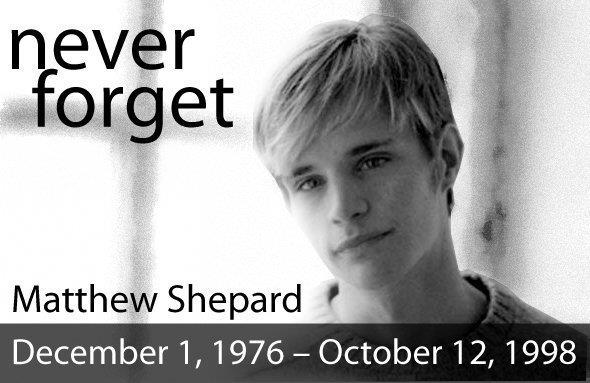
Thank you to the Sacramento Gay and Lesbian Center. Never forget!
Laramie, Wyoming – Wednesday, October 12 will be the thirteenth anniversary of America’s archetypal gay hate crimes victim. Matthew Shepard was brutally attacked and beaten into a coma by two locals who targeted him for abduction, robbery, and murder at the Fireside Lounge on the night of October 7, 1998. They left him trussed to the base of a buck fence, exposed to the freezing cold after stealing his shoes. When Matt was discovered the next day by a passing mountain biker, he was so brutally disfigured that his discoverer at first assumed what he was looking at was a broken down scarecrow that had been put out for Hallowe’en. Matt’s injuries were too severe to be treated at the local hospital emergency room, so he was transported to Fort Collins in neighboring Colorado where a state of the art trauma center fought to save his life. For five agonizing days, Matt lay close to death with an injured brain stem–a terrible wound from which he could never recover. His family, mother Judy, father Dennis, and younger brother Logan stood vigil beside him while the life force ebbed.
For thirteen years, Matt’s memory has been honored, invoked, and ridiculed by a nation wrestling with heterosexism, homophobia, and transphobia–a culture of anti-LGBTQ violence that has claimed the lives of over 13,000 queer folk whom we know about (and God knows how many others whose murders have never been reported to anyone keeping records). Nothing will ever bring any of them back to us. They are gone, but to memory.
Those of us who labor for the better angels of our national character to emerge have a responsibility to remember Matt and all the rest, to honor them by never forgetting the cost of being sexually different in these United States, and to take up the mission of educating the LGBTQ community and the general public that difference of any kind is no warrant for ignorance,prejudice, and violence, but rather is an occasion for understanding and neighborly solidarity. The anniversary of Matt’s untimely death is a good time to erase hatred from the American psyche.
In that spirit, I offer this short excerpt from “The Second Death of Matthew Shepard,” Chapter One of my recently published book, Unfinished Lives: Reviving the Memories of LGBTQ Hate Crimes Victims:
“Matt Shepard died in a Fort Collins, Colorado hospital in the wee hours of October 12, 1998 with his parents by his side. Ironically, it was the day after America’s observance of National Coming Out Day. His team of doctors and nurses, professional as they were, could not undo what hate had done to Matt. He never woke up from his coma. His heart gave out. The ventilator switched off, and Matt was gone. Our memory of him,however, cannot rest in peace. Not yet” (page 3).
Our memory of all the dead whose “unfinished lives” calls out to us to do the work of justice. May Matt and the 13,000 rest in peace. God being our strength, we must not. Grace and peace to all on this National Coming Out Day 2011. ~ Stephen V. Sprinkle
About

If you are a first-time visitor to the Unfinished Lives Project website, we invite you to read A Welcome Message introducing you to our project. We are truly grateful for your visit.
The Unfinished Lives Project website is a place of public discourse which remembers and honors LGBTQ hate crime victims, while also revealing the reality of unseen violence perpetrated against people whose only “offense” is their sexual orientation, gender identity, or gender presentation. LGBTQ people in the United States are suffering a slow-rolling decimation of terror and murder all across the country. Every locale and demographic of society are affected: First Nations, Anglo, Black, Latino and Latina, South and Southeast Asian, Transgender, Bisexuals, Gay men, Lesbians, disabled, young, and mature. Homophobia has a long, crooked arm, and it is reaching out to snatch the life away from women and men whose tragic stories are under-reported to begin with, and whose memories are swiftly forgotten.
The horror of these killings transcends the shock and bereavement of loved ones and friends. These are not typical homicides; they are not killings for money or drugs, incidents of domestic strife, or crimes of passion. The vicious nature of hate crimes against LGBTQ persons is extremely brutal, grotesquely violent, and egregiously hateful.
Each murder serves the LGBTQ population as a sobering warning about the actual level of danger in our communities. The message these killings send is that freedom and open life for LGBTQ people is a cruel dream. Every time we remember one of these victims, however, the intentions of their killers are frustrated. To remember these women and men is to begin the process of changing the culture that killed them.
Our Project Director
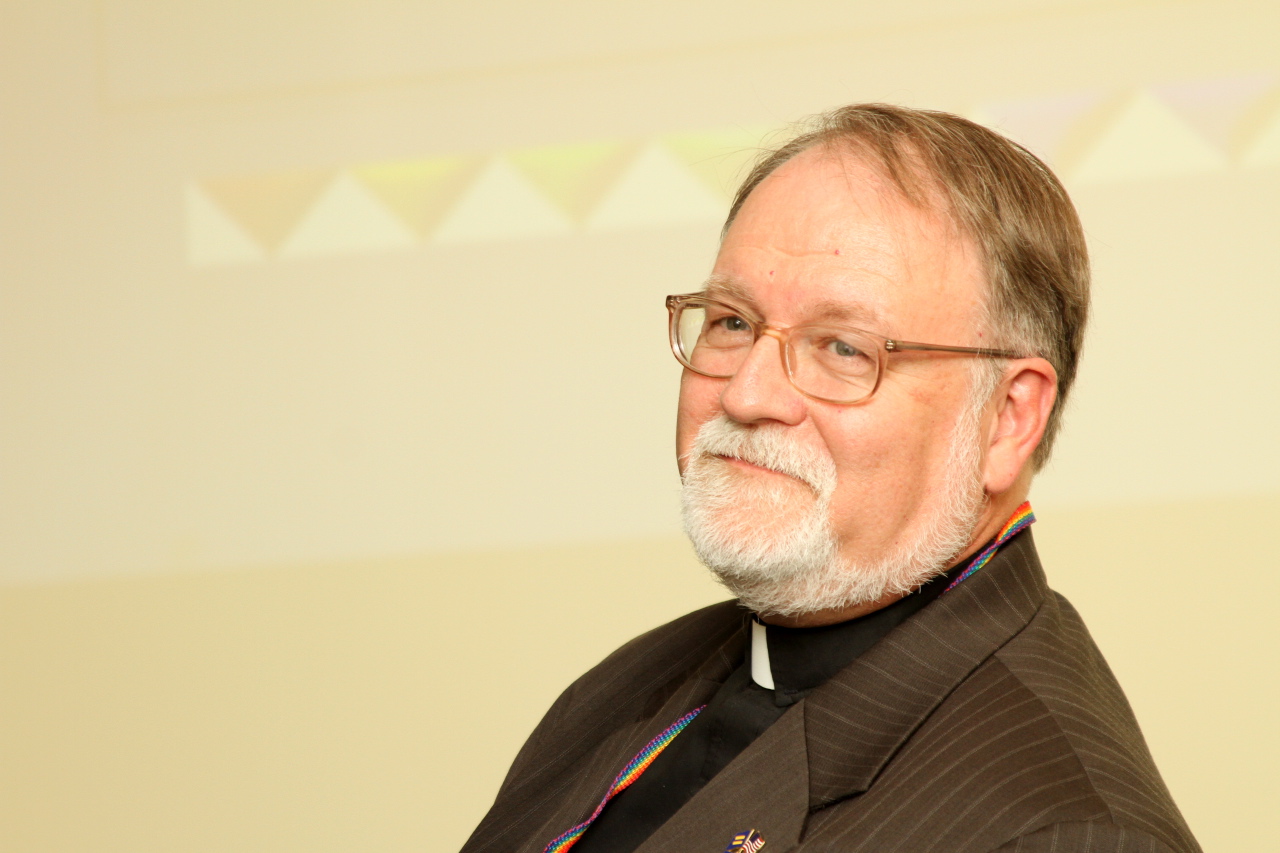
Dr. Stephen V. Sprinkle (Keith Tew photo).
Stephen V. Sprinkle is Director of Field Education and Supervised Ministry, and Professor of Practical Theology at Brite Divinity School, Fort Worth, Texas, a post he has held since 1994. An ordained Baptist minister, he is the first open and out Gay scholar in the history of the Divinity School, and the first open and out LGBTQ person to be tenured there. Read More…
Recent Social Justice Advocacy Activity By Dr. Sprinkle
 Summer 2009 – Dr. Sprinkle responded to the Fort Worth Police Department and Texas Alcoholic Beverage Commission Raid on the Rainbow Lounge, Fort Worth’s newest gay bar, on June 28, 2009, the exact 40th Anniversary of the Stonewall Rebellion. Dr. Sprinkle was invited to speak at three protest events sponsored by Queer LiberAction of Dallas. Here, he is keynoting the Rainbow Lounge Protest at the Tarrant County Courthouse on July 12, 2009. Read More…
Contact Us
Communicate with the Unfinished Lives project team:
info@unfinishedlivesblog.com


Schedule a Presentation
Dr. Sprinkle will gladly present his acclaimed presentation to your organization. To arrange an Unfinished Lives presentation for your organization or group, please contact us.
Dr. Sprinkle has given his Unfinished Lives presentation to these and other community groups and organizations. Read More…
-

Where are our readers?
Publisher: Steve Sprinkle (Project Director)
Steve Sprinkle
Unfinished Lives: Remembering LGBT Hate Crime VictimsBrite Divinity School/Texas Christian UniversityFort Worth TXprofessor, minister, author, blogger, LGBTQ advocate


Follow Unfinished Lives on Facebook
 Box Turtle Bulletin
- An error has occurred; the feed is probably down. Try again later.
- HRC Back Story
- Know About The Gender Identity Movement
- Why Is There A Need For Human Rights?
- Kinds Of Human Rights
- Human Rights Purposes And Violations
- Human Rights For Every Human Incident
- 8 Reasons Human Rights Are Important
- Everything About Human Rights
- Human Rights Issues Education & Law
- We Need To Stand Up For Our Rights And Those Of Others
- Coca-Cola Receives Perfect Score On Human Rights
- The Advocate: Daily News
- Journalist detained for booing Trump at Kennedy Center 'Chicago' performance
- Donald Trump telegraphs war crimes in profanity-filled Easter Sunday Iran threat
- NYC’s most powerful transgender official is fighting intensifying anti-LGBTQ+ federal pressure
- Maryland lawmakers advance broad school protections, including for trans students
- Fired for refusing to remove LGBTQ+ books, Tennessee librarian says she’d do it again
- Lawyers alarmed by immigration judge's 'atrocious' questions for gay asylum seekers
- What is the trans gaze? It's relief and recognition between strangers on a train
- Same-sex couples thrive in U.S. even as GOP support for marriage equality falls
- Did the FBI just post this propaganda video to save Kash Patel’s job?
- Over her short tenure as Trump’s attorney general, Pam Bondi terrorized LGBTQ+ Americans
- Dallas Voice: Instant Tea
- An error has occurred; the feed is probably down. Try again later.

 Unfinished Lives