Austin Rallies Against Downtown Anti-LGBT Hate Crime

Daily Texan photo
Austin, TX – The safety of LGBT folk in the Texas capital remains in question as University of Texas students and native Austinites struggle with the events of February 20. That night, two young gay men wearing Shady Ladies athletic jerseys were assaulted by four African American men shouting anti-gay slurs at them as the pair walked from one of Austin’s most popular gay bars to their car, parked near City Hall. The attack struck Emmanuel Winston and Matt Morgan from behind. They were brutally beaten and left on the sidewalk bleeding. News of the assault has shaken Austin, which prides itself with a progressive reputation in the Lone Star State. Though the investigation is ongoing, police are not yet able to label the attack a hate crime because of the peculiarity of Texas law. Until an arrest has been made and a defendant is prosecuted, a crime cannot be called a “hate crime” under state statutes. That is not stopping the supporters of the two gay men who were assaulted, however, according to News 8 Austin. Jeff Butler, a friend of the targeted men, said, “They were followed, attacked from behind, and brutally beaten by four men who uttered slurs. I don’t care how much lipstick you put on that pig. We will not allow you to cover this hate crime up.” Austin Police Chief Art Acevedo told reporters, “I think we have to finish the investigation first to see what the totality of the facts, evidence and circumstances are.” Acevedo then joined over 1,000 marchers as Winston and Morgan led the crowd from Oilcan Harry’s, the bar they visited that night, to the site of the attack. The Shady Ladies, an LGBT friendly softball team, wore their distinctive pink and blue jerseys and brandished a banner reading, “Austin March Against Hate.” The Daily Texan, UT’s student newspaper, reports that Glen Maxey, the first openly gay legislator in Texas history, expressed concern about the meaning of the attack. Though anti-LGBT hatred was widespread in Texas twenty years ago, for such an attack to occur on the streets of Austin in 2010 is alarming to the gay rights pioneer. “This is supposed to be behind us,” Maxey said. A low-resolution camera caught the suspects on video, but because of the condition of the images, they could not be identified. City officials are debating whether to increase the number of high-resolution surveillance cameras on city streets as a possible way to deter such crimes. City Councilman Mike Martinez told The Daily Texan that the city had applied for federal funds to place more anti-crime cameras on the streets, but the feds denied the request. Voicing his hope that the news of this crime will thaw up federal money, Martinez remains skeptical about stemming the tide of hate violence through technology alone. “A camera can only take a picture of ignorance,” Martinez said. “It’s not going to cure it.” For now, citizens of the Texas capital city are not so much concerned about “Keeping Austin Weird” as they are about keeping the streets of Austin safe.
Gay Teen’s Murder Inspired Federal Student Non-Discrimination Act

Seattle students celebrate Pride, photo by jglsongs
Washington, DC – The execution-style murder of a 15-year-old gay boy inspired an openly gay Congressman to author the Student Non-Discrimination Act. Lawrence “Larry” Fobes King was shot twice in the back of the head two years ago by a fellow computer class student, 14-year-old Brandon McInerney at E.O. Green Middle School in Oxnard, California. Now, even before McInerney stands trial for murdering his gender non-conforming classmate, Congress will consider the proposed law which for the first time would make it unlawful throughout the country for a any school receiving federal aid to discriminate against a person because of a perception that the individual is gay or lesbian. As VCStar.com reports, “Under the proposed law, known as the Student Non-Discrimination Act, gay and lesbian students in public schools could not be excluded from participating in or be subject to discrimination under any educational program that receives federal assistance. Discrimination would include harassment, which is defined as acts of ‘verbal, nonverbal or physical aggression,’ as well as intimidation or hostility based upon a student’s actual or perceived sexual orientation.” Rep. Jared Polis (D-Colorado), the author and primary sponsor of the bill said that King’s death was foremost in his mind as he framed this legislation and promoted it among his colleagues. “I absolutely had Larry King in mind and other kids like him,” he told reporters. In an interview with DCAgenda.com, Polis said the legislation would give schools across the country tools to fight against discrimination that includes “everything from exclusion from prom, to banning clubs, to lack of actions addressing bullying situations.” Polis continued, “Gays and lesbians across the country face discrimination and frequently institutionalized discrimination in many school districts, and giving them a federal remedy, just as girls do and minorities, will help address this.” The bill, H.R. 4530, has good support in Congress, with 65 co-sponsors including Rep. Tammy Baldwin (D-Wisconsin) and Rep. Barney Frank (D-Massachusetts). Speaker of the House Nancy Pelosi (D-California) is reviewing the legislation which Polis introduced in late January 2010. Nine out of ten LGBT students in middle and secondary schools throughout the nation report that they have been harassed because of their actual or perceived sexual orientation, and 61 per cent of them say they feel unsafe in their schools because of attitudes about their sexuality, according to GLSEN, the Gay, Lesbian and Straight Education Network. According to his school friends, Larry King suffered repeated harassment because of his feminine self-presentation. He sometimes wore jewelry and dressed in high heels and feminine apparel. Students have confirmed that he had tense exchanges with McInerney in the weeks before the fatal shooting. Rep. Lois Capps (D-California), one of the bill’s co-sponsors and the Congresswoman representing Oxnard where King was murdered, told the VC Star, “Larry’s murder was particularly painful because it happened at his school, a place that should have been a sacred space where he could grow and learn in a safe and supportive environment.” School officials in Oxnard contend they did nothing wrong, so the proposed law would not affect them. Their critics, among them LGBT activists in Southern California, counter that nothing substantive has been done to address the underlying hatred that permitted one of their students to act out his phobia on another, to the point of murder. McInerney, who is to be tried as an adult because of indications of pre-meditation of the crime, has pleaded not guilty to murder and hate crimes charges in the case.
Gay Brazilian Granted Asylum By Homeland Security: Hope Now For Uganda?

L to R - Rena Stern, Augusto Pereira de Souza, and Brian Ward
New York City – A gay Brazilian man has been granted asylum in the United States on the grounds that deportation to Brazil would threaten his life. Columbia University’s Sexuality and Gender Law Clinic won asylum for Augusto Pereira de Souza, 27, from the U.S. Department of Homeland Security in a move that may bring hope to thousands of Ugandan LGBT persons in the event that the odious “Kill the Gays Bill” becomes law in Uganda. The news highlights the danger LGBT people face in Brazil. According to Grupo Gay da Bahia (GGB), the largest LGBT rights organization in Brazil, between 1980 and 2009, there were 2,998 murders of LGBT people in Brazil. In 2008, 190 such murders were reported, though the GGB notes that since many crimes against LGBT people go unreported in Brazil, the actual number of people who lost their lives because of their sexual orientation is likely much greater. Calling his decision to petition for asylum in the United States “a matter of life or death,” Augusto Pereira de Souza told reporters, “In Brazil, I lived in constant fear for my life. I tried to hide that I was gay, but still faced repeated beatings, attacks, and threats on my life because I was gay. At times I was attacked by skinheads and brutally beaten by cops. After the cops attack you and threaten your life for being gay, you learn quickly that there is no one that will protect you.” He will now live openly as a gay man in Newark, New Jersey, where he had lived for some time hiding his sexual orientation. Pereira de Souza’s writ of freedom is thanks to the tireless legal work of three students from Columbia Law School’s Sexuality and Gender Law Clinic, Rena Stern, Brian Ward, and Mark Musico. The trio of law students worked on the case since last September under the direction of clinic director, Dr. Suzanne Goldberg. In a statement reported by The Advocate, Ward said, “In Brazil, police routinely fail to investigate violence committed against GLBT individuals. In this environment, skinheads and other groups are free to persecute, torture, and even kill GLBT individuals with impunity.” Stern, who also assisted with Pereira de Souza’s case, said attacks and murder based on sexual orientation in Brazil appear to be on the rise there. “Mr Pereira de Souza’s story is unfortunately not unusual for a gay man in Brazil.” Such a grant of asylum is rare, largely because of the time and expense necessary to file the application and see it through the process of vetting to make sure that actual danger is truly probable for the asylum-seeker. Individuals must first make it into the United States even to apply, a significant hurdle for foreign LGBT people from countries in the developing world, such as Brazil and Uganda. For Ugandan LGBT people living in fear for their lives in a country where Parliament is debating the enactment of a law making homosexuality punishable by the death penalty, the decision to grant the Brazilian asylum is potentially life-saving news. President Obama and Secretary of State Clinton have spoken out against the “Kill the Gays Bill” as recently as their appearance at the right-wing sponsored National Prayer Breakfast last Thursday in the nation’s capitol. Should the Ugandan Parliament enact the bill into law, gay Ugandans could face a death sentence, their families and friends could be imprisoned for as much as seven years, and even landlords who rent to homosexuals could face jail time. Now, with the Pereira de Souza decision, the door to freedom and life in the United States is opened just a crack for LGBT Ugandans, but it is much more than they had even a week ago.
Threatening Postcards to Gay Profs Ignite Investigations

Images on hate mail sent to gay professor, John Koster photo for North County Times
San Marcos, CA – Authorities for the county, state, and federal governments launched a co-ordinated investigation last week into menacing postcards being sent to three gay Palomar College professors. Since mid-2008, 20 postcards threatening murder have been sent to the trio, with 1o of these targeting Dr. Fergal O’Doherty, an open and out gay man who teaches English at the San Marcos campus. O’Doherty said that FBI agents had contacted him on January 21, informing him that they are carrying out an investigation. Sending threats through the U.S. Mail is an automatic federal offense. O’Doherty told Morgan Cook, staff writer for the North County Times, that the cards sent to him have included images of sexual violence and death, the most disturbing of which showed skeletons engaged in sex acts with a repetitive caption reading “I’m glad I’m not dead” 10 times. The tenth caption omitted the word “dead.” One of the most recent cards Professor O’Doherty received shows a collage of pop culture images, a Nazi swastika, and a drawing of Elvis Presley sporting devil’s horns. The caption on this postcard reads, “I want to go to Hell like Elvis.” Authorities have not yet determined that these cards constitute a hate crime, but colleagues on the Palomar College campus are not waiting for such a determination. They have founded a group to raise awareness of hate crimes and combat them before they are acted out, called the Palomar College Committee to Combat Hate. Members of the group are committed to the human rights of LGBT people on the campus. O’Doherty says that since he is one of the few openly homosexual professors at the 30,000 student community college, located 30 miles north of San Diego, his sexual orientation is probably the magnet for the hate mail. From the variety of academic and pop culture icons incorporated into the cards, some as eminent as singer/songwriter Leonard Cohen and author Ernest Hemingway, but also including relatively obscure philosophers, O’Doherty speculates that the person creating them is intelligent, well-read, and dangerous. “[The card-creator] mentions works by writers and philosophers that aren’t even assigned in undergrad classes,” he told the North County Times. While this is not the first time O’Doherty and other gay faculty have been harassed for their sexual orientation, this is the first time officials have taken the threat seriously. Even then, when the postcards started appearing, campus police refused to act, apparently believing that they were written by a harmless crank. With over 13,000 documented violent crimes perpetrated against LGBT people throughout the nation in the decade prior to the passage of the Matthew Shepard and James Byrd, Jr. Hate Crimes Prevention Act in October 2009, and spiking numbers of anti-LGBT hate crimes in California where Proposition 8 and Marriage Equality are such hotly contested issues, the decision to launch an investigation is more than prudent on the part of law enforcement. Prevention is possible only when the menace is taken seriously. That is exactly what Professor O’Doherty knows to be true, as he shows his most recent death threat by mail to the press.
Trans Community Demands Justice for Myra Ical
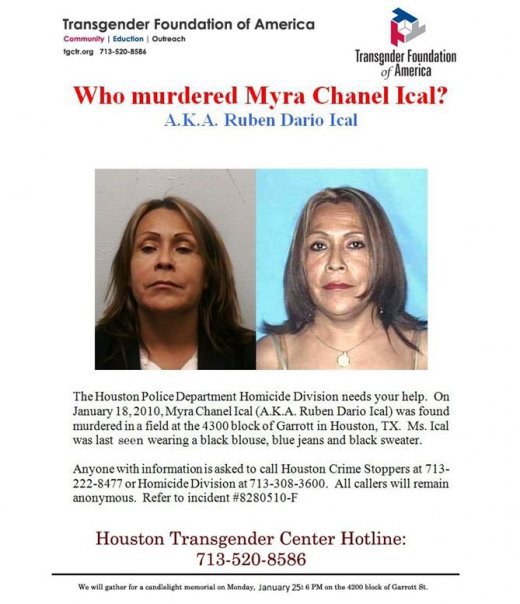
Houston, TX – Cristan Williams, Executive Director of the Transgender Foundation of America, takes the murder of Myra Ical personally. “She died struggling for her life…She went down fighting and she was literally beaten to death,” she said to reporters for KHOU 11 News. “It’s personal. I feel it on a personal level.” Hundreds agree with Williams. Myra Chanel Ical, 51, died in a Montrose area field a week ago, and Houston’s transgender community has rallied to her memory. Seven members of the transgender community have died violently in Houston in the last eleven years, and now the vigil organized to remember Ms. Ical on Monday night is being billed as the largest transgender event in Houston’s history. The vigil’s organizers intend to focus attention on the plight of transgender people in Harris County and Houston as they honor Ms. Ical’s memory and call for neighbors in Montrose to share any leads they may have on the unsolved murder with police investigators. While her slaying is not yet designated as a hate crime, police are certainly not ruling anything out. Sgt. Bobby Roberts, spokesperson for the Houston Police Department, told reporters, “It could have been anything at this point. We just don’t have any motive whatsoever on this case.” ABC News 13 reports that Ms. Ical’s body was covered in bruises and bore several defensive-type wounds that showed she was fighting back against her attacker(s). Harris County’s Medical Examiner ruled that she died from strangulation by some sort of ligature. Cristan Williams cannot get the horror of how Ms. Ical died out of her mind. “That in and of itself was just a horrific way to die. Her last moments of life were sheer terror.” Williams asks why none of the seven murders of Houston transgender people have been solved. Police told her they have no evidence in any of the cases, something Williams attributes to the way anti-transgender crimes went largely unreported in the recent past. Until the passage of the Matthew Shepard and James Byrd, Jr. Hate Crimes Prevention Act this past October, local and federal law enforcement agencies were not mandated to keep statistics on transgender hate crimes. Like the transgender population, these crimes were largely ignored. Human rights advocates for the LGBT community are watching closely to see if the election of Annise Parker, an open and out lesbian, as Mayor of Houston will make a difference in how law enforcement and the media approach violence against some of the most vulnerable citizens of America’s 4th largest city.
Ricky Martin Speaks Out Against Anti-LGBT Hate Violence in Puerto Rico
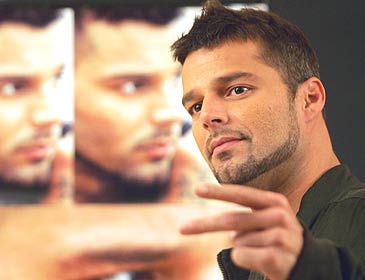 Legendary Latino entertainment idol, Ricky Martin (né Enrique José Martín Morales) spoke out against anti-LGBT hate crimes in his native Puerto Rico on Sunday in an op-ed written for El Nuevo Dia. Martin, who has been the subject of persistent rumors concerning his own sexual orientation for years, is one of a growing chorus of Puerto Rican and other Latino/Latina entertainers who are decrying the spiking incidence of homophobic attacks on gay and gender non-conforming men in the United States Territory. The brutal murder of Jorge Steven López Mercado, the 19-year-old gay man who was found decapitated, dismembered, and partially immolated in Cayey last month, has drawn national and international attention to the problem of cultural homophobia in the Caribbean. Now, with the emerging story of what may well be another anti-gay murder in Ponce this past Wednesday, Martin and others have taken it upon themselves to speak out. Olga Tañón, the talk radio personality, René Perez,the reggaeton artist, and 2001 Miss Universe Denise Quiñones are among other celebrities who are becoming outspoken on the issue along with Martin. Boy in Bushwick quotes Martin as writing, “The deaths of James Byrd, like that of Matthew Shepard, Jorge Steven López, Marcelo Lucero and Luis Ramírez, like other victims of violent hate crimes, should be unacceptable to all human beings; because we are all human beings.” Martin urged his readers to move beyond mere acceptance and toleration. “If we accept each other, humanity will come together,” Martin wrote. “And if humanity comes together, equality for human rights will become a reality. If equality for human rights becomes a reality, peace will be within our reach.” For high-profiled Martin, 38, to speak out so openly against homophobic violence is something of an event in itself. He has consistently denied rumors about his own sexual orientation since the days he was lead singer for the pop group Menudo, and played a popular character in television’s General Hospital. In 1999 he was named one of People Magazine’s “50 Most Beautiful People.” But it was as a singer that the photogenic Puerto Ricaño made his most lasting reputation, with such English-language hits as “Livin’ La Vida Loca.” Last year Martin announced the birth of twin sons by a surrogate mother. The babies, Matteo and Valentino, were frequently photographed in their father’s arms, furthering a wholesome image Martin’s publicists have attempted to blend with his smoldering on-screen persona that made him a pop idol in the late 1990’s. Martin has forayed into public affairs before. He created the “Ricky Martin Foundation” which gave a million dollars’ worth of musical instrument to Puerto Rican public schools. The Foundation is also deeply involved in helping children who are victims of child prostitution and/or pornography, especially in India but also all around the world. According to Martin, “This is the biggest problem our society is going to face within the next 10 years.” This Sunday’s op-ed column, however, is the most outspoken Martin has ever become on the issue of LGBT concerns, and is both a measure of his growing maturity and the degree to which the recent horrific murders of gay men on his home island has shaken him in recent days.
López Mercado Murder To Be Treated as Anti-LGBT Hate Crime Killing
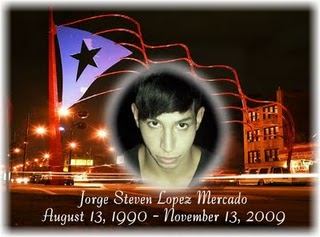 San Juan, Puerto Rico – A federal prosecutor in San Juan has announced that her office is continually monitoring the investigation of the horrific torture-murder of Jorge Steven López Mercado, and promised that she will bring hate crimes charges in the event that Puerto Rican authorities do not. The EDGE reports that United States Attorney Rosa Emilia Rodríguez told the Puerto Rican press she was prepared to lodge anti-LGBT hate crimes charges against Juan A. Martínez Matos, the self-confessed killer of the 19-year-old out gay youth. If she carries through, this will be the first prosecution under the provisions of the Matthew Shepard and James Byrd, Jr. Hate Crimes Prevention Act since it was signed into law by President Barack Obama in October. Martínez Matos, 26, allegedly decapitated, dismembered, and attempted to immolate López Mercado, dumping his remains on a lonely stretch of road outside Cayey on November 13. As an excuse for his crime, the alleged killer has claimed that he was surprised to find out that the youth, who was dressed as a female, was actually a gay person. Believing that Puerto Rican attitudes are still conservative enough to credit some form of the well-worn “gay panic” defense, Martínez Matos says that previous bad encounters with a gay man in his youth caused him to explode with rage. A judge has ruled that Martínez Matos must undergo psychological evaluation to establish that he is mentally healthy enough to stand trial. Local LGBT activists have decried the ruling, but are welcoming the announcement of the United States Attorney that hate crime charges may be brought in this case. Pedro Julio Serrano said to the EDGE, “We are satisfied that the federal authorities are monitoring this case and that they’re respecting the work that the local authorities are doing. We are all vigilant to this process and we won’t rest until justice is served. This was a horrible hate crime and Puerto Rico needs to send a powerful message to the world that we do not tolerate homophobia in any of its ugly forms.”
Puerto Rican Gay Teen’s Confessed Murderer Sent for Psychological Testing

Juan A. Martínez Matos in Custody
The confessed killer of gay teen Jorge Steven López Mercado has been ordered by a judge to undergo psychological evaluation, according to EDGE Boston. Juan A. Martínez Matos, who confessed that he slaughtered his victim in a moment of “gay panic,” will be tested as to his fitness to stand trial before being returned to the court in Caguas on or before January 13, 2010. LGBT advocates in Puerto Rico and on the United States mainland have expressed anger at the judicial move. Pedro Julio Serrano, leading LGBT activist, told EDGE on December 9, “This is outrageous. The reality is we’re seeking justice and we will not rest until this process is done without prejudice.” Serrano said that the concerns expressed by the gay youth’s grieving family were simply for justice to be done. Both Serrano and López Mercado’s family have been assured by local prosecutor Yaritza Carrasquillo that the investigation into his gruesome murder will be conducted as a hate crime under the territory’s sexual orientation hate crimes statute. The LGBT activist community in Puerto Rico remains skeptical. Though a law protecting LGBT people has been on the books for years, local prosecutors have been unwilling to use the hate crimes provision in any LGBT-related cases up to this point. If any murder qualifies as a bias-motivated anti-LGBT crime, the November 13, 2009 killing of López Mercado surely does. Matos confessed shortly after his arrest that he carried out the crime in a homophobic rage because of an encounter with a gay man in his youth, setting the stage for doubts to be sewn about his mental state at the time of the murder. Matos allegedly beheaded his 19-year-old victim, severed his arms and legs from his torso, and attempted to burn the body, which was found dumped by the side of a road in rural Cayey. He is charged with first-degree murder for the slaying, and is being held on $4 million bail.
Slain LGBT Icon Harvey Milk Inducted into California Hall of Fame
 The Associated Press reports that Harvey Milk was inducted on Tuesday into the California Hall of Fame, along with 12 other notables from the Golden State. Thirty-one years after Milk and Mayor George Moscone were assassinated by former San Francisco City Supervisor Dan White, Milk will be featured for the next year in the California Hall of Fame section of the California Museum in Sacramento. Milk, who had served as a San Franciso City Supervisor for 11 months, was 48 at the time of his murder. According to the Bay Area Reporter, Milk’s nephew, Stuart Milk, received the commendatory Spirit of California medal marking his uncle’s induction from Governor Arnold Schwarzenegger and First Lady Maria Shriver. Andy Grove, the former CEO of Intel, read the citation. Interviewed at the induction event, former campaign manager for Milk’s historic 1977 election campaign, Ann Kronenburg, called the honor, “definitely long past due.” Smiling, she told reporters, “Harvey’s up there right now dancing.” When asked about the importance of Harvey Milk to the LGBT community of California, Kronenburg quickly corrected the reporter, “To the world’s. Since the movie [Milk] came out I have continually received letters from around the world about what Harvey’s story means,” she explained. “And what it means is there’s hope. There’s so much hope.” Milk’s Hall of Fame exhibit features a recently-opened urn containing a lock of his hair, a letter in his handwriting, a campaign button, and a rainbow flag. The memorabilia were held by the Congressional Cemetery in Washington, D.C. until transported back to California for the exhibit. Some 50,000 school children are expected to visit the exhibition during the coming year. Though there were 12 other inductees honored at the ceremony, the greatest interest by the public and the press was clearly focused on the choice of Milk. Protesters criticized the selection of the famed gay-rights pioneer for the Hall of Fame. A group from San Leandro’s American Warrior Evangelical Ministry marched outside the ceremony venue carrying signs reading, “Harvey Milk was a pervert.” The Bay Area Reporter quotes one of the demonstrators, Ken Arras, as saying, “We just believe that [Milk] is undeserving of this honor. He may have been a nice guy outside of his immoral lifestyle, but what has he done? This award is all about his lifestyle. It’s just about him being a homosexual.” Another of the San Leandro protestors, Don Grundmann, admitted that Milk’s murder was “a fantastic tragedy,” but argued that an assassination is insufficient reason for public recognition, referring to both the Hall of Fame induction and to Harvey Milk Day, which he claimed was a direct assault on children. Grundmann went to to assert that no LGBT person should ever be inducted in the state’s Hall of Fame since “it would lead to acceptance” of immorality by impressionable youth. Earlier in the year, Governor Schwarzenegger signed a bill sponsored by San Francisco’s openly-gay State Senator, Mark Leno, creating May 22 “Harvey Milk Day,” a day of special significance throughout California. The Hall of Fame’s Class of 2009 included other stellar Californians, such as football coaching legend, John Madden, actor Carol Burnett, Chuck Yeager, the first test pilot to break the sound barrier, filmmaker George Lucas, and author Danielle Steele.
About
If you are a first-time visitor to the Unfinished Lives Project website, we invite you to read A Welcome Message introducing you to our project. We are truly grateful for your visit.
The Unfinished Lives Project website is a place of public discourse which remembers and honors LGBTQ hate crime victims, while also revealing the reality of unseen violence perpetrated against people whose only “offense” is their sexual orientation, gender identity, or gender presentation. LGBTQ people in the United States are suffering a slow-rolling decimation of terror and murder all across the country. Every locale and demographic of society are affected: First Nations, Anglo, Black, Latino and Latina, South and Southeast Asian, Transgender, Bisexuals, Gay men, Lesbians, disabled, young, and mature. Homophobia has a long, crooked arm, and it is reaching out to snatch the life away from women and men whose tragic stories are under-reported to begin with, and whose memories are swiftly forgotten.
The horror of these killings transcends the shock and bereavement of loved ones and friends. These are not typical homicides; they are not killings for money or drugs, incidents of domestic strife, or crimes of passion. The vicious nature of hate crimes against LGBTQ persons is extremely brutal, grotesquely violent, and egregiously hateful.
Each murder serves the LGBTQ population as a sobering warning about the actual level of danger in our communities. The message these killings send is that freedom and open life for LGBTQ people is a cruel dream. Every time we remember one of these victims, however, the intentions of their killers are frustrated. To remember these women and men is to begin the process of changing the culture that killed them.
Our Project Director
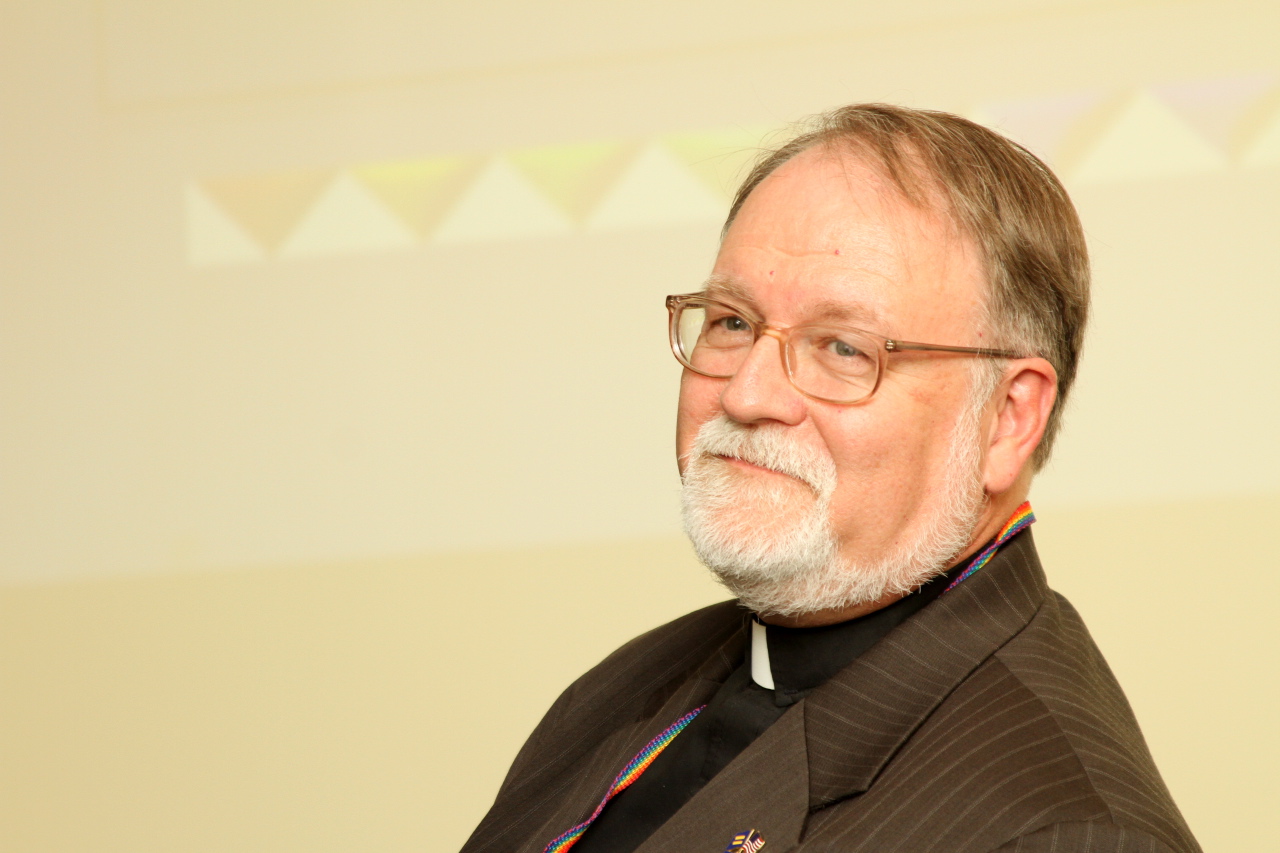
Dr. Stephen V. Sprinkle (Keith Tew photo).
Stephen V. Sprinkle is Director of Field Education and Supervised Ministry, and Professor of Practical Theology at Brite Divinity School, Fort Worth, Texas, a post he has held since 1994. An ordained Baptist minister, he is the first open and out Gay scholar in the history of the Divinity School, and the first open and out LGBTQ person to be tenured there. Read More…
Recent Social Justice Advocacy Activity By Dr. Sprinkle
 Summer 2009 – Dr. Sprinkle responded to the Fort Worth Police Department and Texas Alcoholic Beverage Commission Raid on the Rainbow Lounge, Fort Worth’s newest gay bar, on June 28, 2009, the exact 40th Anniversary of the Stonewall Rebellion. Dr. Sprinkle was invited to speak at three protest events sponsored by Queer LiberAction of Dallas. Here, he is keynoting the Rainbow Lounge Protest at the Tarrant County Courthouse on July 12, 2009. Read More…
Contact Us
Communicate with the Unfinished Lives project team:
info@unfinishedlivesblog.com


Schedule a Presentation
Dr. Sprinkle will gladly present his acclaimed presentation to your organization. To arrange an Unfinished Lives presentation for your organization or group, please contact us.
Dr. Sprinkle has given his Unfinished Lives presentation to these and other community groups and organizations. Read More…
-

Where are our readers?
Publisher: Steve Sprinkle (Project Director)
Steve Sprinkle
Unfinished Lives: Remembering LGBT Hate Crime VictimsBrite Divinity School/Texas Christian UniversityFort Worth TXprofessor, minister, author, blogger, LGBTQ advocate


Follow Unfinished Lives on Facebook
 Box Turtle Bulletin
- An error has occurred; the feed is probably down. Try again later.
- HRC Back Story
- Know About The Gender Identity Movement
- Why Is There A Need For Human Rights?
- Kinds Of Human Rights
- Human Rights Purposes And Violations
- Human Rights For Every Human Incident
- 8 Reasons Human Rights Are Important
- Everything About Human Rights
- Human Rights Issues Education & Law
- We Need To Stand Up For Our Rights And Those Of Others
- Coca-Cola Receives Perfect Score On Human Rights
- The Advocate: Daily News
- NYU Langone Hospital ends gender-affirming care program for trans teens after Trump funding threats
- Heritage Foundation hires conservative education advocate who previously appeared in gay adult films
- He was diagnosed with prostate cancer while homeless. A simple screening likely saved his life
- Trump endorses self-described ‘Nazi-ish’ Texas Republican as Peter Thiel backs his bid for Congress
- Daily newsletter 2/19
- 2025 U.S. LGBTQ+ adult population matches 2024's record; bi identity still most common: Gallup
- We shared a rainbow with Jesse Jackson, who shook our hands when no one else would
- Tennessee bill lets businesses and people refuse to recognize same-sex marriages
- Colorado’s Jared Polis embraces Trump’s national governors’ White House dinner snub: a ‘badge of honor’
- Project 2025 creator wants to ban gender-affirming care for trans adults
- Dallas Voice: Instant Tea
- An error has occurred; the feed is probably down. Try again later.

 Unfinished Lives
Hope for 2010: A New Year’s Special Comment
Share this:
December 24, 2009 Posted by unfinishedlives | Anti-LGBT hate crime, anti-LGBT hate crime murder, Bisexual persons, Colorado, DADT, ENDA, gay men, gay panic defense, Hate Crime Statistics, Hate Crimes, Heterosexism and homophobia, Law and Order, Legislation, Lesbian women, Marriage Equality, Matthew Shepard Act, Media Issues, military, Mistaken as LGBT, New York, Perpetrators of Hate Crime, Politics, Popular Culture, religious intolerance, Remembrances, Social Justice Advocacy, Special Comments, trans-panic defense, transgender persons | anti-LGBT hate crime murder, Bisexual people, Colorado, Don't Ask Don't Tell (DADT), Employment Non-Discrimination Act (ENDA, gay men, gay panic defense, Heterosexism and homophobia, Law and Order, Lesbians, Marriage Equality, Media Issues, New York, religious intolerance, Social Justice Advocacy, Special Comment, trans-panic defense, transgender persons | 3 Comments