So Close!: Matthew Shepard Hate Crimes Amendment Passes Senate 63-28, But Faces Possible Veto
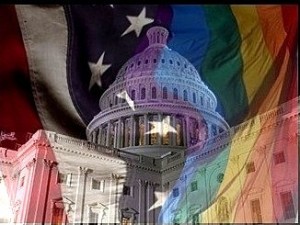 Washington, DC – In an historic vote for LGBT rights and hate crimes prevention, the U.S. Senate last night passed the Matthew Shepard Act as an amendment to the DOD appropriations bill by 63-28. In a last ditch effort to block passage, right wing smear groups roused up 300,000 negative calls and emails, distorting the provisions of the hate crimes legislation. In the end, it didn’t succeed in scaring enough senators. The snag is that the DOD bill includes a measure funding F-22 fighter planes, a provision that President Obama has said he will veto, if it remains in the bill. Would he actually veto a hate crimes law to stop the F-22? To date, no major campaign promise Obama made to the LGBT community has been kept, a source of harsh criticism by activists and rank-and-file queer folk alike. Now, according to Joe.My.God., the blog that helped break this story, “Senators Carl Levin and John McCain have offered a bi-partisan amendment to remove the F-22 funding that is scheduled for a vote Monday, but insiders say the count is unclear. If the amendment fails and President Obama vetoes the bill, it will be sent back to the Senate for a rewrite. A Democratic Senate aide said Senator Reid was optimistic, nonetheless, that hate crimes would ultimately make the final version of DOD authorization. “This was a good vote,” said the aide. ‘Senator Reid is hopeful that we can keep this language in the final bill.'” You can bet that the fingers of every hand at the Unfinished Lives Project are crossed for passage of the hate crimes inclusive DOD appropriations bill.
Sending the Devil to Hell for a Trial?: DFW Leaders Demand Independent Investigation in Rainbow Lounge Raid
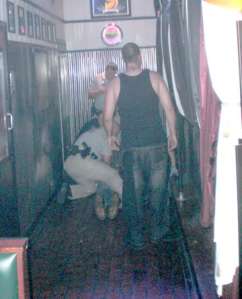 Fort Worth, TX – In the wee hours of Sunday, June 28, 40 years to the day after the Stonewall Inn Raid in Greenwich Village that sparked the Stonewall Rebellion against anti-LGBT oppression, officers of the Fort Worth Police and the Texas Alcohol Beverage Commission raided the Rainbow Lounge. Unlike other so-called “checks” of liquor licenses, the police came hot to trot with a paddy wagon, plastic zip cuffs, and bad attitudes, according to many eye-witnesses and targets in the bar. Word spread fast. Now the Rainbow Lounge Raid is making national and international news, and the police are changing their tunes about what they did on that fateful night when LGBT Pride was challenged by force once again. Originally, FWPD Chief of Police Halstead claimed that officers had been “groped” by at least one patron of the bar, and that the severe cranial injury sustained by Chad Gibson, 26, who was arrested for “public intoxication” was due to “alcohol poisoning.” This is not the first time some version of the tired “gay panic defense” has been marshaled to justify overkill in the treatment of LGBT people. Ironically, hate crimes perpetrators are generally the ones who use the “blame the victim” technique to blur the oppression of LGBT people. That peace officers used it in Fort Worth is nearly as noteworthy as their choice of the Stonewall Anniversary to carry out their assault. Now Chief Halstead is changing stories, saying that Gibson, who is still critical in John Peter Smith Hospital in ICU, was injured “while in custody of the TABC.”
Local business, civic, and activist leaders are calling for an independent investigation of the actions of the FWPD and the TABC during the Raid. Fearing loss of face for Cowtown, as well as loss of business, leaders are demanding more than an internal investigation that may be self-serving at best. Meanwhile, Gibson struggles to heal. No costs of his hospitalization or damages will be forthcoming from the officers who slammed his head into a bathroom step at the Rainbow Lounge, for they are indemnified against facing responsibility for what they did by the state and the city. Too bad. As long as harsh treatment can be whitewashed clean by internal investigations and bureaucratic red tape, LGBT people cannot feel safe anywhere in the Metroplex. The Rainbow Lounge Raid proves that much, at least. The public has yet to hear a full-throated demand for justice from the Fort Worth LGBT community. While some are courageously speaking out, the so-called “Fort Worth way” is in full display, with queer folk in Cowtown still keeping their heads low for the most part.  As the days drag on from the time of the Raid, and as Gibson fights to get better from bleeding on the brain in ICU, the Fort Worth LGBT community may yet find its voice. One of the most telling witness statements from a patron of the Rainbow Lounge on the night of the raid was that the assault by police “was just like Stonewall without fighting back.” The spirit of Stonewall is resistance, plain an simple. Non-resistance is not and never has been the Stonewall way, and Fort Worth LGBT people and their allies have to find more spine if they are to have freedom and equality in deep, dark red Tarrant County, stronghold of right wing Republicanism in North Texas.
This story has all the makings of a regional earthquake in human rights: Excessive police force, severely injured LGBT people, gay panic defense, police cover-up attempts, heterosexist attitudes, terror in the queer community, and finally, the will to resist on the part of gay men and lesbians who have had enough jawboning and harm from their elected leaders and law enforcement agencies. Passively allowing the law enforcement agencies and city officials responsible for this outrage to mollify the public with “internal investigations” is like sending the Devil to Hell for a trial. No jury in perdition would ever find him guilty. Without consistent pressure coupled with open communications, things will pretty much go back to homophobic normal in Cowtown. Instead of an earthquake, all Fort Worth may experience from this unwarranted use of brute force will be a shrug. The coming days will see if the North Texas children of Stonewall will rise up and seize the moment, or not.
 ~ Stephen V. Sprinkle, Director of the Unfinished Lives Project
Anti-LGBT Hate Crimes Incidents Soar in Minnesota, Milwaukee, and Chicago
 More concerning news about increasing violence against LGBT people: Minnesota LGBTs suffered a 48% hike in bias-related hate crimes according to the National Coalition of Anti-Violence Programs (NCAVP) 2008 statistics, issued on Tuesday. This is a confirmation of the multi-year trend queer Minnesotans have recently faced. David Hart on Tips-Q, a gay blog site, shares this information from the North Star State: “We are deeply troubled about the 2008 statistics for a number of reasons including the fact that increases in victimization in the Upper Midwest far exceed the national increase of 2%. With Minnesota’s 48% increase in 2008 and continued multi-year trend of such increases, we are concern for the safety of all GLBT Minnesotans even as we continue to work for equality,” said Rebecca Waggoner Kloek, Anti-Violence Program Director of NCAVP member organization OutFront Minnesota. The same NCAVP report that noted a 28% national increase of hate crime violence against LGBT people in 2008 registered a jump of 64% in Milwaukee, Wisconsin, and a 42% upturn in Chicago, Illinois.
Serial Hate Crimes Against LGBTs Up 63% in Colorado
 Denver – In a report by the National Coalition of Anti-Violence Programs issued Tuesday, the numbers of anti-LGBT hate crimes in the Centennial State jumped 63% in one year. Among the 2008 murders of queer folk was the notorious beating-death of 18-year-old Angie Zapata, a transgender Latina living in Greeley. Allen Ray Andrade, a date, repeatedly bashed Zapata with a home fire extinguisher until she succumbed. Andrade’s conviction for murder under Colorado’s Hate Crime Law was a landmark moment, demonstrating to the nation how significant hate crime enhancements can be in penalizing fatal bias-related attacks against LGBT people. Though he used a version of the trans-panic defense to excuse his actions, arguing that Zapata had somehow deserved her death because of “deceiving” him as to her biological gender, Andrade was sentenced to life in prison with no possibility of parole. According to the Denver Daily News, the Colorado Coalition of Anti-Violence Programs (COAVP) expressed concern over the 24% spike in the number of offenders, meaning that multiple perpetrators attacked a smaller number of victims during the past year. This indicates that certain victims of anti-LGBT hate crimes are targeted for violence that unfolds in a spectrum from verbal harassment to physical attack by more than one antagonist. While this disturbing feature of homophobic and transphobic violence had been suspected by gay rights activists, this report in Colorado is the first to confirm their fears. The percentage of victims also rose significantly during 2008. While the nationwide average rise in victims of harassment, bashing, and murder was 2%, the Colorado numbers moved up a full 8%. Added to the increases of reported violent attacks against LGBT people in Minnesota, Michigan, California, and Tennessee, the Colorado hate crimes statistics contribute to a growing sense that a full-scale national trend of increasing harm against members of the sexual minority is in the offing.
“Remain Vigilant!” Warns Southern Poverty Law Center

Montgomery, AL – In a letter to supporters dated June 17, J. Richard Cohen, CEO and President of the Southern Poverty Law Center urges the entire SPLC network to “remain vigilant” in the wake of the murder of Holocaust Memorial Museum Security Guard Stephen Johns. The SPLC carries out the most extensive program of tracking hate groups and extremist organizations of any non-governmental organization in the nation, most recently on the anti-LGBT hate monger, Scott Lively and his band of co-extremists, Watchmen on the Walls. Two Slavic Christian fundamentalists from Sacramento, CA with ties to Lively’s group carried out a fatal attack on gay East Indian immigrant Satendar Singh during the July 4 holiday season of 2008. Cohen’s important letter reads in part:
“In addition to the Holocaust Museum shooting, we’ve seen the murders of five police officers by extremists in recent months and the assassination of a prominent Kansas physician by an extremist tied to the anti-government militia movement. These killers may have acted alone, but they were all influenced by the hate movement in America. What’s alarming is that this movement is now being aided and abetted by far-right pundits on cable TV and talk radio, who are fanning the flames of hate with their increasingly hysterical rhetoric targeting President Obama, the government, Latino immigrants and others who are not like them. These are the same commentators who ridiculed the recent Department of Homeland Security that predicted the very kind of violent attacks we’re now seeing.” Cohen concludes by urging all fair-minded Americans to stand firm against hatred: “We all need to speak out against hate — whether it’s in the national media or in our communities…. We hope the lessons from this latest tragedy won’t soon fade from our national consciousness.”
Anti-LGBT Hate Crimes the Highest Since 1999

Anti-LGBT violence is up 28% in one year
As Stonewall 40 approaches next week, a New York-based coalition of anti-violence programs reports that bias crimes against LGBT people rose 28% from 2007 to 2008. The National Coalition of Anti-Violence Programs (NCAVP) confirms the grim trend Unfinished Lives has been reporting for months: hate crimes against members of the sexual minority are not only higher than at any time in a decade, but the degree of brutality in the execution of these crimes has also intensified. Marcus Franklin of the Associated Press notes for the Huffington Post that the 29 confirmed bias-related murders of queer folk in 2008 reported by the NCAVP matches the number of similar killings it registered in its 1999 report. The Unfinished Lives Project has noted dramatic increases in anti-LGBT murders and assaults since the latter part of 2008 in California, Michigan, Minnesota, and Tennessee, and has highlighted the extreme savagery of these attacks as in the case of 45 stab wounds in U.S. Army veteran Michael Scott Goucher’s murder in East Stroudsburg, PA, and Duanna Johnson’s shooting death in Memphis, TN. The Huffpost article issued today quotes Sharon Stapel, executive director of the New York Coalition of Anti-Violence Programs, which co-ordinates the NCAVP nationally with pointing to an increase of violence during the presidential campaign last fall, as well as ominous increases during the high-profile national debates over same-sex marriage, the possible passage of the Matthew Shepard Hate Crimes Prevention Act, the Employment Non-Discrimination Act (ENDA), and the proposed repeal of the Defense of Marriage Act (DOMA) and Don’t Ask/Don’t Tell (DADT). “The more visibility there is the more likely we’re going to see backlash, and that’s exactly what we see here,” Stapel said. Since the NCAVP reports anti-Transgender hate crimes in distinction from the annual FBI’s hate crimes report that does not, Stapel is able to reference a more accurate picture of the landscape of peril in which LGBT Americans find themselves. Even so, organizations from only 25 of the 50 states report to the NCAVP, indicating that the

Duanna Johnson, Transwoman, murdered in Memphis
actual number of bias-related hate crimes against LGBT people may be much higher. Additional factors arguing for higher numbers of these crimes than are reported by either the NCAVP or the FBI are the stigma and despair often associated with violent crimes against queer women and men. Local law enforcement agencies tend to skew their investigations away from anti-gay or transgender motives as a reflection of the bias rampant in their home locales. Victims often fear exposure and media scrutiny for themselves and their loved ones, and therefore do not report crimes against their persons. LGBT victims are often discredited as sources of reliable information and are routinely blamed somehow for their own misfortune. Finally, as the Unfinished Lives Project has noted in repeated instances, American heterosexism and homophobia have created a climate for LGBT people such that their lives and deaths are valued less than those of other people, causing reports of attacks and murders against them to be far less likely to gain attention.
The high-profile events surrounding Pride 2009 will be a tempting target for hate groups around the country. At no time since the murder of Matthew Shepard in 1998 has the public presence of LGBT people and their allies been more significant than this season.
Hate Crimes Victims Remembered at Dallas Day of Decision Protest
 Hundreds gathered to hear speakers call for protests in the streets to show the determination of the LGBT community to have equal rights. The Dallas gayborhood rang with with voices of protesters in the largest street demonstration in years along Oaklawn and Cedar Springs. Blake Wilkinson of Queer LiberAction named Matthew Shepard whose death 10 years ago has not yet been vindicated by federal hate crimes legislation. He urged protesters to get angry that LGBT advocacy for hate crimes victims is so ineffective that a decade out from the Shepard murder, the queer community still does not have laws protecting LGBT people from being bashed and killed. Then Wilkinson called on the crowd to channel that anger into effective local, state and national action, starting in the streets, with gay folk taking their message of equality to the people.
The large crowd moved up Cedar Springs Road to TMC, The Mining Company, a popular gay bar on the strip with a large, street side patio, where the rally heard a number of powerful speeches protesting “separate but equal,” second-class status for LGBT Americans.

Dallas Queer LiberAction protest at the Legacy of Love column (Dallas Voice photo)
The Death and Life of Sean Kennedy: A Commemoration
 Sean Kennedy died from injuries sustained in an anti-LGBT hate crime attack outside a Greenville, SC bar on May 16, 2007. The facts of the case are not in dispute. At 3:45 a.m., Sean William Kennedy, 20, an out gay man, approached some young women who were talking with a car full of straight young men, among whom was Stephen Moller, 18. The women were distracted from speaking to the young studs by Kennedy, who inadvertently brushed his cigarette against Moller’s cheek, giving him a little burn. Another passenger in the car told Moller, “You know that dude is gay, right?” and “You probably have got AIDS from him!” Enraged, Moller rushed out of the car and hit Sean Kennedy in the face with his fist so hard that his facial bones broke. Kennedy fell back as a result of Moller’s blow with such force that when his head hit the concrete curb, his brain stem detached from his brain. Moller got back in the car, which sped away from the scene of the crime.
Sean Kennedy had no chance. In effect, he was dead from the moment his skull struck the curb. Elke Kennedy, his mother, has had to live with the horror of his murder ever since.
Moller, on the other hand, reveled in his macho moment. In a drunken phone call to one of Sean’s friends just fifteen minutes after the crime, Moller taunted Kennedy for his sexual orientation. Though it was taped and verified to be Moller’s voice, the call was never allowed into testimony at Moller’s trial:
“Hey. (laughter) Whoa stop. (laughter) Hey, I was just wondering how your boyfriend’s feeling right about now. (laughter) (??) knocked the f— out. (laughter). The f—— faggot. He ought to never stick his mother-f—— nose (??) Where are you going? Just a minute. (laughter). Yea boy, your boy is knocked out, man. The mother——-. Tell him he owes me $500.00 for breaking my god—- hand on his teeth that f—— bitch.”
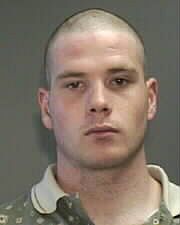
Moller's mug shot, SC Department of Corrections
Gay panic. AIDS terror. Homophobia. Macho bravado. A hands-on-attack in which the assailant feels the need to damage his target up close and personally. These are all the hallmarks of an anti-LGBT hate crime, as well as the response of the police on the scene who refused to take the hate crime dimension of the assault seriously enough to investigate it until later, and the reluctance of the District Attorney to bring sexual orientation into the case for fear of local heterosexist and homophobic prejudices. Local law enforcement reluctance to investigate or prosecute hate crimes against LGBT people is one of the prime reasons a federal hate crimes statute like the Matthew Shepard Act is so needed. Under the provisions of the Shepard Act, the Attorney General of the United States is enpowered to take over the investigation and prosecution of such a hate crime in situations like this one. No doubt, Moller’s homophobic braggadocio would have been taken into account, had the Shepard Act been on the books at the time of Sean Kennedy’s murder. Moller’s defense rested on two contentions that the court in Greenville bought, in the end: first, Moller didn’t even know Kennedy was gay until after the assault, the inadmissible taped phone conversation to the contrary, and second, nothing in this case rose to the level of murder. The D.A. settled for a charge of manslaughter which carries a penalty of 0-5 years in South Carolina. Moller got three years with credit for time served, and sympathy for his need to support a baby he sired while in the custody of the state. An attempt to lessen his prison time failed, thanks to the efforts of Sean Kennedy’s mother, stepfather, and hundreds of concerned people from around the country who petitioned the parole board in Columbia to deny Moller’s petition for early release. In the end, Moller will serve about a year and a half of actual time, with probation for the hate crime murder of an innocent gay man. Moller is due to be set free, his debt to society paid in full, in July 2009.
Sean’s death still tortures his loved ones. His mother said, “My son was violently murdered because of hate and as his mother I wanted justice. My family will never be the same, a big part of our lives has been ripped out of our hearts.” For too many hate crimes victims, that would be the end of it–injustice, anguish, and the eventual amnesia of a society that would rather just not think about such things. But not for Sean.
 Elke and her husband Jim Parker have rallied hundreds to the cause of remembering Sean and advocating for LGBT human rights. They established Sean’s Last Wish, a foundation that perpetuates Sean Kennedy’s desire that everyone be treated equally, www.seanslastwish.org. Sean’s parents have become lions in the struggle for South Carolina and the rest of the nation to have the tools needed to investigate and prosecute violence and intimidation motivated by bias against persons regardless of race, religion, national origin, ancestry, age, disability, gender, sexual orientation, gender expression or gender identity of the victim. Sean’s death has, in effect, given birth to a new and effective way for his memory to be preserved and honored: in the lives of all those spared and enriched to live fully as who they are, free of fear and violence.
The struggle for justice for Sean continues. Elke Kennedy recently said, “No mother should lose a child to hate. No mother should have to fight for justice for their child. To parents who reject their children for their orientation, what would you do if you got a call at three in the morning telling you your child had been murdered?” And Sean’s new life past his death, in memory, in advocacy, and as a cherished story that shall not be forgotten goes on and on. As Sean himself wrote, “So who knows what’s around the corner or down the street. I’m just gonna live life and find out.”

~~ Stephen V. Sprinkle, Director of the Unfinished Lives Project
Ohio Hate Murder Revisited After Six Years: Justice for Gregory Beauchamp
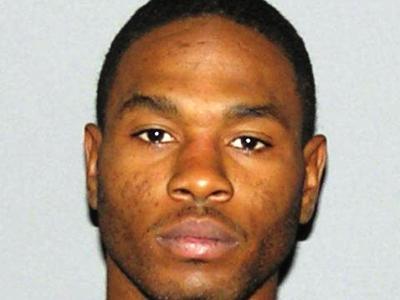
Jerry Jones, 28, indicted for 2002 New Year's Eve Murder of Gregory Beauchamp
On New Year’s Eve 2002, a dark blue Cadillac pulled up to the corner of West Liberty and Vine Streets in Cincinnati beside two cross-dressed friends as they walked to a party. Taunts erupted from the car at the two homosexual men, “Fuckin’ faggot-assed bitches!” Then somebody in the Caddy pulled a trigger, and Gregory Beauchamp, 21, fell fatally wounded in the chest. He was pronounced dead on the scene.

Hate Murder Victim Gregory Beauchamp, 21, wanted to be a fashion designer.
Now, thanks to the work of the Cincinnati Cold Case Unit, Jerry Jones, 28, has been indicted for Beauchamp’s murder. Jones was already in custody at a Dayton, Ohio detention facility on unrelated charges. In 2003, though he had been arrested for killing Beauchamp, the grand jury failed to indict him. The years have not dimmed the pain Beauchamp’s friends still feel for his loss. His friend Dontae refuses to forgive Jones: “This is so sad what they did to Gregory. I miss him so much! The guy who took his life don’t think how much he meant to us. He took my best friend [away from me] that night.”
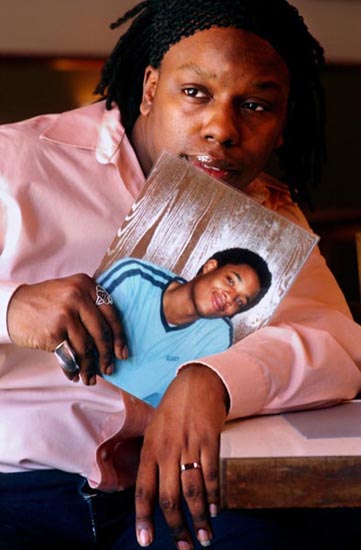
Curtis Johnson holds photo of his friend, Gregory Beauchamp. (Steven Heppich photo)
Gregory Beauchamp was the 65th homicide of the year in Cincinnati, and the last one for 2002. Curtis Johnson remembers the night as if it were yesterday. He told the Cincinnati Enquirer that he was on his way to meet Beauchamp at the party. “He just died in the street–it’s just terrible. I just want people to know he’s more than just the 65th victim. He loved clothes, music, he could sew. He was just a good person. Being black and gay in Cincinnati is tough.”
Beauchamp’s brutal murder sparked a movement in Cincinnati that culminated in the passage of a municipal hate crime statute. Now his friends may get to see justice done for the gentle man who loved to wear women’s clothing and dreamed of studying fashion design in California.
About
If you are a first-time visitor to the Unfinished Lives Project website, we invite you to read A Welcome Message introducing you to our project. We are truly grateful for your visit.
The Unfinished Lives Project website is a place of public discourse which remembers and honors LGBTQ hate crime victims, while also revealing the reality of unseen violence perpetrated against people whose only “offense” is their sexual orientation, gender identity, or gender presentation. LGBTQ people in the United States are suffering a slow-rolling decimation of terror and murder all across the country. Every locale and demographic of society are affected: First Nations, Anglo, Black, Latino and Latina, South and Southeast Asian, Transgender, Bisexuals, Gay men, Lesbians, disabled, young, and mature. Homophobia has a long, crooked arm, and it is reaching out to snatch the life away from women and men whose tragic stories are under-reported to begin with, and whose memories are swiftly forgotten.
The horror of these killings transcends the shock and bereavement of loved ones and friends. These are not typical homicides; they are not killings for money or drugs, incidents of domestic strife, or crimes of passion. The vicious nature of hate crimes against LGBTQ persons is extremely brutal, grotesquely violent, and egregiously hateful.
Each murder serves the LGBTQ population as a sobering warning about the actual level of danger in our communities. The message these killings send is that freedom and open life for LGBTQ people is a cruel dream. Every time we remember one of these victims, however, the intentions of their killers are frustrated. To remember these women and men is to begin the process of changing the culture that killed them.
Our Project Director
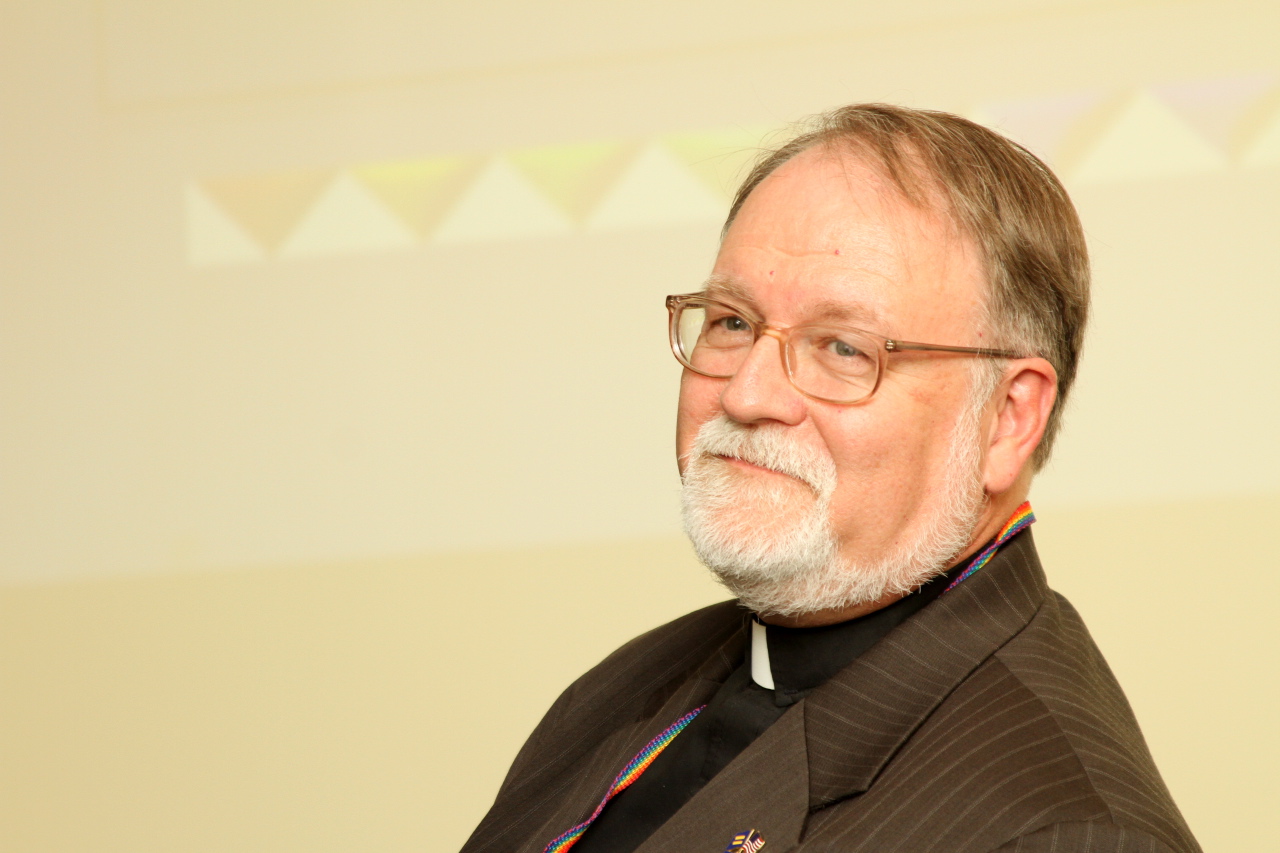
Dr. Stephen V. Sprinkle (Keith Tew photo).
Stephen V. Sprinkle is Director of Field Education and Supervised Ministry, and Professor of Practical Theology at Brite Divinity School, Fort Worth, Texas, a post he has held since 1994. An ordained Baptist minister, he is the first open and out Gay scholar in the history of the Divinity School, and the first open and out LGBTQ person to be tenured there. Read More…
Recent Social Justice Advocacy Activity By Dr. Sprinkle
 Summer 2009 – Dr. Sprinkle responded to the Fort Worth Police Department and Texas Alcoholic Beverage Commission Raid on the Rainbow Lounge, Fort Worth’s newest gay bar, on June 28, 2009, the exact 40th Anniversary of the Stonewall Rebellion. Dr. Sprinkle was invited to speak at three protest events sponsored by Queer LiberAction of Dallas. Here, he is keynoting the Rainbow Lounge Protest at the Tarrant County Courthouse on July 12, 2009. Read More…
Contact Us
Communicate with the Unfinished Lives project team:
info@unfinishedlivesblog.com


Schedule a Presentation
Dr. Sprinkle will gladly present his acclaimed presentation to your organization. To arrange an Unfinished Lives presentation for your organization or group, please contact us.
Dr. Sprinkle has given his Unfinished Lives presentation to these and other community groups and organizations. Read More…
-

Where are our readers?
Publisher: Steve Sprinkle (Project Director)
Steve Sprinkle
Unfinished Lives: Remembering LGBT Hate Crime VictimsBrite Divinity School/Texas Christian UniversityFort Worth TXprofessor, minister, author, blogger, LGBTQ advocate


Follow Unfinished Lives on Facebook
 Box Turtle Bulletin
- An error has occurred; the feed is probably down. Try again later.
- HRC Back Story
- Know About The Gender Identity Movement
- Why Is There A Need For Human Rights?
- Kinds Of Human Rights
- Human Rights Purposes And Violations
- Human Rights For Every Human Incident
- 8 Reasons Human Rights Are Important
- Everything About Human Rights
- Human Rights Issues Education & Law
- We Need To Stand Up For Our Rights And Those Of Others
- Coca-Cola Receives Perfect Score On Human Rights
- The Advocate: Daily News
- Eric Swalwell responds to sexual assault allegations in a to-camera video
- Eric Swalwell’s governor bid is collapsing as top Democrats turn on him
- What Melania Trump’s bizarre Jeffrey Epstein press event reveals about a White House in chaos
- New Bryon Noem bombshell puts Kristi Noem’s anti-trans politics under harsher spotlight
- Former Biden HHS leaders hail syphilis breakthrough as Trump dismantles the system behind it
- Advocate breaking news 4/10/26
- Pete Buttigieg hints at 2028 presidential run: ‘Save me a seat’
- Could Minneapolis welcome bathhouses back for the first time since the late 1980s?
- Donald Trump posts gruesome murder video to Truth Social
- Melania Trump blindsides White House aides with unexpected leap into Epstein scandal
- Dallas Voice: Instant Tea
- An error has occurred; the feed is probably down. Try again later.

 Unfinished Lives
Triangle of Terror: Gays On Their Guard
Police in body armor outside US Holocaust Museum (Shawn Thew/European Pressphoto)
Steven Domer murdered by white supremacist
Steven Domer of Edmonton, Oklahoma, was brutally murdered in October 2007 by Darrell Madden, a white supremacist recently released from prison. Madden, a member of the Aryan Brotherhood, garroted Domer with a wire clothes hanger after binding him with duct tape. Domer’s body was found in a ravine in McClain County. Investigators believe that Madden’s motive was to earn his “patch” from the Aryan Brotherhood, a sign of distinction awarded to a member who murders a Jew, a black, a homosexual, or anyone deemed to be an “enemy” by the group. In October 2008, Madden was found guilty of first degree murder and abduction, and sentenced to four consecutive life terms. The Domer murder and others like it offer a warning to the LGBT community in a time when hostility is clearly on the rise against same-sex marriage, the Matthew Shepard Act, ENDA, and the proposed repeal of both DOMA and DADT. Hate crime statistics demonstrate an upward spiral of violence in Michigan, Tennessee, Minnesota, and California. LGBT Americans share the vulnerability of other targeted groups, and decry the violence perpetrated by religious bigotry, misguided nationalism, racial hatred, and misogyny. The need for the passage of a sexual orientation, gender identity and gender expression hate crimes law has never been greater, given the rising tide of bias-related hate crimes chilling whole segments of the American population. Fear may isolate and paralyze people. Resolve to face hate and fear with justice and hope can unite people, as well. Now is the time for coalition building, rejection of irrational hatred wherever it arises, and a mutual commitment to the health and safety of all Americans. Gays, lesbians, bisexuals and transgender people already know how important vigilance and solidarity in the face of terror are. So do women, Jews, and Blacks, all of whom have been affected by these deplorable killings in recent weeks. Perhaps this time those targeted by the radical right will learn how to stand together, and rally the country to repudiate these senseless acts of violence. We at The Unfinished Lives Project devoutly hope so.
Share this:
June 11, 2009 Posted by unfinishedlives | anti-LGBT hate crime murder, Anti-Semitism, Arkansas, California, Kansas, Racism, religious intolerance, Social Justice Advocacy, Special Comments, Strangulation, Tennessee, Washington, D.C. | African Americans, Anglo Americans, Don't Ask Don't Tell (DADT), gay men, gun violence, Hate Crimes, hate crimes legislation, Matthew Shepard Act, military, Neo-Nazis and White Supremacy | 3 Comments