Hate Crimes Victims Remembered at Dallas Day of Decision Protest
 Hundreds gathered to hear speakers call for protests in the streets to show the determination of the LGBT community to have equal rights. The Dallas gayborhood rang with with voices of protesters in the largest street demonstration in years along Oaklawn and Cedar Springs. Blake Wilkinson of Queer LiberAction named Matthew Shepard whose death 10 years ago has not yet been vindicated by federal hate crimes legislation. He urged protesters to get angry that LGBT advocacy for hate crimes victims is so ineffective that a decade out from the Shepard murder, the queer community still does not have laws protecting LGBT people from being bashed and killed. Then Wilkinson called on the crowd to channel that anger into effective local, state and national action, starting in the streets, with gay folk taking their message of equality to the people.
The large crowd moved up Cedar Springs Road to TMC, The Mining Company, a popular gay bar on the strip with a large, street side patio, where the rally heard a number of powerful speeches protesting “separate but equal,” second-class status for LGBT Americans.

Dallas Queer LiberAction protest at the Legacy of Love column (Dallas Voice photo)
President Obama Meets Judy Shepard at White House
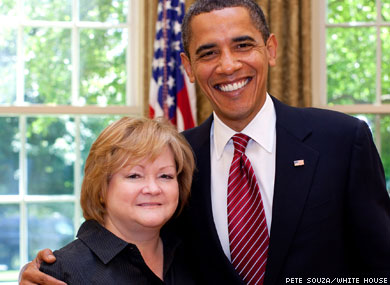 Washington, DC – President Barak Obama met Judy Shepard, mother of slain gay son, Matthew Shepard, in the Oval Office of the White House, according to Jon Barrett of The Advocate. President Obama affirmed his support of the Matthew Shepard Hate Crimes Prevention Act still pending action in the United States Senate. The House version of the bill has already passed by a wide margin. While a Senator, President Obama voted in favor of the act, and told Mrs. Shepard that he would sign it once it reaches his desk. Though brief, the meeting was a significant indication of the support of this president for justice for LGBT people and their families and friends. The Obama administration has been criticized for moving slowly on LGBT issues. Former White House aide to President Bill Clinton, David Mixner, for example, is calling for a march on Washington to pressure the president to follow through on his support for the LGBT community, such as the repeal of DADT (Don’t Ask Don’t Tell) and of DOMA (Defense of Marriage Act). Critics point out that other groups who helped elect President Obama have already received significant support and legislation, such as women, blacks, and hispanics. The LGBT vote went heavily in favor of the president in the November general election, playing a significant role in swinging states into the Democratic column in the case of Florida, Indiana, and North Carolina, where slim margins suggest the necessity of the queer vote. Shepard counseled patience with the president today. “We are victims of our own hope,” she says. “These bills are going to get passed, it’s just going to take time and work.” For now, Shepard is calling on citizens to call their Senators to urge them for passage of the Shepard Act when it comes to floor of the Senate. She also calls on friends of anti-LGBT Hate Crimes legislation across the country to discourage Senate Majority Leader Harry Reid of Nevada from attaching the Shepard Act to a Defense Department Appropriations Bill, which she believes will hurt its chances of passage.
Clergy Call for Passage of Matthew Shepard Hate Crimes Act on Capitol Hill
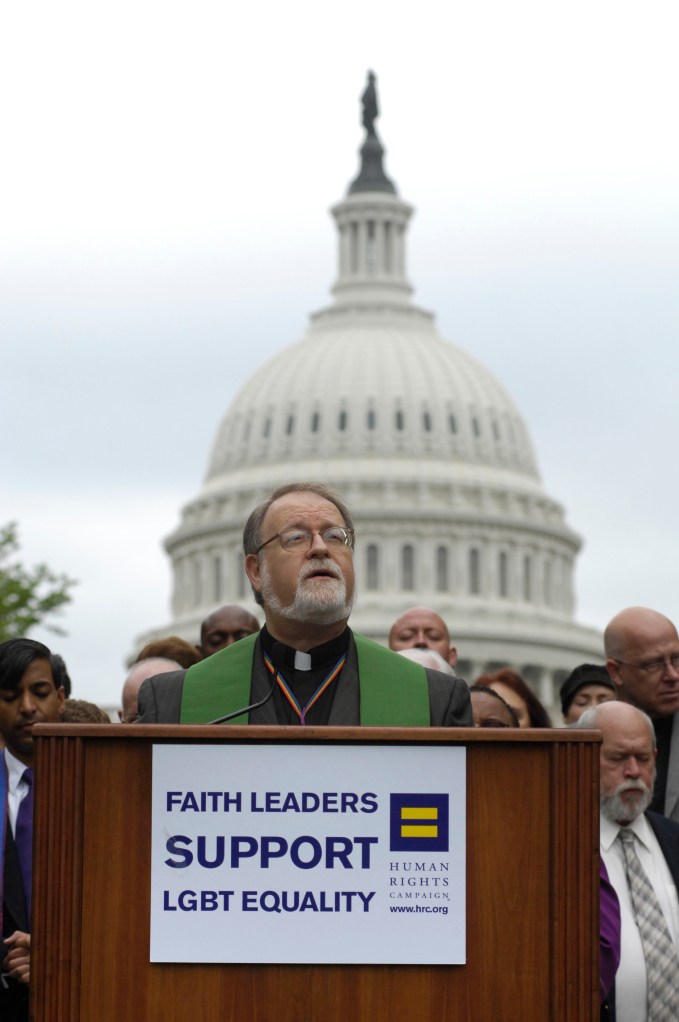
Unfinished Lives Project Director, Dr. Stephen Sprinkle, delivers the Opening Prayer at Clergy Call 2009
More than 300 LGBT Clergy and Allies hit Capitol Hill to pray and lobby for the passage of the Matthew Shepard Act and a fully trans-inclusive Employment Non-Descrimination Act. A new breeze seemed to be blowing in the halls of government. The Human Rights Campaign Religion and Faith Program, directed by Harry Knox and Sharon Groves, coordinated three days of events, May 4-6, 2009. Among the speakers for the Press Conference were Dr. Tony Campolo, noted evangelical leader, and Dr. Jo Hudson, Rector and Senior Pastor of Cathedral of Hope in Dallas. Clergy from all 50 states attended. The Matthew Shepard Act awaits the action of Senate Majority Leader Harry Reid and chief sponsor Senator Ted Kennedy in order to bring the legislation (which has already passed the House of Representatives by a healthy margin) to the floor of the Senate. President Obama has publicly indicated that he would sign the bill into law when it reaches his desk. Federal Hate Crimes legislation was first introduced in Congress 17 years ago. So much has happened since, and so many have needlessly died. With the Hebrew Prophets, the ministers, rabbis, and priests meeting for Clergy Call 2009 cry out, “How long, O Lord?”
The gathering of large contingents of LGBT Clergy and Allies to lobby for passage of fully inclusive hate crimes federal legislation, first in 2007 and now, has done much to persuade fence-sitting members of Congress that the radical right does not own the religious vote on this issue.
Angie Zapata’s Murderer Sentenced to 60 More Years
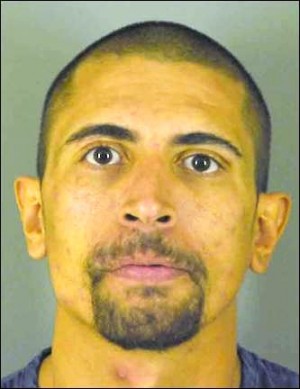
Allen Ray Andrade, Angie Zapata's Convicted Murderer
Denver – the AP reports that Allen Ray Andrade, convicted of murder in the first degree in the Angie Zapata transgender murder case and sentenced to life without parole has been determined to be a “habitual criminal” and sentenced to an additional 60 years in prison. Weld County District Judge Marcello Kopcow ruled on May 8 that the three remaining convictions, for bias-motivated crime, aggravated motor-vehicle theft and identity theft, should carry such a penalty in view of the deliberate criminality with which Andrade committed these offenses.

Angie Zapata, trans-Latina, died violently at 18 years of age
Supporters of federal hate crimes legislation hope that this application of the Colorado hate crimes law will add pressure for the passage of a fully transgender inclusive Matthew Shepard Hate Crimes Act that is awaiting action in the United States Senate. The House of Representatives has recently passed its own version of the legislation, the Local Law Enforcement Hate Crimes Prevention Act, by a large margin. President Obama has publicly stated that he would sign a fully trans-inclusive hate crimes law when it reaches his desk.
Ohio Hate Murder Revisited After Six Years: Justice for Gregory Beauchamp
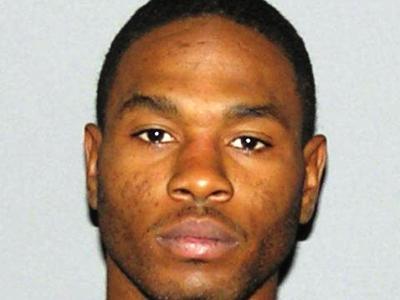
Jerry Jones, 28, indicted for 2002 New Year's Eve Murder of Gregory Beauchamp
On New Year’s Eve 2002, a dark blue Cadillac pulled up to the corner of West Liberty and Vine Streets in Cincinnati beside two cross-dressed friends as they walked to a party. Taunts erupted from the car at the two homosexual men, “Fuckin’ faggot-assed bitches!” Then somebody in the Caddy pulled a trigger, and Gregory Beauchamp, 21, fell fatally wounded in the chest. He was pronounced dead on the scene.

Hate Murder Victim Gregory Beauchamp, 21, wanted to be a fashion designer.
Now, thanks to the work of the Cincinnati Cold Case Unit, Jerry Jones, 28, has been indicted for Beauchamp’s murder. Jones was already in custody at a Dayton, Ohio detention facility on unrelated charges. In 2003, though he had been arrested for killing Beauchamp, the grand jury failed to indict him. The years have not dimmed the pain Beauchamp’s friends still feel for his loss. His friend Dontae refuses to forgive Jones: “This is so sad what they did to Gregory. I miss him so much! The guy who took his life don’t think how much he meant to us. He took my best friend [away from me] that night.”
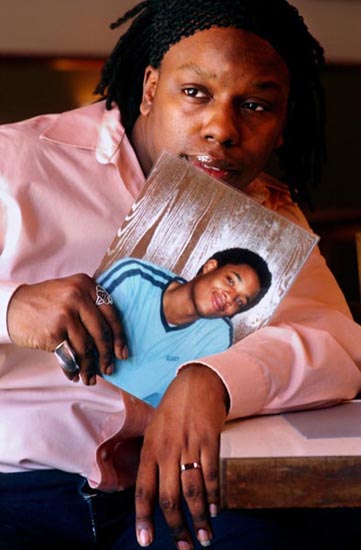
Curtis Johnson holds photo of his friend, Gregory Beauchamp. (Steven Heppich photo)
Gregory Beauchamp was the 65th homicide of the year in Cincinnati, and the last one for 2002. Curtis Johnson remembers the night as if it were yesterday. He told the Cincinnati Enquirer that he was on his way to meet Beauchamp at the party. “He just died in the street–it’s just terrible. I just want people to know he’s more than just the 65th victim. He loved clothes, music, he could sew. He was just a good person. Being black and gay in Cincinnati is tough.”
Beauchamp’s brutal murder sparked a movement in Cincinnati that culminated in the passage of a municipal hate crime statute. Now his friends may get to see justice done for the gentle man who loved to wear women’s clothing and dreamed of studying fashion design in California.
Mother of Sean Kennedy, Slain South Carolina Gay Man, Lobbies Congress for Matthew Shepard Act
Elke Kennedy, here with Unfinished Lives Project Director, Dr. Stephen Sprinkle, lobbies Congress for the passage of the Matthew Shepard Hate Crimes Act, May 5, 2009. For more information on the advocacy done in Sean’s name, be sure to visit Sean’s Last Wish on the web,http://www.seanslastwish.org/.
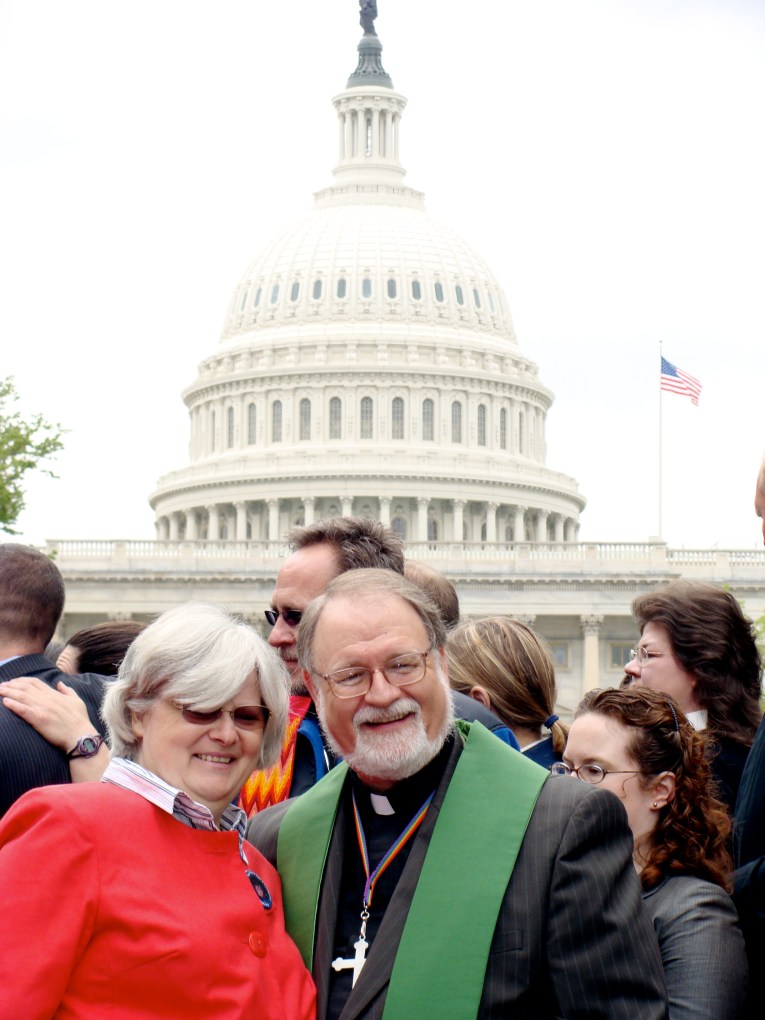
Elke Kennedy and Steve Sprinkle on Capitol Hill for HRC Clergy Call 2009
U.S. House of Representatives Passes Fully Inclusive Hate Crimes Act
The Matthew Shepard Act, fully inclusive of sexual orientation and gender identity, passed the House of Representatives April 29 by a large majority, 249-175. Judy Shepard, mother of slain University of Wyoming student, Matthew Shepard, lobbied hard today for passage. Now, on to the U.S. Senate where the measure needs a super majority of 60 to get it to President Obama’s desk.
About

If you are a first-time visitor to the Unfinished Lives Project website, we invite you to read A Welcome Message introducing you to our project. We are truly grateful for your visit.
The Unfinished Lives Project website is a place of public discourse which remembers and honors LGBTQ hate crime victims, while also revealing the reality of unseen violence perpetrated against people whose only “offense” is their sexual orientation, gender identity, or gender presentation. LGBTQ people in the United States are suffering a slow-rolling decimation of terror and murder all across the country. Every locale and demographic of society are affected: First Nations, Anglo, Black, Latino and Latina, South and Southeast Asian, Transgender, Bisexuals, Gay men, Lesbians, disabled, young, and mature. Homophobia has a long, crooked arm, and it is reaching out to snatch the life away from women and men whose tragic stories are under-reported to begin with, and whose memories are swiftly forgotten.
The horror of these killings transcends the shock and bereavement of loved ones and friends. These are not typical homicides; they are not killings for money or drugs, incidents of domestic strife, or crimes of passion. The vicious nature of hate crimes against LGBTQ persons is extremely brutal, grotesquely violent, and egregiously hateful.
Each murder serves the LGBTQ population as a sobering warning about the actual level of danger in our communities. The message these killings send is that freedom and open life for LGBTQ people is a cruel dream. Every time we remember one of these victims, however, the intentions of their killers are frustrated. To remember these women and men is to begin the process of changing the culture that killed them.
Our Project Director
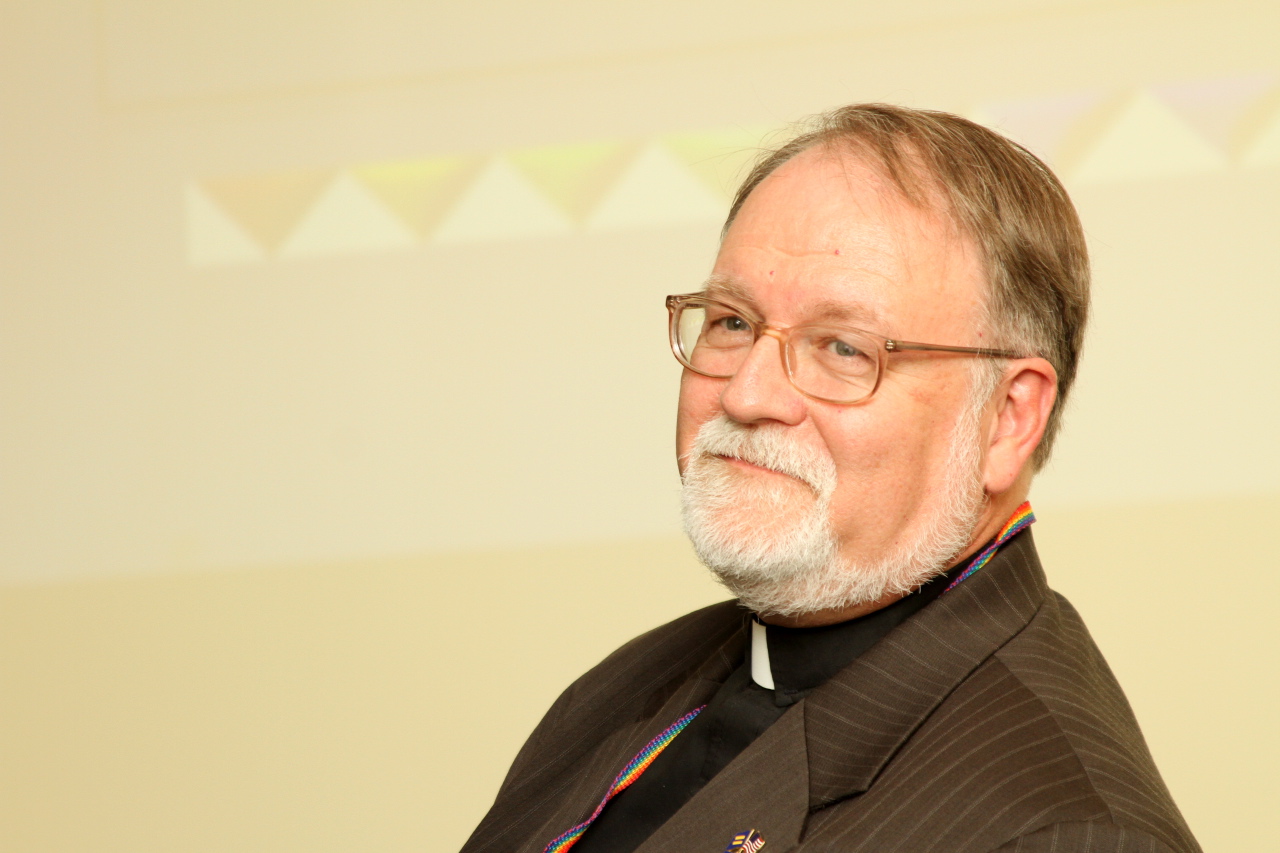
Dr. Stephen V. Sprinkle (Keith Tew photo).
Stephen V. Sprinkle is Director of Field Education and Supervised Ministry, and Professor of Practical Theology at Brite Divinity School, Fort Worth, Texas, a post he has held since 1994. An ordained Baptist minister, he is the first open and out Gay scholar in the history of the Divinity School, and the first open and out LGBTQ person to be tenured there. Read More…
Recent Social Justice Advocacy Activity By Dr. Sprinkle
 Summer 2009 – Dr. Sprinkle responded to the Fort Worth Police Department and Texas Alcoholic Beverage Commission Raid on the Rainbow Lounge, Fort Worth’s newest gay bar, on June 28, 2009, the exact 40th Anniversary of the Stonewall Rebellion. Dr. Sprinkle was invited to speak at three protest events sponsored by Queer LiberAction of Dallas. Here, he is keynoting the Rainbow Lounge Protest at the Tarrant County Courthouse on July 12, 2009. Read More…
Contact Us
Communicate with the Unfinished Lives project team:
info@unfinishedlivesblog.com


Schedule a Presentation
Dr. Sprinkle will gladly present his acclaimed presentation to your organization. To arrange an Unfinished Lives presentation for your organization or group, please contact us.
Dr. Sprinkle has given his Unfinished Lives presentation to these and other community groups and organizations. Read More…
-

Where are our readers?
Publisher: Steve Sprinkle (Project Director)
Steve Sprinkle
Unfinished Lives: Remembering LGBT Hate Crime VictimsBrite Divinity School/Texas Christian UniversityFort Worth TXprofessor, minister, author, blogger, LGBTQ advocate


Follow Unfinished Lives on Facebook
 Box Turtle Bulletin
- An error has occurred; the feed is probably down. Try again later.
- HRC Back Story
- Know About The Gender Identity Movement
- Why Is There A Need For Human Rights?
- Kinds Of Human Rights
- Human Rights Purposes And Violations
- Human Rights For Every Human Incident
- 8 Reasons Human Rights Are Important
- Everything About Human Rights
- Human Rights Issues Education & Law
- We Need To Stand Up For Our Rights And Those Of Others
- Coca-Cola Receives Perfect Score On Human Rights
- The Advocate: Daily News
- Donald Trump threatens genocide in Iran: ‘A whole civilization will die tonight’
- The Supreme Court’s conversion therapy ruling is being misunderstood
- Hegseth compares Iran rescue to resurrection as Trump threatens strikes on civilian infrastructure
- Trump administration undoes civil rights settlements that found discrimination against trans students
- Don't fall for WSJ's 'normal gay' whitewashing of queer life
- Federal judge rebuffs Trump administration push to restrict gender-affirming care for minors
- Donations surge for Tennessee librarian fired by conservative board over LGBTQ+ books
- South Carolina man faces hate crime charges after shooting into Myrtle Beach LGBTQ+ nightclub
- Journalist detained for booing Trump at Kennedy Center 'Chicago' performance
- Donald Trump telegraphs war crimes in profanity-filled Easter Sunday Iran threat
- Dallas Voice: Instant Tea
- An error has occurred; the feed is probably down. Try again later.

 Unfinished Lives
The Death and Life of Sean Kennedy: A Commemoration
Sean Kennedy had no chance. In effect, he was dead from the moment his skull struck the curb. Elke Kennedy, his mother, has had to live with the horror of his murder ever since.
Moller, on the other hand, reveled in his macho moment. In a drunken phone call to one of Sean’s friends just fifteen minutes after the crime, Moller taunted Kennedy for his sexual orientation. Though it was taped and verified to be Moller’s voice, the call was never allowed into testimony at Moller’s trial:
“Hey. (laughter) Whoa stop. (laughter) Hey, I was just wondering how your boyfriend’s feeling right about now. (laughter) (??) knocked the f— out. (laughter). The f—— faggot. He ought to never stick his mother-f—— nose (??) Where are you going? Just a minute. (laughter). Yea boy, your boy is knocked out, man. The mother——-. Tell him he owes me $500.00 for breaking my god—- hand on his teeth that f—— bitch.”
Moller's mug shot, SC Department of Corrections
Gay panic. AIDS terror. Homophobia. Macho bravado. A hands-on-attack in which the assailant feels the need to damage his target up close and personally. These are all the hallmarks of an anti-LGBT hate crime, as well as the response of the police on the scene who refused to take the hate crime dimension of the assault seriously enough to investigate it until later, and the reluctance of the District Attorney to bring sexual orientation into the case for fear of local heterosexist and homophobic prejudices. Local law enforcement reluctance to investigate or prosecute hate crimes against LGBT people is one of the prime reasons a federal hate crimes statute like the Matthew Shepard Act is so needed. Under the provisions of the Shepard Act, the Attorney General of the United States is enpowered to take over the investigation and prosecution of such a hate crime in situations like this one. No doubt, Moller’s homophobic braggadocio would have been taken into account, had the Shepard Act been on the books at the time of Sean Kennedy’s murder. Moller’s defense rested on two contentions that the court in Greenville bought, in the end: first, Moller didn’t even know Kennedy was gay until after the assault, the inadmissible taped phone conversation to the contrary, and second, nothing in this case rose to the level of murder. The D.A. settled for a charge of manslaughter which carries a penalty of 0-5 years in South Carolina. Moller got three years with credit for time served, and sympathy for his need to support a baby he sired while in the custody of the state. An attempt to lessen his prison time failed, thanks to the efforts of Sean Kennedy’s mother, stepfather, and hundreds of concerned people from around the country who petitioned the parole board in Columbia to deny Moller’s petition for early release. In the end, Moller will serve about a year and a half of actual time, with probation for the hate crime murder of an innocent gay man. Moller is due to be set free, his debt to society paid in full, in July 2009.
Sean’s death still tortures his loved ones. His mother said, “My son was violently murdered because of hate and as his mother I wanted justice. My family will never be the same, a big part of our lives has been ripped out of our hearts.” For too many hate crimes victims, that would be the end of it–injustice, anguish, and the eventual amnesia of a society that would rather just not think about such things. But not for Sean.
The struggle for justice for Sean continues. Elke Kennedy recently said, “No mother should lose a child to hate. No mother should have to fight for justice for their child. To parents who reject their children for their orientation, what would you do if you got a call at three in the morning telling you your child had been murdered?” And Sean’s new life past his death, in memory, in advocacy, and as a cherished story that shall not be forgotten goes on and on. As Sean himself wrote, “So who knows what’s around the corner or down the street. I’m just gonna live life and find out.”
~~ Stephen V. Sprinkle, Director of the Unfinished Lives Project
Share this:
May 17, 2009 Posted by unfinishedlives | Heterosexism and homophobia, Perpetrators of Hate Crime, Social Justice Advocacy, South Carolina | Anglo Americans, Beatings and battery, gay men, hate crime, hate crimes legislation, Law and Order, Matthew Shepard Act, Remembrances, Special Comment | Comments Off on The Death and Life of Sean Kennedy: A Commemoration