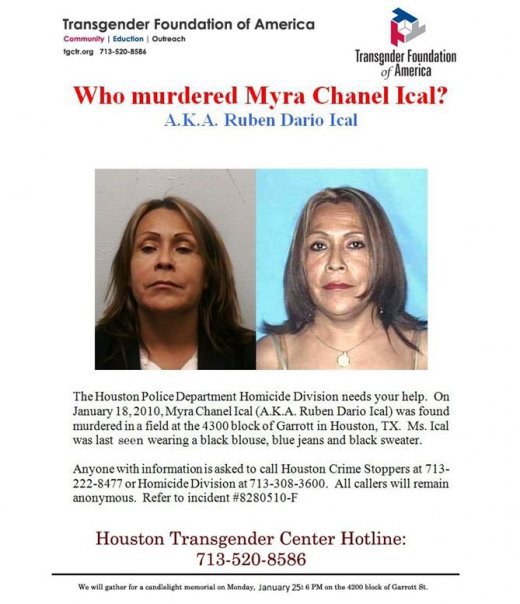
Trans Community Demands Justice for Myra Ical
Houston, TX – Cristan Williams, Executive Director of the Transgender Foundation of America, takes the murder of Myra Ical personally. “She died struggling for her life…She went down fighting and she was literally beaten to death,” she said to reporters for KHOU 11 News. “It’s personal. I feel it on a personal level.” Hundreds agree with Williams. Myra Chanel Ical, 51, died in a Montrose area field a week ago, and Houston’s transgender community has rallied to her memory. Seven members of the transgender community have died violently in Houston in the last eleven years, and now the vigil organized to remember Ms. Ical on Monday night is being billed as the largest transgender event in Houston’s history. The vigil’s organizers intend to focus attention on the plight of transgender people in Harris County and Houston as they honor Ms. Ical’s memory and call for neighbors in Montrose to share any leads they may have on the unsolved murder with police investigators. While her slaying is not yet designated as a hate crime, police are certainly not ruling anything out. Sgt. Bobby Roberts, spokesperson for the Houston Police Department, told reporters, “It could have been anything at this point. We just don’t have any motive whatsoever on this case.” ABC News 13 reports that Ms. Ical’s body was covered in bruises and bore several defensive-type wounds that showed she was fighting back against her attacker(s). Harris County’s Medical Examiner ruled that she died from strangulation by some sort of ligature. Cristan Williams cannot get the horror of how Ms. Ical died out of her mind. “That in and of itself was just a horrific way to die. Her last moments of life were sheer terror.” Williams asks why none of the seven murders of Houston transgender people have been solved. Police told her they have no evidence in any of the cases, something Williams attributes to the way anti-transgender crimes went largely unreported in the recent past. Until the passage of the Matthew Shepard and James Byrd, Jr. Hate Crimes Prevention Act this past October, local and federal law enforcement agencies were not mandated to keep statistics on transgender hate crimes. Like the transgender population, these crimes were largely ignored. Human rights advocates for the LGBT community are watching closely to see if the election of Annise Parker, an open and out lesbian, as Mayor of Houston will make a difference in how law enforcement and the media approach violence against some of the most vulnerable citizens of America’s 4th largest city.
Major Media Fail Over Murder of Houston Transwoman
 Houston, TX – Myra Ical lived and died as a transwoman, but the Houston media have not given her the dignity of acknowledging her gender identity when reporting on her likely hate murder. The Houston Chronicle reported Ical’s January 18 murder in the Montrose section using exclusively male pronouns, calling her male, and playing up the sensational aspects of the area where homeless people eek out a living. As is often sadly the case in reportage that is lazy and salacious, the Chronicle used innuendo to suggest that Ical, whose body was found partially naked and covered with bruises and defensive injuries indicative of her fight with her attacker(s), was consorting with prostitutes and drug addicts. Local and national LGBT rights organizations have pushed back against this media injustice by calling attention to Ms. Ical’s gender identity and expression, and demanding that reportage get this aspect of such a terrible story right. According to The Advocate, Human Rights Campaign board member and Pride Houston president Meghan Stabler submitted a strongly worded letter on behalf of both organizations to media outlets covering Ms. Ical’s murder, urging reporters to “use fair, accurate and inclusive reporting” when reporting on LGBT issues. The letter read, in part: “On Monday January 18 the brutal murder of Myra Ical occurred in Houston. She is a transgender woman but the media continue to use male pronouns along with colorful statements about being found in an area known for drugs and prostitution. This lazy and irresponsible journalism shows the amount of ignorance about transgender issues that is rampant among far too many reporters despite the existence of resources to help them report accurately.” GLAAD and the AP have clear guidelines on how LGBT-oriented stories should be reported, leaving big media like the Houston Chronicle without excuse. Myra Ical, who was 51 when she died, will be remembered at a candlelight vigil near the site of her murder at the corner of Richmond Avenue and Garrott Street on Monday, January 25, from 6-6:30 pm. The Facebook notice for the vigil calls upon media and the Houston Police Department “to communicate with the public in a way that respects the victim.” Thanks to Daniel Williams for breaking this story in the DFW metroplex.
Dallas Vigil for Slain Gay Teens Voices Sadness, Anger, and Hope
 Dallas, TX – A large crowd of vigil keepers gathered at the Crossroads in Dallas on Sunday night to remember murdered gay teens, Jorge Steven López Mercado of Caguas, Puerto Rico, and Jason Mattison, Jr. of Baltimore, Maryland. A third gay teen, Jayron Martin, who survived a vicious homophobic attack in Houston, was also remembered. A coalition of organizations led by Bob McCranie of the Carrolton Project and Daniel Cates of Equality March Texas met at the corner of Cedar Springs and Throckmorton, the historic center of LGBT life in Dallas to voice anger, to express their sadness in solidarity with the families and friends of the slain teens, and to send messages of hope and support from Texas to the loved ones of the boys who were attacked for no other reason than their sexual orientation. Other sponsoring organizations were Cathedral of Hope United Church of Christ, the largest LGBT-predominant congregation in the world, Syangogue Beth El Binah, Resource Center Dallas, the Dallas Chapter of the Gay, Lesbian & Straight Education Network (GLSEN), and the Lambda Weekly. Speakers urged the gathering to turn their anger and sorrow into meaningful action for a just world, not only for LGBT people, but for everyone. As vigil keepers lit their candles, the names of 100 slain Transgender, Lesbian, Gay, and Bisexual victims of hate crime murder were spoken aloud in the night. The march wound several blocks down to the Legacy of Love monument at the corner of Cedar Springs and Oak Lawn, and then returned. Rainbow flags were signed by many of the participants with messages of hope and support for Jorge Steven’s family in Puerto Rico, and for Jason’s family in Baltimore. A giant card was signed for Jayron, to let him know of the support he has from the Dallas-Fort Worth LGBT community.

Flags for the deceased at the Dallas Candlelight Vigil
NYC Memorial for Jorge Steven López Mercado – Sunday, November 22 at the Christopher Street Piers (Tentative), 7 – 9 p.m. Further Information: http://www.facebook.com/event.php?eid=179256219695

Jorge Steven López Mercado, 19
Suspect Arrested in Puerto Rican Gay Teen Hate Murder Case

Jorge Steven López Mercado
San Juan, Puerto Rico – The Associated Press is reporting that the arrested suspect in Jorge Steven Lopez Mercado’s grisly murder is claiming the infamous “gay panic” defense to besmirch the character of the victim, and appeal to anti-gay machismo. Regional Police Director Hector Agosto said, “This was a ruthless crime. Whoever did this just wanted to make the person disappear.” Gay rights advocates in the Caribbean United States Territory have carried out a number of memorial events for young Lopez Mercado, as well as protests in the capital, San Juan demanding that police investigate the murder as a bias-related hate crime. “They are hurt and they are indignant,” gay activist Pedro Julio Serrano said to reporters. “They are calling for justice.” Local island media are reporting that Juan Antonio Martínez Matos, 26, a father of four, was arrested by authorities for the murder. Matos is alleging that he was in search of a woman for sex, and when he found out that Lopez Mercado was a gay youth instead of a female, he panicked. Whether he is speaking under the direction of an attorney is not known at this time, but in any event, the suspect has appardently made the calculation that enough members of the public will buy his account that he will be more likely to receive a lighter sentence, if convicted. On the mainland, the gay or trans-panic defense has been tried on many occasions in an attempt to cast enough aspersions on the character of the LGBT victim that public opinion will soften toward the defendant. In recent court cases, such as the trial of Allen Ray Andrade, the murderer of trans Latina Angie Zapata in Greeley, Colorado, the panic defense has fallen flat. Andrade, who made a similar claim, left both judge and jury unconvinced, and received life in prison without hope of parole. According to Box Turtle Bulletin, Matos also claimed that Lopez Mercado demanded money from him. Police investigators have allegedly discovered a wig, a burned mattress, burned PVC pipe, and a knife at the suspect’s apartment. Accounts also say that police found blood stains on the wall of the courtyard of the apartment. Investigator José J. Bermúdez said to the press that he has no doubt that López’s murder can be prosecuted as a hate crime. Since the public can easily be prejudiced by media accounts that are both uncritical of a suspect’s allegations about his victim, and unverified as to what actually may (or may not) have been found at a crime scene, the Unfinished Lives Project will pass these details along as currently unsubstantiated reports until properly and fully vetted. Officials in Puerto Rico are now saying that the mutilated, beheaded and partially burned body of Lopez Mercado was discovered on Friday, November 13 in a wooded area near Cayey, only a few miles from his home in Caguas. Both the LGBT community in Puerto Rico and the Puerto Rican population of New York City have expressed grave concern about the most savage murder of a gay person in Puerto Rico’s history.
19 Transgender Murders Per Month in 2009 To Be Remembered at TDOR
 On November 20, 2009, the international transgender community will observe the 11th annual Transgender Day of Remembrance. The Transgender Day of Remembrance (TDOR) is a memorial observance of the lives of transmen and transwomen who have been killed during the previous year due to anti-transgender hatred, violence, and prejudice. According to the Transgender Legal Defense & Education Fund (TLDEF), Rita Hester’s murder in 1998 sparked the beginning of the TDOR which has evolved into hundreds of local events and memorials throughout the nation and the world. This year the LGBT community will mourn more than 95 murdered transgender individuals internationally according to Ethan St. Pierre, amounting to an average of 19 per month. In 2008, there were 47 transgender murder victims remembered at TDOR. The murder rate has spiked nearly 100%, virtually doubling in just 12 months. A more frightening assessment issued by Liminalis, a journal “For Sex/Gender Emancipation and Resistance,” reports that in the year-and-a-half from January 2008 until the middle of 2009, better than 200 transgender people were murdered world-wide, with the bulk of these statistics coming from North and South America. According to this report, Brazil is the most dangerous country in the world for transpeople accounting for 59 deaths in 2008, followed by the United States of America where 16 murders of transgender folk occurred. Accurate data are notoriously hard to establish on the numbers of transgender murders domestically and world-wide. Reporters and researchers have meticulously combed the internet for names and accounts, but many victims remain unnamed. Reports of trans deaths in news sources with no internet presence are routinely missed. While the most sensational murders of transpeople remain those of transwomen, the numbers of reported slayings of transmen and queer youths who present femininely are clearly on the rise. In addition to memorials for the slain at this year’s TDOR, major political and legal victories for the transgender community will also be highlighted. The Matthew Shepard and James Byrd, Jr. Hate Crimes Prevention Act has been signed into law by President Obama, extending protections from violent crimes to transgender people in the United States for the first time. The past year has also seen the successful conviction and sentencing of two murderers who took the lives of transgender women under state anti-hate crime statutes, one in Colorado and another in New York. The message of these convictions to reluctant local law enforcement officials is that convictions for bias-related hate crimes against transgender people are attainable from juries throughout the country, giving the lie to the often-repeated excuse that hate crimes are difficult to impossible to prosecute successfully. Allen Ray Andrade was put away for life for the murder of Angie Zapata in Greeley, Colorado under such a statute, as well as Dwight DeLee, who received 25 years for the murder of Lateisha Green in Syracuse, New York.
20 Years of Effort Led to the Matthew Shepard and James Byrd, Jr. Act of 2009

Matthew Shepard and James Byrd, Jr.
When President Obama signs the Matthew Shepard and James Byrd, Jr. Act of 2009 into law sometime next week, that moment will be the culmination of two decades of tireless work at the federal level to protect Lesbian, Gay, Bisexual and Transgender people from violent, bias-motivated crimes. The term “hate crime” did not enter the American lexicon until the 1980s, though crimes of violence against minorities that caused whole groups to live in fear. First introduced in 1989, Congress passed the Hate Crime Statistics Act (HCSA) of 1990 which mandated the that U.S. Department of Justice collect statistics on crimes that “manifest prejudice based on race, religion, sexual orientation, or ethnicity” from law enforcement agencies across the country and to publish an annual summary of the findings. In the Violent Crime Control and Law Enforcement Act of 1994, Congress expanded coverage of the HCSA to require FBI reporting on crimes based on “disability.” Pursuant to the passage of the HCSA of 1990 and at the request of the Attorney General of the United States, the FBI first gathered and published this data in 1992, and has done so every year since. The collection and publication of data supporting the claims of the LGBT community, that they were indeed being targeted by terror-attacks, set the stage for all subsequent federal legislation relating to the protection of people who were being physically harmed because of actual or perceived sexual orientation. Transgender persons have been left out of any data gathering done by the federal government right up until the present, as if there were no violent crimes perpetrated against this important population of gender non-conformists. The FBI Sexual Orientation Hate Crimes Statistics for 2007, published in October 2008, recorded 1,512 persons or 11% of the total of the 9,535 persons victimized in physical attacks classified as hate crimes. This number of individual victims was the third highest of all victims of hate crimes, after race and religion bias crimes. Further, the 2007 figures show that two and a half times more Lesbians, Gay men, and Bisexual persons were victimized by murder or non-negligent manslaughter than any other group on whom the FBI kept statistics that year. Though flawed and under-counted according to the National Coalition of Anti-Violence Programs, the incidence of violent crime against the LGBT community recorded by the FBI established something of the magnitude of the national crisis brought on by homophobia and heterosexism. In 1993, the Hate Crimes Sentencing Enhancement Act was enacted into law, allowing judges to impose harsher penalties for hate crimes, including hate crimes based on gender, disability and sexual orientation that occur in national parks and on other federal property. According to the Human Rights Campaign, the Hate Crimes Prevention Act, predecessor of the Matthew Shepard Act, was first introduced in the 105th Congress. At that time, 1997-1999, both houses of the federal legislature had Republican majorities. Successive attempts to pass federal hate crimes legislation covering LGBT people were frustrated until the 111th Congress. First named the Local Law Enforcement Enhancement Act, then the Matthew Shepard Hate Crimes Prevention Act, and finally the Matthew Shepard and James Byrd, Jr. Hate Crimes Prevention Act (in memory of Shepard, a gay 21-year-old student murdered in Wyoming and Byrd, a 49-year-old African American dragged to death in Texas), the legislation moved steadily through Houses of Congress. The vote in the United States Senate on October 22, 2009 was the “14th and final time” this legislation faced a vote on the floor in either the House or the Senate.
Anti-Transgender Violence Hot Topic for LGBT Community
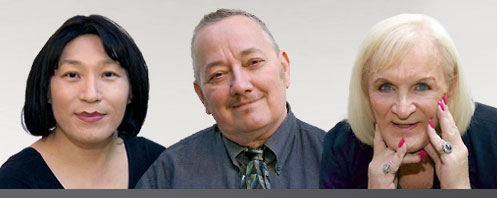 New York City – The Associate Press reports that a major anti-transgender violence forum slated for October 7 will address the rising incidence of attacks against transgender New Yorkers. Brooklyn Law School is hosting the forum,which will be attended by the family of Lateisha Green, transwoman of color, who was murdered in Syracuse last year. Her convicted killer, Dwight DeLee, was convicted of manslaughter in her shooting death three months ago. The conviction was the first under New York State’s hate crimes law, sending a message to perpetrators of violence against transgender people that transphobic attacks will no longer be tolerated in the Empire State. The Transgender Legal Defense and Education Fund, organizers of the Brooklyn forum, point out that transgender people face increasing degrees of “pervasive discrimination, harassment and violence.” Statistics gathered by transgender advocacy groups note that 12% of all violent attacks against LGBT people in 2008 were perpetrated against transgender people. As Joseph Erbentraut, Great Lakes Regional Editor for EDGE reported earlier this week, Lesbians, Gay Men, and Bisexuals are complicit in these crimes of violence because of prejudices they hold against gender non-conforming people. Activists agree that lesbians, gay men, and bisexuals are hardly immune from the prejudice vented against transpeople by the society. Each group too easily absolutizes the gender presentation they are familiar and comfortable with. Jokes and slurs aimed by LGB people against transgender people, calling them “trannies” or “drag queens” differ little from the epithets cast at them by straight haters. While actual instances of anti-trans violence by LGB people are rare, the bias is symptomatic of a tragic lack of awareness that all prejudice against members of the sexual minority is interconnected. The Lateisha Green case, however, is a source of hope in New York. While the conviction of DeLee was based on anti-gay epithets he used while murdering Green rather than transphobic ones, the severity of the first-degree manslaughter sentence woke the Empire State legal community up, and began a movement to add transphobic language to the hate crimes penal code as well as homophobic speech. The precedent-setting case sends a message that attacks against transgender New Yorkers will no longer be tolerated. Erbentraut reports that all sources he contacted agreed that the most effective way to blunt anti-transgender violence would be the swift passage of comprehensive hate crimes protections and employment security legislation at the federal level, such as the Matthew Shepard Act, now in the House-Senate conference process, and the recently introduced Employment Non-Discrimination Act.
Murder Most Foul: Transgender Holocaust in the United States
 Chicago, IL – The Great Lakes Regional Editor of EDGE reports that the slaughter of transgender persons in the United States has already gone 12 per cent higher than last year at this time, and the grim statistics are growing. Joseph Erbentraut, in his important essay, “Violence Against the Transgendered Only Getting Worse,” published on edgeonthenet.com, notes that the silence and invisibility common to LGBT hate crime murders is intensified for transgender Americans. As in the case of Paulina Ibarra, the lives of transgender victims are often ignored until a more culturally sensational aspect of the crime surfaces, as it did in the August stabbing death of the East Los Angeles Latina transwoman when a known parole jumper surfaced as a “person of interest” in the investigation. Until then, Ibarra’s brutal murder was largely neglected, even by the LGBT press, and her life has been reduced to a string of seamy innuendoes and a few glam photos. Other notorious instances this year have been the broad-daylight attack on Ty’lia “Nana Boo-Boo” Mack in D.C. last month, Lateisha Green, shot to death in Syracuse, NY last November, Angie Zapata, bludgeoned to death with a fire extinguisher in Greeley, CO last July, and Duanna Johnson and Ebony Whitaker who died on the streets of Memphis, TN last November and July, respectively. According to Erbentraut, the media are largely to blame for this stunning neglect of one of the most important human rights stories of 2009: “Underreporting from official statistics leaves the issue in the hands of media outlets, which have historically been known for problems identifying victims’ genders through using incorrect names and pronouns,” he writes. “The past year has also seen a number of examples of media programs condoning violence against the community,” Erbentraut continues, “including a radio news program on KRXQ Sacramento which referred to gender dysphoric children as ‘idiots’ and ‘freaks.’ Co-host Arnie States said he ‘[looked] forward to when [transgender children] go out into society and society beats them down…'” While 32 states have some form of hate crime legislation that increases the penalty for violence against LGB people, only 11 have statutes covering their transgender population. Only Brazil, with 80 transgender murders this year, has a larger number of transgender killings than the United States. Until gays, lesbians, and bisexual people and their allies begin to take violence against transgender people, especially transgender people of color, as seriously as they do crimes against themselves, this deplorable trend will surely continue.
About
If you are a first-time visitor to the Unfinished Lives Project website, we invite you to read A Welcome Message introducing you to our project. We are truly grateful for your visit.
The Unfinished Lives Project website is a place of public discourse which remembers and honors LGBTQ hate crime victims, while also revealing the reality of unseen violence perpetrated against people whose only “offense” is their sexual orientation, gender identity, or gender presentation. LGBTQ people in the United States are suffering a slow-rolling decimation of terror and murder all across the country. Every locale and demographic of society are affected: First Nations, Anglo, Black, Latino and Latina, South and Southeast Asian, Transgender, Bisexuals, Gay men, Lesbians, disabled, young, and mature. Homophobia has a long, crooked arm, and it is reaching out to snatch the life away from women and men whose tragic stories are under-reported to begin with, and whose memories are swiftly forgotten.
The horror of these killings transcends the shock and bereavement of loved ones and friends. These are not typical homicides; they are not killings for money or drugs, incidents of domestic strife, or crimes of passion. The vicious nature of hate crimes against LGBTQ persons is extremely brutal, grotesquely violent, and egregiously hateful.
Each murder serves the LGBTQ population as a sobering warning about the actual level of danger in our communities. The message these killings send is that freedom and open life for LGBTQ people is a cruel dream. Every time we remember one of these victims, however, the intentions of their killers are frustrated. To remember these women and men is to begin the process of changing the culture that killed them.
Our Project Director
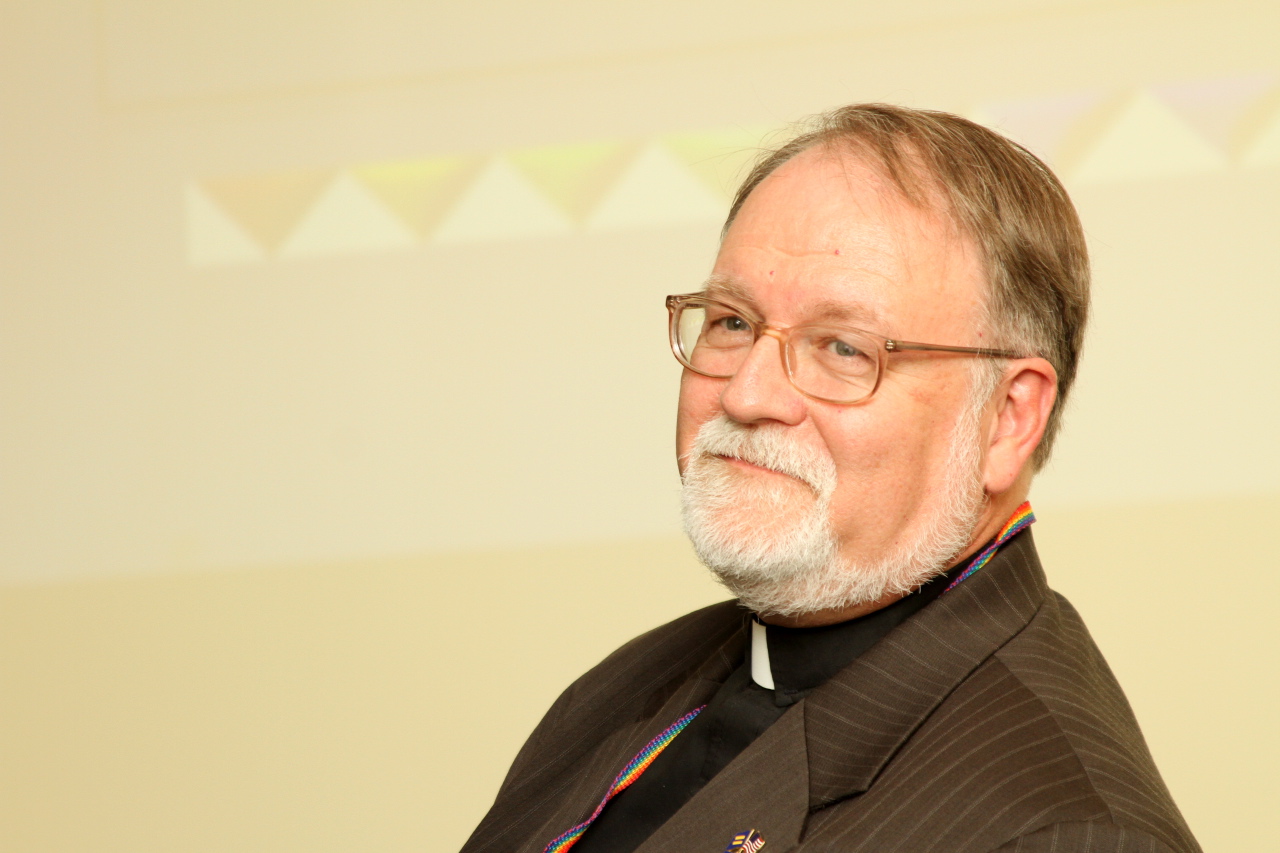
Dr. Stephen V. Sprinkle (Keith Tew photo).
Stephen V. Sprinkle is Director of Field Education and Supervised Ministry, and Professor of Practical Theology at Brite Divinity School, Fort Worth, Texas, a post he has held since 1994. An ordained Baptist minister, he is the first open and out Gay scholar in the history of the Divinity School, and the first open and out LGBTQ person to be tenured there. Read More…
Recent Social Justice Advocacy Activity By Dr. Sprinkle
 Summer 2009 – Dr. Sprinkle responded to the Fort Worth Police Department and Texas Alcoholic Beverage Commission Raid on the Rainbow Lounge, Fort Worth’s newest gay bar, on June 28, 2009, the exact 40th Anniversary of the Stonewall Rebellion. Dr. Sprinkle was invited to speak at three protest events sponsored by Queer LiberAction of Dallas. Here, he is keynoting the Rainbow Lounge Protest at the Tarrant County Courthouse on July 12, 2009. Read More…
Contact Us
Communicate with the Unfinished Lives project team:
info@unfinishedlivesblog.com


Schedule a Presentation
Dr. Sprinkle will gladly present his acclaimed presentation to your organization. To arrange an Unfinished Lives presentation for your organization or group, please contact us.
Dr. Sprinkle has given his Unfinished Lives presentation to these and other community groups and organizations. Read More…
-

Where are our readers?
Publisher: Steve Sprinkle (Project Director)
Steve Sprinkle
Unfinished Lives: Remembering LGBT Hate Crime VictimsBrite Divinity School/Texas Christian UniversityFort Worth TXprofessor, minister, author, blogger, LGBTQ advocate


Follow Unfinished Lives on Facebook
 Box Turtle Bulletin
- An error has occurred; the feed is probably down. Try again later.
- HRC Back Story
- Know About The Gender Identity Movement
- Why Is There A Need For Human Rights?
- Kinds Of Human Rights
- Human Rights Purposes And Violations
- Human Rights For Every Human Incident
- 8 Reasons Human Rights Are Important
- Everything About Human Rights
- Human Rights Issues Education & Law
- We Need To Stand Up For Our Rights And Those Of Others
- Coca-Cola Receives Perfect Score On Human Rights
- The Advocate: Daily News
- Ohio queer motorcycle gang responds to anti-LGBTQ+ laws by teaching how to fire guns
- Georgia court upholds firing of teacher who read LGBTQ+ book to class
- Tennessee Republican 'honorifics' bill is personal for the trans teacher at its center
- Senior Trump officials seem to have no idea what ICE agents are supposed to be doing at airports
- Advocate newsletter 3/24/26
- Meet the LGBTQ+ disabililty activist who climbed Mount Kilimanjaro
- Idaho Senate takes up bill to jail trans people for using public bathrooms
- Gay drag artist murdered in Virginia shooting
- Dallas destroys rainbow crosswalks under Texas mandate
- Senate confirms brawler Markwayne Mullin to lead Homeland Security Department after Kristi Noem
- Dallas Voice: Instant Tea
- An error has occurred; the feed is probably down. Try again later.

 Unfinished Lives
Protecting Wretches: Why Freedom of Speech Belongs to Fred Phelps, Too
Share this:
September 26, 2009 Posted by unfinishedlives | bi-phobia, Bisexual persons, gay men, harassment, Hate Crimes, Heterosexism and homophobia, Kansas, Law and Order, Lesbian women, Matthew Shepard Act, military, Monuments and markers, Perpetrators of Hate Crime, Politics, Popular Culture, Protests and Demonstrations, religious intolerance, Slurs and epithets, Social Justice Advocacy, Special Comments, transgender persons, transphobia | bisexuals, freedom of speech, gay men, harassment, Heterosexism and homophobia, Kansas, Law and Order, legal rulings, Lesbians, Maryland, Matthew Shepard Act, perpetrators, protests, religious hate speech, religious intolerance, Special Comment, transgender persons, transphobia | Comments Off on Protecting Wretches: Why Freedom of Speech Belongs to Fred Phelps, Too