“Unfinished Lives” Book Tour Rolls Through North Carolina

Stephen Sprinkle signs "Unfinished Lives" book at Barton College, Wilson, North Carolina (Keith Tew photograph)
Raleigh, North Carolina – The Unfinished Lives Book Tour is visiting cities, churches, and campuses throughout the Old North State, and buzz is growing on the book wherever it goes. Dr. Sprinkle commenced at the home of the Reverends Phil Jones and Cathy Cralle-Jones in Cary on April 9, where a packed house heard the story of how Unfinished Lives came to be. “I survived an anti-gay hate crime threat myself in 2000,” Dr. Sprinkle told the gathering of well-wishers for the book. “That near-brush with physical violence just because I was gay set me on the journey to learn as much as I could about other stories of hate crimes victims in the United States,” he said. Representatives of St. Paul’s Christian Church (Disciples of Christ), Hillyer Memorial Christian Church (Disciples of Christ), and Pullen Memorial Baptist Church in Raleigh, Covenant Christian Church (Disciples of Christ) in Cary, Hopewell United Methodist Church in Sampson County, and the Graduate School at North Carolina State University engaged Dr. Sprinkle in a lively Q & A on hate crimes in America. On Sunday, April 10, Dr. Sprinkle preached for the 9 and 11 a.m. services at St. Jude’s Metropolitan Community Church in Wilmington, an LGBTQ-predominant congregation founded after the brutal 1990 disembowelment slaying of lesbian carpenter, Talana Quay Kreeger, “Talana with the wild, blonde hair.” No church in the city would allow Kreeger’s funeral because of the negativity toward her homosexuality, though she was the innocent victim of a horrendous hate crime. Coastal Carolina queer folk vowed never to depend on a straight Christian congregation again to allow a funeral for one of their own. Local visionary activist, social worker Tab Ballis, introduced Dr. Lou Buttino, head of the UNC-Wilmington Film Studies Department, and announced that “The Park View Project” documenting the murder of Talana Kreeger, would be seen to completion by the eminent filmmaker. Reverend John A. McLaughlin, pastor of St. Jude’s, welcomed Dr. Sprinkle on behalf of the city of Wilmington. In the afternoon, representatives of St. Jude’s and First Christian Church (Disciples of Christ) in Wilmington, and Winterville Christian Church (Disciples of Christ) joined Dr. Sprinkle for a book signing at Two Sisters Bookery in the historic Cape Fear Riverfront Cotton Exchange. On Monday, April 11, Dr. Sprinkle spoke at the NC State University GLBT Center “Lunch and Learn” event, and signed copies of his book. Center Director Justine Hollingshead and Emeritus Professor Bill Swallow hosted Dr. Sprinkle at State, where members of the Wolfpack Football Team were in attendance for the talk. This was Dr. Sprinkle’s second appearance at the NC State GLBT Center. In the afternoon, Dr. Sprinkle and Rev. Phil Jones went to Wilson to deliver a lecture and sign books at Barton College. Dr. Sprinkle was hosted by Dr. Joe Jones, and greeted by members of the Religion and Philosophy, Sociology, Social Work, and English faculties of the college. He spoke on “Honor and Educate: How the Community of the Dead Shapes LGBTQ Community.” Students, faculty, and staff asked many probing and pertinent questions about the nature of anti-LGBTQ hate crimes and the linkage with religious intolerance. On Tuesday, April 12, Rev. Jones and Dr. Sprinkle traveled to Duke University Divinity School in Durham for a book signing sponsored by Cokesbury Bookstore. Dr. Stanley Hauerwas, renowned theological ethicist, called “America’s best theologian” by Time Magazine, attended, and got his copy of Unfinished Lives. “These stories need to be gotten out there,” Dr. Hauerwas said. He presented Dr. Sprinkle with a signed copy of his 2005 book, Cross-Shattered Christ: Meditations on the Seven Last Words. Later in the afternoon, the tour went to the LGBTQ Center on the campus of the University of North Carolina at Chapel Hill, where Dr. Sprinkle and Rev. Jones were greeted by Terry Phoenix, Center Director. A topic of discussion was the April 4 torture attack on gay UNC student Quinn Matney, who claimed he was branded by a super-hot metal instrument while being held down by his assailant. “Here is a taste of hell for you, you fucking faggot!”, the UNC student said his attacker shouted while torturing him, as reported to the Daily Tarheel. Before departing Chapel Hill, Dr. Sprinkle introduced his book to Dr. Rick Edens and Dr. Jill Edens, co-pastors at the 800-member United Church, a congregation of the United Church of Christ. Dr. Sprinkle plans to contact RDU leaders on behalf of the Human Rights Campaign’s Religion and Faith Program on Wednesday, before returning to Brite Divinity School in Fort Worth. The book tour is making friends and news everywhere it goes. A four-session series on the book is planned for Houston during Pride Month, in June, and a six city national tour in the Fall. Stay tuned for more on Unfinished Lives!
Unfinished Lives on OutCast Austin
 Our Project Director Stephen V. Sprinkle was on last night’s OutCast Radio talk show on the book, Unfinished Lives: Reviving the Memories of LGBTQ Hate Crimes Victims.
Click on this link to listen to Sprinkle’s interview on Outcast Austin. Steve say’s that he had a wonderful time being on the program. (The Interview starts about 6:00 minutes in).
NC Gay Couple Harassed for a Year, Then Burned Out of Home
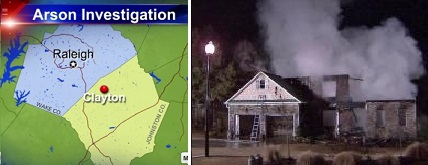
WRAL photo and graphic
Clayton, NC – A gay couple anonymously hiding in a motel out of fear for their safety, were burned out of house and home on Friday. Neighbors say the gay men suffered at least three deliberate acts of anti-gay harassment for over a year – but the neighbors are too scared to identify themselves, either. So Johnston County law enforcement, working from a state arson statute that doesn’t allow for violence against gay men as a hate crime, have determined that the burnout was “just arson.” Like 9/11 was “just some plane crashes.” Or like the murder of Ugandan gay activist David Kato was “just a robbery gone bad.” North Carolina has not seen fit to include sexual orientation, gender identity, or gender expression as protected classes in its existing hate crimes laws. So, an act of blatant hate crime terror that holds a gay couple and their whole neighborhood in fear is playing with matches. That is all this deed will remain officially unless the U.S. Justice Department invokes the Matthew Shepard Act to rectify neglectful conduct by the Johnston County Sheriff’s Department. WRAL.com interviewed a frightened, anonymous neighbor, who is sure that the three incidents of harassment were related to anti-gay hatred: “A note with derogatory language was left in the mailbox, an anti-gay slur was written on the house with marker, and the tires of a car parked in the garage were slashed.” The gay men’s friend and neighbor continued, “I felt sick to my stomach. I felt so sorry for the two gentlemen. They lost everything. We do believe that this is a hate crime.” The couple was out of town when other residents in the Winston Pointe subdivision discovered the fire belching from the brick veneer home at 1:30 a.m. Friday and called the alarm in. Flames quickly engulfed the structure, gutting it and destroying all the couple’s possessions. The American Red Cross has stepped in to offer food, clothing, and insurance contacts to the victims. Johnston County Sheriff Steve Bizzell says that the investigation has turned up no suspects yet. Bizzell acknowledged that he knew of two out of the three incidents of harassment against the gay men this past year, but he would not say which two.
Landmark Transgender Study Reveals Staggering Degree of Discrimination
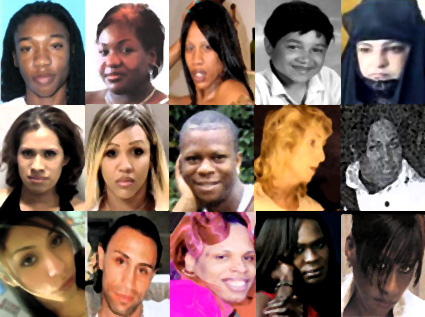
Collage courtesy of Transgender Day of Remembrance
Washington, DC – You will change the way you perceive transgender people, and rethink how you advocate for our sisters and brothers after you read the findings of the largest national study of transpeople and gender non-conforming people ever done. The National Center for Transgender Equality and the National Gay and Lesbian Taskforce released “Injustice at Ever Turn” on February 4, a massive study of 6,450 respondents. Sixty-three percent (63 %) of all respondents reported a serious act of discrimination because of their gender identity or gender presentation and expression. Twenty-three percent (23%) experienced a “catastrophic level of discrimination” according to the report, meaning they had faced significant acts of bias and harm in at least three of these categories:
- Sexual assault due to bias
- Physical assault due to bias
- Job loss due to bias
- Eviction from residence due to bias
- School bullying/harassment severe enough to cause dropout
- Homelessness because of gender identity/expression
- Denial of medical care/service due to bias
- Incarceration due to gender identity/expression
- Loss of relationship with partner or child due to gender identity/expression
Among the findings: forty-one percent (41%) of respondents reported attempting suicide, compared to a mere 1.6% of the general population; one in five experienced homelessness due to their gender expression/identity; transpeople are four times more likely to live in extreme poverty (income of $10,000 annually, or less) than Americans at large; and respondents were twice as likely to be unemployed than the general population. The combination of transgender discrimination and structural racial bias proved especially devastating in the lives of respondents. The study concludes, in part:
“It is part of social and legal convention in the United States to discriminate against, ridicule, and abuse transgender and gender non-conforming people within foundational institutions such as the family, schools, the workplace and health care settings, every day. Instead of recognizing that the moral failure lies in society’s unwillingness to embrace different gender identities and expressions, society blames transgender and gender non-conforming people for bringing the discrimination and violence on themselves.”
It is astounding that seventy-eight percent (78%) of those responding reported to the study that they feel more confident and comfortable at work, and more satisfied with their job performance after transitioning than they felt before–despite the levels of discrimination they constantly face in the workplace. As a survey respondent testified: “My mother disowned me. I was fired from my job after 18 years of loyal employment. I was forced onto public assistance to survive. But still I have pressed forward, started a new career, and rebuilt my immediate family. You are defined not by falling, but how well you rise after falling. I’m a licensed practical nurse now and am studying to become an RN. I have walked these streets and been harassed nearly every day, but I will not change. I am back out there the next day with my head up.”
“Injustice at Every Turn” is a wake up call to the lesbian, gay, and bisexual community, who have an uneasy history with transgender people since the days of the Stonewall Rebellion in New York City in 1969. Transpeople were integral to the liberation movement that propelled queer folk toward freedom, yet gender non-conforming people, especially transpeople of color, remain among the most misunderstood and neglected segments of the LGBTQ community in the United States. The incidence of hate crimes perpetrated against the transgender population, witnessed to each year by the national Transgender Day of Remembrance, is finally being documented thanks to the passage of the Matthew Shepard Act law–and the statistics are daunting.
No one should suffer discrimination based on gender identity or expression in the United States. The passion for justice must respond to the findings of this groundbreaking study. For an executive summary of the “Injustice at Every Turn,” click here.
Gay Georgian Nearly Roasted Alive As He Slept
 Carrollton, Georgia – A 43-year-old, disabled gay man was targeted by arsonists as he slept in his bedroom. Christopher Staples, affectionately called “Brother” by acquaintances in this Appalachian foothills community, was lucky to escape with his life on Sunday, January 23, when his house was set ablaze in the predawn hours by charcoal fluid squirted into water pipe access holes in the home’s kitchen area. The victim called the Carroll County Sheriff’s Department to report that about 8:30 p.m. on Saturday, while he was watching television and finishing a cigarette, someone threw a heavy rock with a note attached threatening his life for being gay. Staples and his family sounded the alarm for the Sheriff’s Department again at 5:30 a.m. on Sunday, reporting that he had nearly burned alive, and that his small house was engulfed in flames. Staples, who has been open about his gay orientation for thirty years, told WSBTV 2 that the note read: “We know you’re gay. And God hates gays. You won’t be raping anybody in the county and God’s going to make sure that you burn in hell . . .My daddy will make sure you burn in hell.” Staples revealed further details on the note to the Georgia Voice. The note, he said, had algebra homework written on one side, and “On the other side in pencil, it called me an ‘AIDS infested faggot’ and ‘God hates gays’ and ‘God will make sure all gays burn in hell.” After Staples had gone to sleep, he was awakened by a repetitive “popping” noise which made him think someone was throwing rocks at the house again. When he pushed back the covers, his comforter was already melting, and the bed was wreathed in thick smoke. “The house was black. And all I could see was an orange glow behind my head,” Staples said in the WSB interview. Staples believes God “held his hand” led him to safety, according to the GA Voice. The Sheriff’s Department is heading the investigation, assisted by the FBI. Possible hate crimes angles are being considered, but the case for what most anywhere else would be automatically considered an anti-gay hate crime will prove difficult to make in Georgia, one of only five states that has no LGBTQ protections in its laws. The only way the crime could be prosecuted as a hate crime would be by invoking the federal Matthew Shepard Act, something unlikely in rural west Georgia. The Times-Georgian reports that a $10,000 reward has been offered for information leading to arrests and convictions in the Staples case from the Georgia Arson Control Program. Initially, a Christian hate group was reported to have carried out the hit on the Carrollton native, but as the investigation proceeds, the identification of the perpetrators becomes less clear. Some local church groups have actually reached out to assist Staples, but whether out of a sense of Christian solidarity with the gay man, or in order to counter anti-Christian publicity is a matter of interpretation. On the whole, according to Staples’s family, gay outreach from around the country has outstripped the response of local straight groups and individuals. Now, two weeks after the attack, Staples is trying to put his life back together, and cope with the idea that someone tried to kill him in his sleep. “I know it happened, you look out there at my place and you see that,” Staples told the Times-Georgian. “But the severity of it hasn’t hit me. The fact that someone threw a rock through my window, told me they were going to kill me and then tried to do it is what doesn’t seem possible. I hear that whoever did this could get life in prison and I think, no way. But then my friends are like ‘Dude, someone tried to burn you alive.’ I mean, I still can’t grasp the thought of that. Why? I just don’t understand.”
Conversion of a Cop: How Matt Shepard’s Murder Convinced a Policeman to Change

Sheriff Dave O'Malley (News 5 photo)
Cleveland, Ohio – In a startlingly frank address to police and federal agents, Sheriff Dave O’Malley challenged law enforcement officers to change their anti-gay attitudes towards hate crimes victims. O’Malley, who was Chief of Police of Laramie, Wyoming in October 1998 when University of Wyoming student Matthew Shepard was murdered, confessed he harbored serious homophobic feelings against LGBTQ people at one time, feelings that changed as a consequence of what he learned in the course of his investigation into the hate crime that took Shepard’s life. The Cleveland Plain Dealer reports that O’Malley admitted to telling gay jokes and having serious prejudice against queer folk before the infamous murder of the 21-year-old gay man by two local Laramie men. Speaking to a packed house of 250 law men and women, prosecuting attorneys, and federal agents in Cleveland on November 15, O’Malley said that back in 1998, “I was fully homophobic. Mean-spirited. ‘Faggot’ came out of my mouth as easily as ‘I love you’ to my children.” The gruesome nature of the attack on Matthew Shepard, solely because he was gay, by Aaron McKinney and Russell Henderson shocked the hard-bitten Wyoming lawman. Shepard suffered “injuries like I had never seen before,” O’Malley told the rapt audience at what has come to be known in Ohio as the annual “hate crimes conference,” sponsored by the Northern District of the U.S. Attorney’s Office and the local branch of the FBI. He also saw the anguish of Shepard’s parents, Dennis and Judy Shepard, as they had to face the worst thing that ever could happen to a child–the brutal killing of their son because of homophobia. Now, O’Malley says he thinks of the Shepards every time he hugs his own son, thankful for the life of his child, but sorrowing for the senseless loss they suffered. Matthew Shepard’s murder shocked the conscience of the nation in 1998, leading to the eventual passage of the Matthew Shepard and James Byrd Jr. Hate Crimes Prevention Act by the United States Congress in 2009. McKinney and Henderson were convicted of the murder, and are serving life sentences. Through the years, there have been various attempts to rewrite the story of Matthew Shepard’s murder, including an exposé by ABC News 20/20 that suggested “new evidence”–that young Shepard was killed inadvertently in a drug purchase gone sour, rather than as an anti-gay hate crime. O’Malley rejects the 20/20 thesis, and from first-hand investigative experience declares that the chief motive for the killing was prejudice against Shepard because he was gay. WEWS News 5, the local ABC affiliate, reports O’Malley urged law enforcement officers to set aside their prejudices against LGBTQ people, remembering that all people are fully human and have human rights. The chief way to combat hate crimes of all kinds is to change the hearts and minds of investigators and prosecutors, O’Malley told the crowd; and then the effort must be made to stop the purveyors of hate. “If somebody could cure the hate-teachers, you could make a dent” in the problem, said O’Malley. Now O’Malley is Sheriff of Albany County, where Laramie is the county seat. Federal hate crimes law has become one of his top concerns, he explained to the Cleveland Plain Dealer. “Why is this legislation important?” O’Malley asked. “Because there are places in our country where, if you’re queer, you deserve what you get. If you happen to be gay, we may not investigate as well. We may not prosecute. I’m hoping that stops.” Attendees say that because of O’Malley’s powerful, graphic speech, they will have to re-examine their attitudes toward minorities like LGBTQ people. Sheriff O’Malley changed from a homophobe to an advocate for human rights for all people. That would be the ultimate good outcome from the outrageous murder of a young gay man whose only offense was living as the person he truly was.
Halloween Hate Crime Attack in San Diego

Jacob Harshbarger, gay bashed in San Diego (Fernando Lopez photo)
San Diego, California – A gay man was brutally beaten behind his home on Halloween morning by a mixed gender gang who shouted anti-gay epithets as they punched, kicked, and body-slammed him. “Come over here and kick the fairy!” they shouted, among other slurs. San Diego Gay and Lesbian News (SDLN) reports that Jacob Harshbarger, a well-known 32-year-old San Diegan gay man, was walking his two dogs in the alley behind his home about 3 a.m., after the bars closed on Sunday, October 31. He noticed a group of three women and two men in the alley who seemed suspicious. Intent on finishing his dog-walking, Harshbarger did not respond when one of the suspects asked him a question. That night, Harsbarger had donned a tee-shirt with a catty, gay theme on it to wear out to the local bars for the Halloween parties. Upon returning to his home, he wore a hoodie over the tee-shirt that covered the slogan. The victim wondered if somehow during the exchange, one of the gang read his shirt, igniting the attack. One of the males shouted out that Harsbarger was a gay man, drawing the others into the assault. SDLN reports that the assailants fell upon Harsbarger, screaming that he was a “f*****g faggot.” A neighbor recalls hearing a loud “bang,” which was most likely the sound of Harsbarger’s body as he was slammed into the house during the gay bashing. The neighbor and her son investigated the commotion in the alley beside their house and found Harsbarger unconscious on the ground. Though brief, the assault was savage. Harsbarger was diagnosed with a concussion, and needed thirteen stitches to close his split lip, and was beaten so severely in the face that he sustained bruising behind his eyes. The victim remembers very little, once the attack commenced. He recalled for SDLN that one of the female gang members tried to get the chief attacker to stop when he kicked Harsbarger in the face, and that in the argument that broke out between the females and the males, one of the male attackers kicked one of the women in the stomach. The next thing the victim remembered was the journey to a local hospital in an ambulance. Harsbarger was treated and released to recover at home. LGBTQ activists in San Diego say that the North Park section of the city is supposed to be safe and friendly to LGBTQ, people. This attack is a wake-up call to the community, and a further indicator of the mounting violence against gay and lesbian people throughout the nation in the wake of the passage of the Matthew Shepard and James Byrd Jr. Hate Crimes Prevention Act into law last October. Local activist Fernando Lopez told reporters, “We think of San Diego and North Park as being progressive and safe. It’s devastating that someone would do this to Jacob, or any member of our community.” Police officers are not willing to label the attack a hate crime. A spokesperson for the San Diego Police Department speculated that Harsbarger was “in the wrong place at the wrong time,” likely a spurious opinion, since the North Park area is thought to be relatively free of problems for LGBTQ people. Investigators found that Harsbarger’s hoodie was zipped up when paramedics found him lying unconscious on the ground, so the attack was not sparked by the victim’s clothing, as he feared. One of the attackers left a cell phone at the scene, which may prove to be a critical element in locating the suspects. Since no one saw the bashing, investigators are left with the partial memories of a shaken and hurt victim of yet another crime of hate violence against the LGBTQ community in southern California.
Anti-LGBT Junk Suit Fails Against Shepard Hate Crimes Law
 Washington, D.C. – Human Rights Campaign Back Story reports that a suit brought against the Matthew Shepard and James Byrd, Jr. Hate Crimes Prevention Act failed in the U.S. District Court of Eastern Michigan. The suit, put forward by Michigan pastors and the American Family Association of Michigan, challenged the constitutionality of the Shepard Act in February of this year. Among its claims, the suit alleged that the Shepard Act forecloses on the free exercise of fundamental rights of those who “publicly oppose homosexual activism, the homosexual lifestyle, and the homosexual agenda.” Further, the law suit argues that the Shepard Act creates “thought crimes” and “is an effort to eradicate religious beliefs opposing the homosexual agenda.” The three Michigan pastors claimed that the law had chilled their rights under the First Amendment, the Tenth Amendment, the Equal Protection Clause, and the Commerce Clause. U.S. Attorney General Eric Holder called upon the court to dismiss the case, arguing that the Shepard Act does not violate the rights of Americans, and was passed to protect LGBTQ people in this country from physical violence, not thought or speech. The judge hearing the case agreed with Attorney General Holder, and dismissed the case as meritless on all counts on September 7.
About
If you are a first-time visitor to the Unfinished Lives Project website, we invite you to read A Welcome Message introducing you to our project. We are truly grateful for your visit.
The Unfinished Lives Project website is a place of public discourse which remembers and honors LGBTQ hate crime victims, while also revealing the reality of unseen violence perpetrated against people whose only “offense” is their sexual orientation, gender identity, or gender presentation. LGBTQ people in the United States are suffering a slow-rolling decimation of terror and murder all across the country. Every locale and demographic of society are affected: First Nations, Anglo, Black, Latino and Latina, South and Southeast Asian, Transgender, Bisexuals, Gay men, Lesbians, disabled, young, and mature. Homophobia has a long, crooked arm, and it is reaching out to snatch the life away from women and men whose tragic stories are under-reported to begin with, and whose memories are swiftly forgotten.
The horror of these killings transcends the shock and bereavement of loved ones and friends. These are not typical homicides; they are not killings for money or drugs, incidents of domestic strife, or crimes of passion. The vicious nature of hate crimes against LGBTQ persons is extremely brutal, grotesquely violent, and egregiously hateful.
Each murder serves the LGBTQ population as a sobering warning about the actual level of danger in our communities. The message these killings send is that freedom and open life for LGBTQ people is a cruel dream. Every time we remember one of these victims, however, the intentions of their killers are frustrated. To remember these women and men is to begin the process of changing the culture that killed them.
Our Project Director
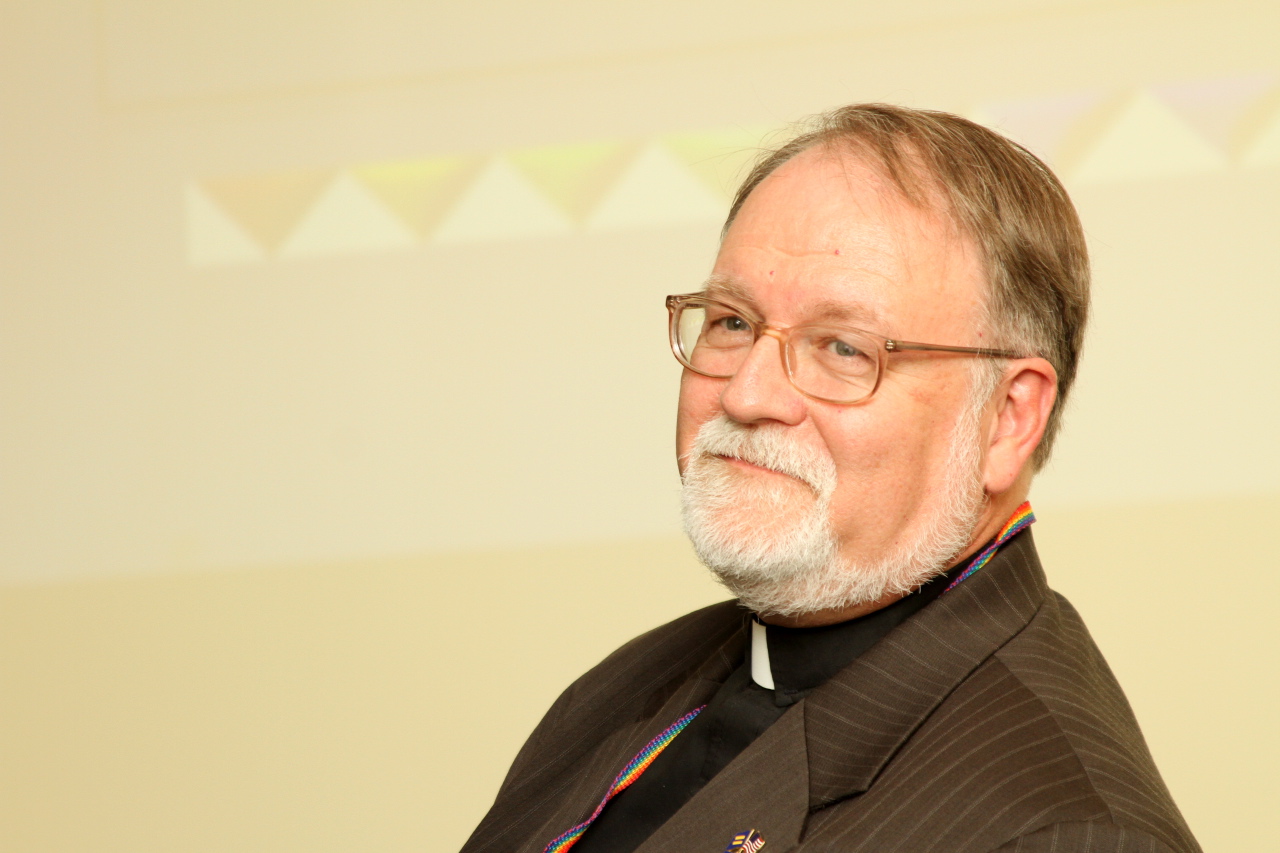
Dr. Stephen V. Sprinkle (Keith Tew photo).
Stephen V. Sprinkle is Director of Field Education and Supervised Ministry, and Professor of Practical Theology at Brite Divinity School, Fort Worth, Texas, a post he has held since 1994. An ordained Baptist minister, he is the first open and out Gay scholar in the history of the Divinity School, and the first open and out LGBTQ person to be tenured there. Read More…
Recent Social Justice Advocacy Activity By Dr. Sprinkle
 Summer 2009 – Dr. Sprinkle responded to the Fort Worth Police Department and Texas Alcoholic Beverage Commission Raid on the Rainbow Lounge, Fort Worth’s newest gay bar, on June 28, 2009, the exact 40th Anniversary of the Stonewall Rebellion. Dr. Sprinkle was invited to speak at three protest events sponsored by Queer LiberAction of Dallas. Here, he is keynoting the Rainbow Lounge Protest at the Tarrant County Courthouse on July 12, 2009. Read More…
Contact Us
Communicate with the Unfinished Lives project team:
info@unfinishedlivesblog.com


Schedule a Presentation
Dr. Sprinkle will gladly present his acclaimed presentation to your organization. To arrange an Unfinished Lives presentation for your organization or group, please contact us.
Dr. Sprinkle has given his Unfinished Lives presentation to these and other community groups and organizations. Read More…
-

Where are our readers?
Publisher: Steve Sprinkle (Project Director)
Steve Sprinkle
Unfinished Lives: Remembering LGBT Hate Crime VictimsBrite Divinity School/Texas Christian UniversityFort Worth TXprofessor, minister, author, blogger, LGBTQ advocate


Follow Unfinished Lives on Facebook
 Box Turtle Bulletin
- An error has occurred; the feed is probably down. Try again later.
- HRC Back Story
- Know About The Gender Identity Movement
- Why Is There A Need For Human Rights?
- Kinds Of Human Rights
- Human Rights Purposes And Violations
- Human Rights For Every Human Incident
- 8 Reasons Human Rights Are Important
- Everything About Human Rights
- Human Rights Issues Education & Law
- We Need To Stand Up For Our Rights And Those Of Others
- Coca-Cola Receives Perfect Score On Human Rights
- The Advocate: Daily News
- Iowa House Republicans pass a bill that will make the lives of transgender residents worse
- Why gay conversion therapy survivor Mathew Shurka says people like him are needed in Congress
- Kristi Noem is a cautionary tale for white gay Republicans
- Gay professional gamer detained by ICE fears deportation to Cameroon, where homosexuality is illegal
- Anti-DEI bill threatening Florida Pride events gains momentum in GOP legislature
- The incredible story of a gay interracial love affair in the midst of WWII
- Republicans rage after Trump appears to soften stance on trans care
- Christopher Wiggins wins GLAAD award for Advocate cover story on Sarah McBride
- Scouting America accuses LGBTQ+ travel agency Queer Scout of trademark infringement
- Breaking: Kristi Noem fired
- Dallas Voice: Instant Tea
- An error has occurred; the feed is probably down. Try again later.

 Unfinished Lives
Remembering Matthew Shepard on the 12th Anniversary of His Murder
~ Stephen V. Sprinkle, Director of the Unfinished Lives Project
Share this:
October 12, 2010 Posted by unfinishedlives | anti-LGBT hate crime murder, Bisexual persons, Bullying in schools, Colorado, gay men, gay teens, Gender Variant Youth, harassment, Hate Crimes, hate crimes prevention, Heterosexism and homophobia, Law and Order, Legislation, Lesbian women, LGBT teen suicide prevention, LGBTQ suicide, Matthew Shepard, Matthew Shepard Act, Matthew Shepard Foundation, Media Issues, Remembrances, Sakia Gunn Film Project, Social Justice Advocacy, Special Comments, transgender persons, transphobia, Wyoming | anti-LGBT hate crime murder, Bisexual persons, Bullying in schools, Colorado, gay men, gay teens, Gender Variant Youth, harassment, Hate Crimes, hate crimes legislation, Law and Order, Lesbians, LGBTQ suicide, LGBTQ suicide prevention, LGBTQ teen suicide, Matthew Shepard, Matthew Shepard Act, Matthew Shepard Foundation, Media Issues, Remembrances, Sakia Gunn Film Project, Social Justice Advocacy, transgender persons, transphobia, Wyoming | 1 Comment