Gay Literary Lion, Gore Vidal (1925-2012)

“How marvelous books are, crossing worlds and centuries, defeating ignorance and, finally, cruel time itself.” Gore Vidal, Julian
Los Angeles, California – Gay intellectual and literary giant, Gore Vidal, died Tuesday at his home in the Hollywood Hills. He succumbed to pneumonia after what his nephew, Burr Steers, called “a long illness.” Vidal was 86.
Charles McGrath of the New York Times writes in his obituary, “Mr. Vidal was, at the end of his life, an Augustan figure who believed himself to be the last of a breed, and he was probably right.” Eugene Gore Vidal, born at the U.S. Military Academy where his father was an assistant football coach and flying instructor, grew up in the patrician environs of New York City. He dropped his first name so he would not be confused with his father, Eugene Vidal Sr. His grandfather, Senator T.P. Gore of Oklahoma, tried to steer his grandson toward a life of politics. Instead, Vidal pursued a literary career, eventually churning out more than 25 books, numerous celebrated essays, a raft of plays for theater, and many successful and lucrative screenplays for Hollywood.
By turns moody, brooding, trenchant, and uncommonly brilliant, Vidal was a star in the remarkable constellation of gay writers who transformed American life and set their stamp on gay culture throughout the world. Vidal had a celebrated feud with Truman Capote, a rich friendship with Tennessee Williams, and wrote alongside James Baldwin, Allen Ginsberg, and Christopher Isherwood. His 1947 novel, The City and the Pillar, was the earliest fiction title in American literature to feature a fully gay character.
Vidal loved sex but rejected labels. It was clear that his preference was for men, whom he cruised with abandon. Yet, the only person he ever loved, to whom he dedicated The City and the Pillar, was Jimmie Trimble, a classmate of his at the exclusive St. Alban’s School, who died on Iwo Jima.
Vidal carried out a highly publicized antagonism with conservative maven, William F. Buckley Jr., who, in a fit of pique at being bested by Vidal’s razor tongue and superior wit, denounced him as a “queer” on national television. Vidal accused Buckley of libeling him (though at a later time he agreed that he was, indeed, gay), and the quarrel spilled over into print. Buckley wrote in the August 1969 Esquire Magazine, “On Experiencing Gore Vidal,” with the subtitle, “Can there be any justification in calling a man a queer before ten million people on television?” Vidal answered with a broadside of his own in the September edition, entitled “A Distasteful Encounter with William F. Buckley, Jr.,” with the subheading, “Can there be any justification in calling a man a pro crypto Nazi before ten million people on television?” The cover of the magazine flashed the title, “The Kids vs. The Pigs” and a photo of a collegiate boy face-to-face with a live pig, to reflect the confrontation of youth and police at the Chicago Democratic National Convention–the nub of the argument between Vidal and Buckley.
Twice Vidal ran unsuccessfully for public office as a Democrat in New York. But his real charism was writing, and through that medium he left an indelible stamp on the creation and definition of what it means to be gay in American life. For many years, he lived abroad in Ravello, Italy, returning as needed to the States. He once said, “In America, the race goes to the loud, the solemn, the hustler. If you think you are a great writer, you must say that you are.” Vidal followed his own advice. He was never able to remain quiet about his own genius. In large measure, he was right–both about himself and the American people.
Gore Vidal was an outlaw prince amidst a band of queer princelings who changed the fortunes of the countless LGBTQ people who followed them. From the era prior to World War II, when gayness was thought to be unspeakably dirty and verboten, to the 21st century when queer folk have become media darlings, Vidal and his associates wrote a whole new reality into existence–a more diverse and tolerant nation than the one into which they were born. We owe him and them for that. And we will not forget it.
“Why We Fight”: Fallen Gay Activist’s Fierce AIDS Speech Remembered on His Birthday
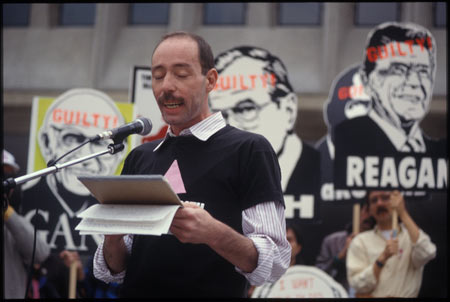
Vito Russo delivering his powerful AIDS activist speech, “Why We Fight,” as part of the ACT-UP protest against callous government neglect of the HIV/AIDS pandemic.
Vito Russo (1946-1990) would have been 66 today, had the AIDS pandemic not robbed us of him. As a gay activist and groundbreaking film historian, Russo is best remembered for authoring the 1981 book, The Celluloid Closet: Homosexuality in the Movies. But Russo’s impact on LGBTQ equality and American culture and politics reached farther. He was a participant in virtually every landmark gay and lesbian rights effort since the Stonewall Rebellion in the streets of New York City in 1969–where he was actually present, protesting in the crowd who fought back against police oppression in what has come to be known as the birth date of the gay rights movement. He became a leader in the Gay Activists Alliance in the aftermath of Stonewall, and a co-founder of the Gay and Lesbian Alliance Against Defamation (GLAAD) because of his concern about how gay people were portrayed by the media. In the 1980s, Russo became involved in ACT-UP (AIDS Coalition To Unleash Power) out of deepening frustration over federal and state governmental refusal to take the HIV/AIDS epidemic seriously. In 1990, he died of complications from the disease, but his legacy became secure after HBO aired a documentary film version of The Celluloid Closet narrated by comedy great, Lilly Tomlin. Russo’s family authorized a biography in 2011 published by the University of Wisconsin Press, Michael Shiavi’s Celluloid Activist: The Life and Times of Vito Russo. On July 23, HBO will premier a new documentary film, Vito.
On the anniversary of his birthday, July 11, we at the Unfinished Lives Project join Jeffrey Schwarz, the Producer/Director of Vito, to recall Russo’s powerful AIDS activism, and to remember the multitudes of women, men, and youth cut down so senselessly by a pandemic the U.S. government would not acknowledge until it began to affect the heterosexual population of this country. As Schwarz says in the Huffington Post: “During the AIDS epidemic Vito watched the world he loved crumble beneath his feet. By the time Vito received his AIDS diagnosis in 1985, the epidemic was well into its first decade, and thousands had already died. Vito had long been involved in empowering his community, so he found a way to channel his rage and grief into effective and history-making activism. ‘Why We Fight,’ Schwarz goes on to say, “was a fiery 1988 speech given before a tumultuous crowd of angry ACT UP demonstrators at the New York State Capitol in Albany.” The Queer Rhetoric Project records that the speech was delivered first in Albany as a part of the “9 Days of Protest” demonstration, and then later in Washington, D.C. at the Department of Health and Human Services.
“Why We Fight,” in its entirety, can be found here. Toward the climax of his fierce indictment of a medical and political regime in the U.S. marked by footdragging and homophobia, Russo said, almost prophetically:
“Someday, the AIDS crisis will be over. Remember that. And when that day comes, when that day has come and gone, there’ll be people alive on this Earth, gay people and straight people, men and women, black and white, who will hear the story that once there was a terrible disease in this country and all over the world, and that a brave group of people stood up and fought and, in some cases, gave their lives, so that other people might live and be free. So I’m proud to be with my friends today and the people I love, because I think you’re all heroes, and I’m glad to be part of this fight. But, to borrow a phrase from Michael Callen’s song, ‘all we have is love right now. What we don’t have is time.'”
The wrack and ruin of the AIDS pandemic is still with us, and the disease as dangerous as ever. The Unfinished Lives Team asks you to join us in honoring Vito Russo on the anniversary of his birth by advocating for increased research funding, effective education, and regular testing until this horrible disease is finally defeated. For now, like Russo, we must continue the struggle–remember the fallen–and do the work of hope. Happy Birthday, Vito!
Remembering Sakia Gunn (1987-2003): A Special Comment on Her Birthday

Sakia LaTona Gunn, murdered by a male homophobe as she defended her friends from him. She was not yet 16 when she died.
Newark, New Jersey – On Saturday, Sakia LaTona Gunn would have been 25 years old–but instead, she was murdered by a homophobe on the make for young lesbians. Sakia’s story never got the press attention other LGBTQ hate crimes murder victims did. She was a young, black, poor girl from the wrong side of the Hudson River. But among those who know her story, there is great power for change still waiting to be released until justice finally comes for Sakia–and for all queer youth caught in the national nightmare of violence against young people of color that just won’t seem to go away.
The narrative of her last night is chilling. Sakia and her friends returned from a great day at the Chelsea Piers over in the Big Apple. They laughed, joked, sneaked drinks, and held each other in a blissful freedom they did not know back home. Late, late–or early, depending on how you keep time–Sakia and her friends stood waiting for a bus to pick them up at one of the busiest bus stops in Newark, when two older, much more powerful men drove by cat-calling at them, trolling for something young and vulnerable. They recognized that the girls were Aggressives–gender non-conforming youth who lived the hip hop life as fully as they could. And something snapped within Richard McCullough when his blandishments were rejected by Sakia.
When McCullough, much larger and stronger than any of the girls he attacked, moved against her friends, Sakia defended them with her life. McCullough stabbed her in the chest with a switchblade knife, later lamely claiming that she had “run” onto the knife he somehow was wielding in self defense. Neither the jury nor the judge bought his story, and he was convicted of manslaughter in a plea bargain and sentenced to 20 years (rather than face a murder charge and be subject to far more prison time).
Sakia’s funeral was huge. Over 2,500 people attended the wake, though it was only slightly covered in the gay media, and virtually not at all in the mainstream press–a fact that has been controversial ever since her story broke. Racism and sexism played their part in dampening the story, as did Sakia’s self identification as a lesbian Aggressive, effectively rendering her a minority within a minority. A courageous filmmaker, Chas Bennet Brack, worked tirelessly to bring Sakia’s story to the big screen as a documentary. “Dreams Deferred: The Sakia Gunn Film Project” became an award winner at film festivals around the country. Sakia’s story became a subject of research, scholarship, and artistic interest, with plays, articles, and books dedicated to her memory. Among them is the IPPY Award winning Unfinished Lives: Reviving the Memories of LGBTQ Hate Crimes Victims (Resource Publications, 2011), by Stephen V. Sprinkle, the founder and director of the Unfinished Lives Project.
Against the odds, Sakia Gunn intended on being a basketball star. She found love and friendship in plenty during her woefully shortened life. But her story persistently clamors for attention, crying out for justice for youth of color, queer people, and economically disadvantaged persons of all races and backgrounds. Though she never wished it, she has become an ongoing inspiration–a brave young woman unafraid to be who she was in a hostile world, one who defended her friends. What greater love can anyone have than that?
Gay Martyr for Justice Harvey Milk Celebrated Throughout America
 San Francisco, California – Harvey Milk Day, May 22, celebrates the life and legacy of love of Harvey Bernard Milk, born May 22, 1930, and gunned down in his San Francisco City Hall office on November 27, 1978. He was the first openly gay person elected to a major political office in the United States when he won a seat on the San Francisco Board of Supervisors. His close associate, gay activist Cleve Jones, says of his friend Harvey, “He fought for gay people, against war and for workers and the poor. He stood with women, immigrants, seniors and youth. He forged coalitions that built power for ordinary men and women and moved us all forward with his humor, compassion and great love for his people.”
In today’s San Francisco Chronicle, Anne Kronenberg, another intimate friend of Harvey’s who managed his successful election campaign to the Board of Supervisors, reflects on Harvey’s legacy of human rights progress in the 33 years since he was assassinated. She writes, “In 1977” (the year of Harvey’s election), “we were taking baby steps in our fight for equal rights. In 2012, we have come a long way as the dialogue on equality is a top-of-mind issue and specific actions are reaching that goal. Harvey Milk’s life and death changed the course of history,” Kronenberg went on to say. “Milk’s legacy, to give people hope for a better tomorrow, is very much alive in the hearts of anyone working to achieve change. Thank you, Harvey!”
In 2010, the State of California officially set aside May 22, the anniversary of Harvey’s birth, to be an annual celebration of his memory, the story of the struggle for LGBTQ rights, and of the continuing effort to make this a better world. His work in education (successfully opposing the infamous Briggs Initiative, also known in California as Prop 6), and in youth empowerment is now being championed by the Harvey B. Milk Foundation, founded by Harvey’s nephew Stuart Milk and his friend Anne Kronenberg. To learn more about Harvey’s life, times, assassination and witness for justice, see the Academy Award winning films The Times of Harvey Milk (1984) and Milk (2009). In book form, the definitive work is still Randy Shilts’s The Mayor of Castro Street: The Life and Times of Harvey Milk (St. Martins Griffin, 2008).
The Unfinished Lives Project Team joins grateful Americans from every walk of life in the celebration of Harvey Milk, hate crimes murder victim, gay rights pioneer, and friend of all marginalized people. Though he died, yet he lives in our hearts and minds, and in the living shrine of liberty made up of the lived experiences of increasing millions of out and proud LGBTQ people. Happy Birthday, Harvey!
Hate Crimes Blog Marks Quarter-Million Milestone!

Celebrating 250,000 readers and more! Many thanks!
Dallas, Texas – A blog site created to change the conversation on anti-LGBTQ hate crimes hosted the 250K visitor today, marking a milestone in cyberspace. Unfinished Lives Blog broke the quarter million hit barrier Tuesday morning, January 10, fueled by intense interest in gay bashing stories from Wisconsin, California, and the Republic of the Philippines.
Created by Dr. Stephen Sprinkle, the author of Unfinished Lives: Reviving the Memories of LGBTQ Hate Crimes Victims (Resource Publications, 2011) as “a place of public discourse which remembers and honors LGBTQ hate crime victims, while also revealing the reality of unseen violence perpetrated against people whose only ‘offense’ is their sexual orientation, gender identity, or gender presentation,” the blog has to date posted 432 articles relating to overcoming violence against sexual and gender dissidents in 370 categories. Assisted by the Unfinished Lives Project Team, the blog ginned up in June 2008, and gradually gained a loyal readership, becoming a trusted source on hate-crimes-related issues affecting Lesbian, Gay, Bisexual, Transgender and Queer people.
Originally, the site appealed to colleagues at Brite Divinity School, students, and interested North Texans. Early on, however, the blog began to gain a national and international constituency. As of this date, the top ten U.S. states represented by hits are (in rank order) California, Texas, New York, Florida, North Carolina, Georgia, Pennsylvania, Illinois, Ohio, and New Jersey, with all 50 states, U.S. Territories and the District of Columbia represented. Internationally, readers from Canada, Great Britain, Germany, Australia, Brazil, France, the Netherlands, Mexico, Italy, and Spain lead the pack, with the Philippines, India, Indonesia and Taiwan leading Asian visitors, and South Africa, Egypt, Algeria, and Nigeria contributing the most readers from Africa. In all, Unfinishedlivesblog.com counts readers and followers from 174 foreign countries and territories.
One distinctive feature of Unfinished Lives Blog is its combination of reportage, ethnography, theological orientation, and academic origins. Few academically-originated blogs reach the number of people this one consistently does.
The month of January will be a time of appreciation and celebration in the life of this blog. Highlighted for thanks and recognition are four groups: the Endorsers of this blog and the Unfinished Lives book, the growing number of Followers (now more than 470 official Followers!), the Unfinished Lives Project Team support staff, and, of course, the 250K readers without whom this effort would be a lone voice in the dark.
This effort has no paid staff, no advertising to defray expenses, and no full-time personnel. Instead, this blog has been and remains a labor of love and remembrance. No end to the violence perpetrated against LGBTQ people is yet in sight. We cannot, will not forget the women, men, and youths cut down by irrational hatred because of their real or perceived sexual orientation, gender identity, and gender presentation. Their families, friends, and lovers are dear to us. Their attackers and murderers are in our prayers. The work of this blog is in no wise done–there is so much more remaining to do until hate violence is erased. So, we who believe in Justice cannot rest–we who believe in Justice cannot rest until it comes!
Thank you for your continuing readership, commentary, and support!
Gay Couple That Changed the World: John Lawrence and Tyrone Garner Remembered

Tyrone Garner (l) and John Lawrence celebrate Lawrence v. Texas.
Houston, Texas – Lawrence v. Texas, set in motion by a couple of accidental gay activists, broke the back of anti-sodomy laws in the United States. What they did amounts to the “Brown v. Board of Education for gay and lesbian America,” according to Harvard constitutional law expert, Laurence Tribe. Yet when John Geddes Lawrence, aged 68, died on November 20 of heart disease at his home in Houston, no mention of the landmark Supreme Court decision was made in the obituary or at his funeral. Tyrone Garner, the other half of this remarkable couple, had preceded Lawrence in death back in 2006. Only when a lawyer in the case, Mitchell Katine, called Lawrence to invite him to a ceremony commemorating the law-changing decision, did he receive word of Lawrence’s passing from his life-partner, according to the New York Times. Katine let the rest of the world know that an inadvertent giant in the struggle of LGBTQ equality had died.
Lawrence and Garner were arrested on September 17, 1998 for sodomy in a private home by Houston Police. The police had been called in to investigate a false weapons report by a jealous former lover of Lawrence’s, who admitted he had falsified the report as an act of revenge. Nonetheless, the arrest went down, and Lawrence and Garner, who had hooked up earlier that day, were thrust by events upon the stage of history. Lawrence was angry at the arrest, feeling that his privacy had been violated unjustly. That anger was a fire in his belly that saw the case through lower courts to the U.S. Supreme Court for its decisive ruling of June 2003, striking down anti-sodomy laws in fourteen states. Writing for five of the six Justices on the prevailing side, Justice Anthony Kennedy declared, “The petitioners are entitled to respect for their private lives. The state,” he continued, “cannot demean their existence or control their destiny by making their private sexual conduct a crime.” A compilation of documents and the text of Lawrence v. Texas, provided by Justia.com, the U.S. Supreme Court Center, may be accessed here.
We cannot overestimate the significance of John Lawrence and Tyrone Garner’s decision to fight back against an unjust law. So much hung in the balance. They were not professional activists, the rainbow-flag-waving kind. They were simply two gay men, attracted to each other, whose right to privacy was trampled by a legal system that upheld a heterosexist status quo. One black, one white, this gay couple set the wheels in motion for every forward step in human rights since 2003: the passage of the Matthew Shepard and James Byrd Jr. Hate Crimes Prevention Act in 2009, the repeal of Don’t Ask, Don’t Tell in 2010, and its full implementation by the Joint Chiefs of Staff, the Secretary of Defense, and President Barack Obama in 2011, and the whole raft of same-sex marriage laws passed on the state level around the nation.
Professor Dale Carpenter, who wrote a recent book on Lawrence v. Texas, interviewed John Lawrence. In conversation, this unassuming naval veteran and obstinate gay man asked Carpenter, “Why should there be a law passed that only prosecutes certain people? Why build a law that only says, ‘Because you’re a gay man you can’t do this. But because you’re a heterosexual, you can do the same thing’?” Tyrone Garner told the Houston Chronicle in 2004 that he took quiet pride in the role he played in history. “I don’t really want to be a hero,” Garner said. “But I want to tell other gay people, ‘Be who you are, and don’t be afraid.’ ”
Sometimes a couple of men get mad, and dig in, and the world changes. That is what the LGBTQ community owes John Lawrence and Tyrone Garner. Because of their courage, the United States justice system has changed forever.
Remembering Our Dead During the Holidays

Lawrence Fobes "Larry" King, one of our ancestors who received a measure of justice in 2011.
2011 was a year to remember. The stories of the LGBTQ sisters and brothers who have died among us are windows through which we can see into our own souls. Our ancestors are our teachers, if we will let them be. At some point, I cannot pinpoint exactly when, I made the choice to still my powerful emotions around the murders of LGBTQ people, and let their stories teach me what it means to be alive. That choice is one of the most important I have every made, and one of the most fruitful. The book, Unfinished Lives: Reviving the Memories of LGBTQ Hate Crimes Victims, was truly born in that moment. Though I never met a one of the persons whose stories I tell in my book, they are very close to me–not in a morbid sense, at all. I believe I can understand why so many gay folk would rather not remember how quickly our lives can be snuffed out. But a truly community-shaping insight the dead have given me is that only the choice not to remember is morbid. Re-telling the stories of those who have died among us because of who they were, gay men, lesbians, bisexual and transgender people, gives our community a new sense of how precious each life is, and a new resolve to be a justice-oriented people who treasure every moment we are given.
2011 is full of such memories for the LGBTQ community. So many have faced terrible persecution, just to love whom they choose, just to live as they were created to live. We remember the young–so many of them–who found life too much to bear in a homophobic, bullying world. We remember the transgender sisters, especially, who faced injustice everywhere they turned, and for whom living daily is an act of uncommon courage. We remember the families, the lovers, the neighbors, the friends–and the killers, too. Change comes at a glacial pace…so slowly. But it comes.
Our dead have only died in vain if we refuse to remember and honor them. Like the Mexican people know who treasure their dead on the Dia de los Muertos, the Day of the Dead, death is a stark reality however it comes. But our friends south of the border also know how to tease death, argue with it, make fun of it, create works of art, song and dance out of it, and how to transcend the fear of death by gathering together to remember and cherish those who have died. The LGBTQ community is learning how to do that, as well. In Houston, Texas, right off of the Montrose, a memorial to LGBTQ people who have died has been created and dedicated this very year. Everywhere I have gone this year to talk with people, more and more are finding the healing empowerment of remembrance. Around the memories of our dead, extraordinary communities of strength, advocacy, and love have arisen. These are all such good things, and they all have come about as gifts from our ancestors who have died among us.
We cannot, will not forget our fallen ancestors. In their memories lies the key to becoming a true people of maturity, gratitude, justice, and hope. That is the true fruit of remembrance for the LGBTQ community. So, we who believe in justice cannot rest. We honor and educate. We recall, re-tell, and remember. We push for justice, and then we push some more. Our ancestors expect us to do no less. And we, in their memories, can do no less.
Happy Holidays, however you celebrate them in your homes, from the Unfinished Lives Project Team. We give thanks for each of you! ~ Dr. Stephen Sprinkle, Founder and Director of the Unfinished Lives Project
Waymaking Gay Rights Pioneer, Frank Kameny, is Dead at 86.
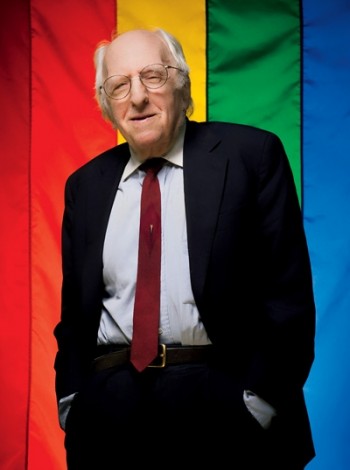 Washington, D.C. – Frank Kameny, pioneering gay rights advocate, is dead of natural causes at 86 years of age. The Dallas Voice and the Washington Blade reported the details of Kameny’s passing, and began the assessment of his leadership to the LGBTQ rights movement in the United States. A full decade before the Stonewall Uprising of 1969, Kameny was strategically planning and leading the nascent gay rights movement, along with a handful of other brave women and men. He co-founded the Washington, D.C. chapter of the Mattachine Society, the first gay rights organization in the nation’s capitol.
Kameny was a combat soldier in World War II, and used the G.I. Bill to earn a doctorate in astronomy from Harvard University after the war. He worked for the U.S. Army Map Service in the 1950s until his superiors learned he was gay, and fired him for it. Kameny contested the firing, taking his case all the way to the U.S. Supreme Court–making him the first person to bring a gay-related issue to the high court. The Supremes held in favor of the lower court, setting aside Kameny’s suit, but his experience before the court confirmed him as a lifelong gay rights activist. He launched the first gay rights demonstrations at the White House in 1965, and was the first gay person named to the D.C. Human Rights Commission.
Joe Solmonese, head of the Human Rights Campaign, said of him, “From his early days fighting institutionalized discrimination in the federal workforce, Dr. Kameny taught us all that ‘Gay is Good.’ As we say goodbye to this trailblazer on National Coming Out Day, we remember the remarkable power we all have to change the world by living our lives like Frank — openly, honestly and authentically.”
In later years, Kameny fell on hard times, running short of money for food and housing. Friends and activists spearheaded an effort to raise funds to make his later years more secure and worry-free. As the movement for LGBTQ rights evolved, Kameny became something of an artifact–honored for his role in the past, but paid less attention than he deserved, in the opinion of many. Recognition, however, came to him beyond any of the neglectfulness he suffered. A younger generation of activists discovered him, and celebrated him. Official notoriety came to him, as well. As the Washington Blade reported in another article detailing the response of the LGBTQ community to his passing: “In 2007, the Smithsonian Institution’s National Museum of American History included his picket signs from the White House demonstration. Papers documenting his life were added to the Library of Congress in 2006. In 2009, Kameny received the Theodore Roosevelt Award.”
I met Kameny at a 2009 wreath laying for Sgt. Leonard Matlovich at the Old Congressional Cemetery in Washington City. He spoke to the hundred or so in attendance on a beautiful October day, just prior to the National Equality March. He beamed with pride, recounting his days as a soldier in the U.S. Army, as an astronomer, and then as a fighter for our rights. Sitting with Rev. Troy Perry, the Founder of the MCC Church, Kameny was no museum piece. He was strong and determined to win 21st century freedoms for his people. In death, his influence and inspiration have every prospect of increasing with the passage of time.
So, Frank Kameny, student of the stars, passed quietly from this life at his home. Before him, there was no way. Thanks to him and his colleagues in the equality movement, a way was made out of no way. Rest in peace, Frank. We will not forget you. ~ Stephen V. Sprinkle, Founder and Director of the Unfinished Lives Project
Matthew Wayne Shepard: Honor and Educate in His Memory
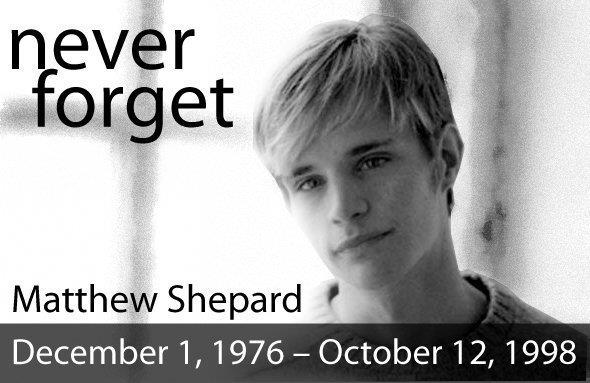
Thank you to the Sacramento Gay and Lesbian Center. Never forget!
Laramie, Wyoming – Wednesday, October 12 will be the thirteenth anniversary of America’s archetypal gay hate crimes victim. Matthew Shepard was brutally attacked and beaten into a coma by two locals who targeted him for abduction, robbery, and murder at the Fireside Lounge on the night of October 7, 1998. They left him trussed to the base of a buck fence, exposed to the freezing cold after stealing his shoes. When Matt was discovered the next day by a passing mountain biker, he was so brutally disfigured that his discoverer at first assumed what he was looking at was a broken down scarecrow that had been put out for Hallowe’en. Matt’s injuries were too severe to be treated at the local hospital emergency room, so he was transported to Fort Collins in neighboring Colorado where a state of the art trauma center fought to save his life. For five agonizing days, Matt lay close to death with an injured brain stem–a terrible wound from which he could never recover. His family, mother Judy, father Dennis, and younger brother Logan stood vigil beside him while the life force ebbed.
For thirteen years, Matt’s memory has been honored, invoked, and ridiculed by a nation wrestling with heterosexism, homophobia, and transphobia–a culture of anti-LGBTQ violence that has claimed the lives of over 13,000 queer folk whom we know about (and God knows how many others whose murders have never been reported to anyone keeping records). Nothing will ever bring any of them back to us. They are gone, but to memory.
Those of us who labor for the better angels of our national character to emerge have a responsibility to remember Matt and all the rest, to honor them by never forgetting the cost of being sexually different in these United States, and to take up the mission of educating the LGBTQ community and the general public that difference of any kind is no warrant for ignorance,prejudice, and violence, but rather is an occasion for understanding and neighborly solidarity. The anniversary of Matt’s untimely death is a good time to erase hatred from the American psyche.
In that spirit, I offer this short excerpt from “The Second Death of Matthew Shepard,” Chapter One of my recently published book, Unfinished Lives: Reviving the Memories of LGBTQ Hate Crimes Victims:
“Matt Shepard died in a Fort Collins, Colorado hospital in the wee hours of October 12, 1998 with his parents by his side. Ironically, it was the day after America’s observance of National Coming Out Day. His team of doctors and nurses, professional as they were, could not undo what hate had done to Matt. He never woke up from his coma. His heart gave out. The ventilator switched off, and Matt was gone. Our memory of him,however, cannot rest in peace. Not yet” (page 3).
Our memory of all the dead whose “unfinished lives” calls out to us to do the work of justice. May Matt and the 13,000 rest in peace. God being our strength, we must not. Grace and peace to all on this National Coming Out Day 2011. ~ Stephen V. Sprinkle
About
If you are a first-time visitor to the Unfinished Lives Project website, we invite you to read A Welcome Message introducing you to our project. We are truly grateful for your visit.
The Unfinished Lives Project website is a place of public discourse which remembers and honors LGBTQ hate crime victims, while also revealing the reality of unseen violence perpetrated against people whose only “offense” is their sexual orientation, gender identity, or gender presentation. LGBTQ people in the United States are suffering a slow-rolling decimation of terror and murder all across the country. Every locale and demographic of society are affected: First Nations, Anglo, Black, Latino and Latina, South and Southeast Asian, Transgender, Bisexuals, Gay men, Lesbians, disabled, young, and mature. Homophobia has a long, crooked arm, and it is reaching out to snatch the life away from women and men whose tragic stories are under-reported to begin with, and whose memories are swiftly forgotten.
The horror of these killings transcends the shock and bereavement of loved ones and friends. These are not typical homicides; they are not killings for money or drugs, incidents of domestic strife, or crimes of passion. The vicious nature of hate crimes against LGBTQ persons is extremely brutal, grotesquely violent, and egregiously hateful.
Each murder serves the LGBTQ population as a sobering warning about the actual level of danger in our communities. The message these killings send is that freedom and open life for LGBTQ people is a cruel dream. Every time we remember one of these victims, however, the intentions of their killers are frustrated. To remember these women and men is to begin the process of changing the culture that killed them.
Our Project Director
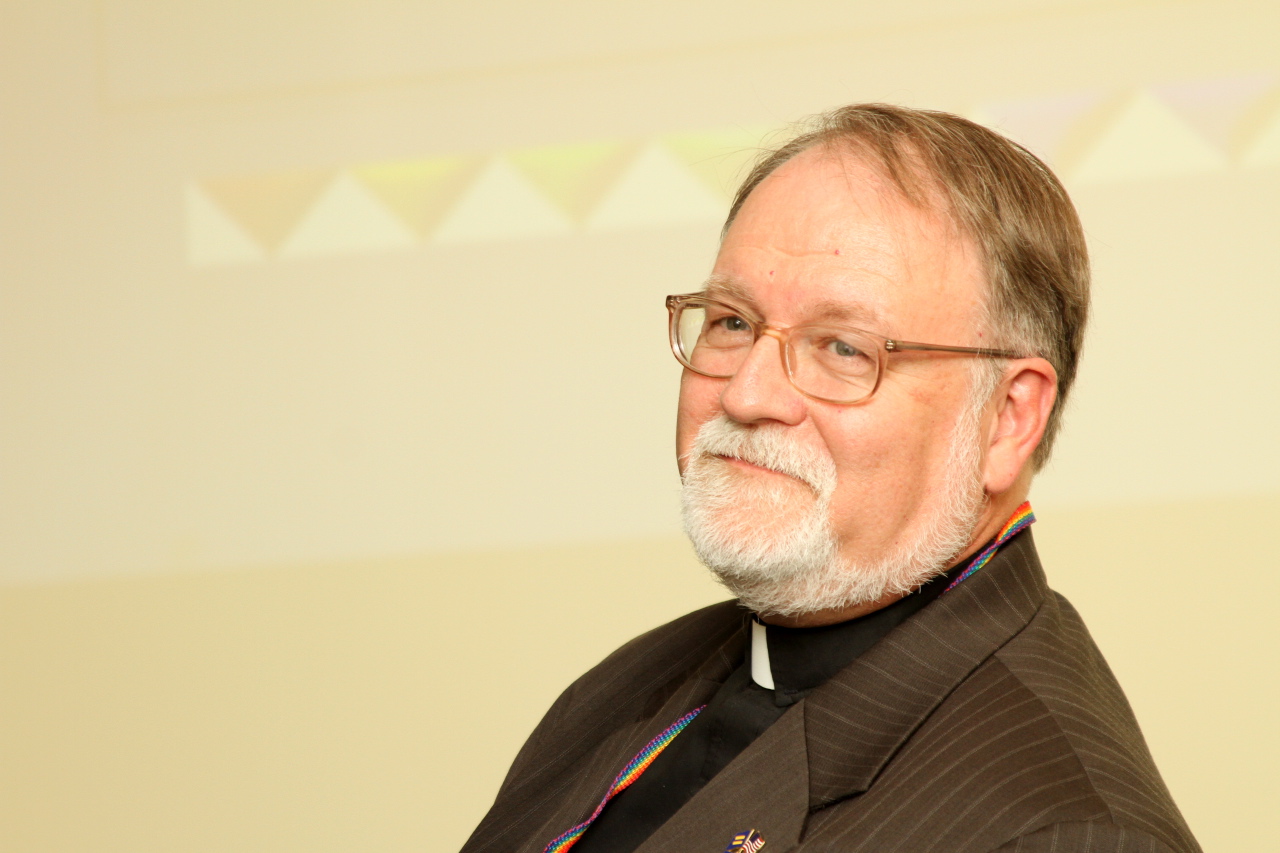
Dr. Stephen V. Sprinkle (Keith Tew photo).
Stephen V. Sprinkle is Director of Field Education and Supervised Ministry, and Professor of Practical Theology at Brite Divinity School, Fort Worth, Texas, a post he has held since 1994. An ordained Baptist minister, he is the first open and out Gay scholar in the history of the Divinity School, and the first open and out LGBTQ person to be tenured there. Read More…
Recent Social Justice Advocacy Activity By Dr. Sprinkle
 Summer 2009 – Dr. Sprinkle responded to the Fort Worth Police Department and Texas Alcoholic Beverage Commission Raid on the Rainbow Lounge, Fort Worth’s newest gay bar, on June 28, 2009, the exact 40th Anniversary of the Stonewall Rebellion. Dr. Sprinkle was invited to speak at three protest events sponsored by Queer LiberAction of Dallas. Here, he is keynoting the Rainbow Lounge Protest at the Tarrant County Courthouse on July 12, 2009. Read More…
Contact Us
Communicate with the Unfinished Lives project team:
info@unfinishedlivesblog.com


Schedule a Presentation
Dr. Sprinkle will gladly present his acclaimed presentation to your organization. To arrange an Unfinished Lives presentation for your organization or group, please contact us.
Dr. Sprinkle has given his Unfinished Lives presentation to these and other community groups and organizations. Read More…
-

Where are our readers?
Publisher: Steve Sprinkle (Project Director)
Steve Sprinkle
Unfinished Lives: Remembering LGBT Hate Crime VictimsBrite Divinity School/Texas Christian UniversityFort Worth TXprofessor, minister, author, blogger, LGBTQ advocate


Follow Unfinished Lives on Facebook
 Box Turtle Bulletin
- An error has occurred; the feed is probably down. Try again later.
- HRC Back Story
- Know About The Gender Identity Movement
- Why Is There A Need For Human Rights?
- Kinds Of Human Rights
- Human Rights Purposes And Violations
- Human Rights For Every Human Incident
- 8 Reasons Human Rights Are Important
- Everything About Human Rights
- Human Rights Issues Education & Law
- We Need To Stand Up For Our Rights And Those Of Others
- Coca-Cola Receives Perfect Score On Human Rights
- The Advocate: Daily News
- Journalist detained for booing Trump at Kennedy Center 'Chicago' performance
- Donald Trump telegraphs war crimes in profanity-filled Easter Sunday Iran threat
- NYC’s most powerful transgender official is fighting intensifying anti-LGBTQ+ federal pressure
- Maryland lawmakers advance broad school protections, including for trans students
- Fired for refusing to remove LGBTQ+ books, Tennessee librarian says she’d do it again
- Lawyers alarmed by immigration judge's 'atrocious' questions for gay asylum seekers
- What is the trans gaze? It's relief and recognition between strangers on a train
- Same-sex couples thrive in U.S. even as GOP support for marriage equality falls
- Did the FBI just post this propaganda video to save Kash Patel’s job?
- Over her short tenure as Trump’s attorney general, Pam Bondi terrorized LGBTQ+ Americans
- Dallas Voice: Instant Tea
- An error has occurred; the feed is probably down. Try again later.

 Unfinished Lives
Gay Hate Crimes Victim Ryan Keith Skipper Lives On: A Special Comment
Ryan Keith Skipper (April 28, 1981 - March 14, 2007)
Wahneta, Florida – Today would have been Ryan Keith Skipper’s 31st birthday, had he not died at the hands of two reckless, homophobic men in Central Florida five years ago. But Ryan lives on in the hearts and minds of his family, his friends, and countless supporters of human rights who commemorate his life and the lives of other hate crimes murder victims around the nation.
Ryan’s murderers are both sentenced to life in prison for their crimes. William David “Bill-Bill” Brown Jr. and Joseph “Smiley” Bearden killed Ryan on the night of March 14, 2007 in cold blood, stole his car, and vainly attempted to fence it before desperately trying to burn it up in order to destroy evidence of the murder. The Sheriff of Polk County, Grady Judd, capitalized on Ryan’s murder politically, and crassly blamed Ryan for his own death. Sheriff Judd, as of this writing, still holds office, though every one of his innuendoes and allegations concerning Ryan have been categorically disproved.
In the five years since Ryan’s untimely death, his parents, Pat and Lynn Mulder, his brother Damien, and his host of friends have gotten on with their lives, dealing with their grief the best they can. His family has become one of the foremost voices for justice for hate crimes victims in the nation. A major documentary film, “Accessory to Murder: Our Culture’s Complicity in the Death of Ryan Skipper,” directed by Vicki Nantz, a former news director for Orlando’s WESH-TV, continues to open hearts and minds to the cause of human equality throughout Florida and beyond. Damien, Ryan’s older brother, has married and moved away from Florida. He and his wife welcomed a beautiful baby girl, Ryan, into the world this past year, so in an act of life in defiance of death, another Ryan Skipper lives and thrives in her uncle’s memory.
The Unfinished Lives Project was inspired by the life story of Ryan Skipper: his extraordinary capacity for love and friendship, his ability to make people feel appreciated and important, and his unconquerable spirit of life. His story occupies a chapter in the recent book, Unfinished Lives: Reviving the Memories of LGBTQ Hate Crimes Victims (Resource Publications, 2011), entitled “Keeper of Hearts.”
Every time Ryan is remembered and his story is retold, the intentions of his killers and their accomplices in today’s culture and politics are thwarted. Ryan is precious in our memory on his birthday. Our fight for equality and justice continues because Ryan lives on in our hearts.
Share this:
April 28, 2012 Posted by unfinishedlives | Anglo Americans, anti-LGBT hate crime murder, Blame the victim, Florida, gay men, GLBTQ, Hate Crimes, Heterosexism and homophobia, LGBTQ, Media Issues, Politics, Remembrances, Slashing attacks, Social Justice Advocacy, Special Comments | anti-LGBT hate crime murder, Blame the victim, Florida, gay men, GLBTQ, Hate Crimes, Heterosexism and homophobia, LGBTQ, Remembrances, Slashing attacks, Social Justice Advocacy, Special Comment, Unfinished Lives book, Unfinished Lives Project | 7 Comments