Second Man ID’ed in Austin’s Lesbian-Related Double Murder

Norma Hurtado (l), and Maria Hurtado, daughter and mother, slain on Monday.
Austin, Texas – Austin police have identified a second man involved in Monday night’s double murder of a lesbian athlete and her mother in Southeast Austin. KXAN reports that authorities made the announcement on Wednesday, and are currently trying to decide the role this second suspect played in the brutal shooting of the two women by José Alfonso Aviles, disgruntled father of the lesbian’s teenaged girlfriend. Both Norma Hurtado and Maria Hurtado, 24 and 57 respectively, died in the attack. Aviles was infuriated about the same-sex dating relationship his daughter had with Ms. Hurtado, and had threatened both Ms. Hurtado and her family with harm prior to the double homicide. As police reconstructed the killing, Aviles and the second suspect drove to the Hurtado home on Monday evening, knocked on the door of the residence, and as Ms. Hurtado and her mother answered the door, Aviles allegedly opened fire. Both suspects then fled into the night. At the time of the attack, Ms. Aviles, daughter of her lover’s assailant, was in the back of the Hurtado residence and heard the shots fired. She discovered the bodies on the floor, and called 911. Both daughter and mother were pronounced dead at the scene. José Aviles fled to the San Antonio area where U.S. Marshals arrested him on Tuesday. He has been charged with capital murder, and is being held in the Bexar County Jail without bond. We Are Austin reports that friends gathered at the Hurtado home Tuesday evening to comfort each other and to remember the slain women. Norma Hurtado was a renowned soccer player in the Millennium League, and was considered one of its best players. On Thursday, April 21, a Community Candlelight Vigil in memory of the slain women is planned at the offices of OutYouth, 909 East 49 1/2 Street in Austin, beginning at 8 p.m. The public is encouraged to attend. Speaking on behalf of the faith communities of Austin, Rev. Karen Thompson, senior pastor of the Metropolitan Community Church of Austin, decried the attack prompted by a father’s anger at the lesbian relationship between Ms.Hurtado and Ms. Aviles. “It is always, always heartbreaking when ignorance and hatred lead to this kind of violence,” she said. “But today, on this Thursday of Holy Week, the heartbreak and sadness are multiplied by a terrible irony. As our GLBTQ brothers and sisters gather together to mourn two more senseless deaths, Christians all over the world will be gathering to observe Maundy Thursday. Maundy Thursday, the day on which our tradition holds that Jesus had a last supper with his disciples and gave them a new mandate, ‘A new commandment I give you, that you love one another.'”
Unfinished Lives Book Debuts in DC and Dallas

Interfaith Peace Chapel on the Campus of Cathedral of Hope, Dallas, Texas
Washington DC – Unfinished Lives: Reviving the Memories of LGBTQ Hate Crimes Victims, made its debut at the annual meeting of the Forum on the Military Chaplaincy this past Friday. Dr. Stephen Sprinkle will kick off a series of book signing events nationally, beginning with a lecture, panel discussion, book signing and reception at the Interfaith Peace Chapel on the campus of the Cathedral of Hope in Dallas, Texas, next Sunday, March 27. The Cathedral of Hope, a congregation of the United Church of Christ, is the world’s largest LGBTQ-predominant faith community. Members of the Forum on the Military Chaplaincy, meeting at the headquarters of the Human Rights Campaign in Washington, received the book with enthusiasm. Dr. Sprinkle was a guest at the 19th Annual Servicemembers Legal Defense Network Dinner, held at the National Building Museum on F Street. A stellar gathering of LGBTQ heroes and their allies celebrated the Repeal of Don’t Ask, Don’t Tell, and honored two mothers of gay servicemembers who were murdered because of their sexual orientation. Dorothy Hajdys-Clausen of Chicago Heights, Illinois, the mother of slain sailor Allen R. Schindler, and Pat Kuteles of Kansas City, Missouri, mother of murdered soldier Barry Winchell, were given a standing ovation. A chapter on Schindler, “Hell to Pay on the Belleau Wood,” is in Unfinished Lives, and Winchell has been featured in this blog repeatedly. A panel discussion is planned for the March 27th book signing event at the Interfaith Peace Chapel in response to a short lecture by Dr. Sprinkle. Dr. Keri Day, Assistant Professor of Theological Ethics and Director of Brite Divinity School’s Black Church Studies Program, Pastor Alex Byrd of Living Faith Covenant Church of Dallas, and Colonel Paul Dodd, U.S. Army Chaplain (Ret) of Austin will be on the panel. The event is scheduled from 3:30 until 5:30 pm. Dr. Sprinkle will be signing his book following the 9 am and the 11 am services at the Cathedral that morning in the Sources of Hope Bookstore. Cathedral of Hope is located at 5910 Cedar Springs Road in Dallas. For more information about the book signings on Sunday, March 27, contact Sue Schrader at sschrader@cathedralofhope.com, or Brian Parman at bparman@cathedralofhope.com.
Reverend Professor Peter J. Gomes, Eminent Gay Theologian, Dies at 68
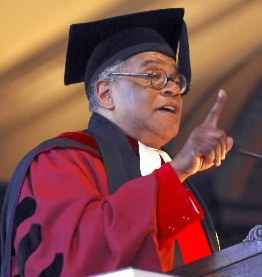
(Fred Field/Harvard News Office photo)
Plymouth, Massachusetts – One of America’s best-known preachers and theologians, and arguably the most famous out gay scholar in the nation, Peter J. Gomes died February 28 of a brain aneurysm and heart attack. He was 68 years old. For three and a half decades, Gomes was a member of the faculty of Harvard Divinity School, and served as Pusey Minister in the Memorial Church as well as Plummer Professor of Christian Morals. A New York Times Bestselling Author, Gomes will be remembered as the person who put the Bible’s teachings within reach of an intelligent, progressive secular audience with his widely acclaimed book, The Good Book: Reading the Bible with Mind and Heart (HarperOne: 2002). The son of a Cape Verdean father and a Bostonian mother, Gomes graduated from Bates College in 1965 and Harvard Divinity School in 1968. As he rose to prominence in Harvard, African Americans rejoiced to have a scholar and preacher so well situated in the academy. In recognition of the role he fulfilled in American black life, Henry Louis Gates featured Gomes in the Public Broadcasting System documentary,African American Lives 2. A life-long Republican until 2006 (having offered prayers at the inaugurations of Presidents George H.W. Bush and Ronald Reagan), Gomes became a registered Democrat in order to vote for Deval Patrick, the first African American Governor in Massachusetts history. In 1991, Gomes shocked the public by coming out openly as a gay man during a campus controversy over homosexuality–a story he tells eloquently inThe Good Book. Upon announcing his sexual orientation in order to support Harvard gay and lesbian students, Gomes was targeted by a hail of criticism. His defense of himself was forceful, measured, and laser-sharp: “Many of my critics, chiefly from within the religious community, asked if I read the same Bible they did, and if I did, how then could I possibly reconcile my position with that of scripture? When arguments failed, anathemas were hurled and damnations promised. The whole incident confirmed what had long been my suspicion. Fear was at the heart of homophobia, as it was at the heart of racism, and as with racism,religion—particularly the Protestant evangelical kind that had nourished me—was the moral fig leaf that covered naked prejudice” [The Good Book, p. 166]. Throughout the rest of his life, Gomes combatted fear and advocated for the equality of all people, regardless of their sexual orientation, gender identity, or gender expression. Among his other New York Times Bestselling books are The Good Life: Truths That Last in Times of Need (2003), and most recently The Scandalous Gospel of Jesus: What’s So Good About the Good News? (2007). Gomes suffered a stroke in December 2010, and was recently transferred to a rehabilitation center in his beloved hometown of Plymouth. News reports suggested that he was planning to return to Harvard this spring, and fulfill his career until his announced retirement in 2012. As the Harvard Crimson says, “He maintained a tremendous presence at Harvard as well as around the country.” More particularly for the LGBTQ community, Professor Gomes’s voice of faithful sanity and his incarnated presence as a person who was both black and gay will be sorely missed. Ave atque vale, Professor Gomes! “Hail and fare you well!”
Houston Churches Break Cycle of Gay Hate: “Bring Your Gay Teen to Church Sunday,” Feb. 20
 Houston, Texas – When school bullying drove 13-year-old Asher Brown to take his own life on September 23, the horror and despair of so many LGBTQ youth was laid bare for Houston to see. LGBTQ teen suicide, a crisis for any society, hit leaders of Houston’s gay-affirming religious communities particularly hard. Now, the Houston Chronicle and the Dallas Voice report that 22 area churches are doing their part to break the cycle of religion-based negativity toward homosexuality by inaugurating “Bring Your Gay Teen to Church Sunday” this week. On Sunday, February 20, churches from a broad range of traditions make it public that their doors and fellowships are fully open and affirming of LGBTQ youth, their families, and loved ones. The connection with the suicide of young Asher Brown is important, since at the time public rallies and memorials in his memory were taking place, the visual absence of churches, synagogues, temples, and mosques was telling. Surely hundreds of people from faith communities attended these public memorial events, but there was no organized presence on the part of religious communities–a glaring absence that communicated a message of neglect or disapproval that concerned religious leaders are eager to dispel. The Houston Chronicle details grim statistics about how religion is perceived to reinforce LGBTQ youth attitudes of alienation from faith communities. The Chronicle reports that a recent survey by the Public Research Institute showed that less than 20 percent of Americans believe faith communities do a “good job” on the issues of homosexuality and gender expression. Almost half of those surveyed said that the religious message on the topic was “negative,” and fully 40 percent said that the intolerant attitudes of religious communities contributed “a lot” to the disapproval and condemnation of LGBTQ people in this country. The most damning statistic associated with these issues referred to teen LGBTQ suicides: two out of three Americans in the survey said that religion contributed heavily to increasing rates of suicide among gender non-confroming, queer, and gay youth. Robert P. Jones, executive officer of the Public Research Institute, underlined the long history of anti-LGBTQ messages coming from America’s houses of faith: “Religious Americans historically have had negative attitudes about gays and lesbians.” In response to the crisis of teen despair in public and private schools in the metro area, the Houston Clergy Council devised “Bring Your Gay Teen to Church Sunday” as a means of getting out the word that God and the faith community do not hate, reject, or despise LGBTQ youth–quite to the contrary, these affirming churches welcome gender non-conforming people and their families every day. The masthead of the Facebook page announcing the project reads, “Is your teenager Gay, Lesbian, Bisexual, Transgender, a Questioning (GLBTQ) teen? Bring your teen to one of these affirming churches, and rest assured we won’t try to ‘fix’ them. We think they are awesome just the way they are!” The list of churches is impressive, including historic mainline denominations (Episcopal, United Church of Christ, Lutheran, and United Methodist), non-denominational communities, the Society of Friends (Quakers), Unitarians and Universalists, and the largest Metropolitan Community Church in the world. There is even a lone courageous Baptist church with an open and affirming stance. The struggle with religious intolerance and hate speech from pulpits in Houston and around the nation will go on for a long time. Thousands of congregations in the Houston metro area deny the acceptability of homosexuality and gender non-conformity, declaring queer youth sinful or worse. But a cadre of deeply committed faith leaders and their communities are determined to get out the word in America’s fourth largest city that sexual minority youth are acceptable to God, and most certainly to them. “Bring Your Gay Teen to Church Sunday” is tomorrow, February 20.
Fr. Matthew Kelty, OCSO, Passes Away: Out Gay Monk was Thomas Merton’s Confessor

Fr. Matthew Kelty, OCSO, Monk of Gethsemani (1915-2011)
Trappist, Kentucky – The most widely known and beloved monk of the Abbey of Our Lady of Gethsemani died peacefully among his brothers today in the Kentucky Hill Country. Fr. Matthew, né Charles Richard Kelty Jr., was born in South Boston, Massachusetts in 1915. Educated in the public schools of Milton, Massachusetts, he followed his vocation to the religious life, attended the seminary of the Society of the Divine Word in Techny, Illinois, and was ordained a Roman Catholic Priest in 1946. Fr. Matthew served as a writer for the magazine of the order, and became a Divine Word missionary in Papua, New Guinea from 1947 to 1951. Sensing all the while that his vocation was to the contemplative life, Fr. Matthew petitioned to enter the Abbey of Gethsemani in February 1960. “A natural love for the monastic life drew me to Gethsemani and fulfilled a lifelong dream,” he said. At Gethsemani, Fr. Matthew did many things. He once said, “Over the past decades, I have served in various capacities: master of the brothers, shoe shop, tailor shop, vocations office, and retreat house. Monastic life is everything I wanted, my happiness. All dreams fulfilled. But the fulfillment came slowly. Following your dreams and not giving up is my best recommendation.” Two interludes in his life are most worth mentioning. First, Fr. Matthew served as Prior of Holy Mother of God Monastery in Henderson, North Carolina, a small foundation near Oxford that the Trappists took over from Benedictines in the 1970s. In those days, when I first met Fr. Matthew, he was ebullient, funny, and a committed motorcycle driver. I can see him in my mind’s eye, zipping down the two-lane state roads, with his habit’s black scapular streaming behind him in the slip stream. I remember he loved and tended peacocks and pea hens that roosted in the pine trees bordering the chapel grounds, and he shared afternoon strolls with his dog and an obstreperous billy goat named “Philip Morris.” It was during this period that Fr. Matthew protested the war in Vietnam in a most monastic way: he and his dog walked for peace all the way from North Carolina to Washington, D.C. His journey was carried widely in the media. Standing on the banks of the Potomac River, looking over at the stately marble buildings of government, Fr. Matthew said that Washington looked to him like “frosting over so much burnt cake.” Second, Fr. Matthew received permission from Gethsemani to return to his beloved Papua, but this time as a hermit. He lived on the coast, loved the Papuans, and sewed clothes for his living as a tailor. During his hermitage, Fr. Matthew married Lady Poverty. Upon his re-entrance to Gethsemani, he wrote his spiritual autobiography, Flute Solo. It was in this book that he revealed his homosexuality as a celibate monk. Many years ago, I nervously came out to Fr. Matthew when I was on one of many retreats to the Abbey. He was so pastoral, loving, and understanding. He affirmed his own gayness, and mine, and advised me to live my dreams. He also helped change my life. “I will pray for you every day, Stephen,” he said, “as I say mass.” And I believe he did. Every day. Without fail. Fr. Matthew served as Thomas Merton’s confessor from the days of his entrance to the Abbey and Merton’s death in 1968. He always said Merton was the finest monk of Gethsemani, because he knew that in order for God to get a hearing, you had to have cunning enough to use other means to do it. Fr. Matthew must have taken those words to heart, for he will be best remembered and loved as the Guest House Chaplain and post-Compline preacher for years. His homilies are online for readers at the Abbey website. There are many ways God has of blessing the human race with gayness. Fr. Matthew was the queerest person I ever met, or am likely to meet. He hid nothing. He lived as a true child of his tradition, out in the open where God, the pea fowl, and the hierarchy could see. “Who wouldn’t want to live here?” he asked me one day when I was on a Fall retreat at the Abbey. “I am surrounded by good men, and get to wear beautiful clothes!” Now his transition is complete. He is with beloved Jesus, whom he loved as a consort and ascetic for 51 years. Not bad for an Irishman, eh?. Requiescat in pace, Padre. ~ Stephen Sprinkle, Unfinished Lives Project Team Member
How to Remember a Gay Hate Crimes Victim: 12 Years After Murder, Billy Jack Gaither’s Memory is Alive

Billy Jack Gaither
Montgomery, Alabama- Billy Jack Gaither’s memory will not die. A determined group of family, friends, and human rights advocates see to that annually, and on Sunday, February 2o, the 13th Annual Vigil for Victims of Hate and Violence will take place on the steps of the Alabama State Capital Building. Billy Jack, 39, died February 19, 1999 on the banks of Peckerwood Creek at the hands of two local men who hate him for being gay. Steven Mullins and Charles “Charlsey” Butler had no other motive for the grisly murder. They killed Billy Jack with a pick ax handle, and then burned his body on a pyre of old tire carcasses as an expression of their disdain for him and for all LGBTQ people as human beings. “Charlsey” and the “Skinhead” wanted this gentle, loving Alabamian from Sylacauga dead, immolated, and forgotten. But Billy’s family, especially sisters Kathy Jo and Vickie, and allies such as Dr. Beverly Hawk of the University of Alabama – Tuscaloosa and David Gary of Birmingham, have doggedly refused to let the killers win. They established the Billy Jack Gaither Humanitarian Award, to be presented annually at the Vigil to persons of outstanding social conscience and action. This year, the Vigil will commence at 3 p.m. with music by The Shouting Stones, and the Unitarian Universalist Fellowship Choir. Professor Gwen Thomas of Auburn University is the featured speaker. The Fourth Annual Billy Jack Humanitarian Award will be given to the Rev. and Mrs. Robert Graetz. Graetz was the white pastor of the predominantly black Trinity Lutheran Church in Montgomery during the historic Montgomery Bus Boycott in 1955. A personal friend of Rosa Parks, the Rev. Graetz was ostracized by whites for his support of the non-violent civil rights movement. His auto tires were slashed. The home he shared with his wife Jennie and their family was bombed three times, but thankfully the largest and last of the bombs was a dud, and did not go off. For Billy Jack to be remembered by awarding good works such as the courageous witness of the Rev. Graetz and his wife Jeanie is wonderful in itself. The award this year certainly embraces the LGBTQ and African American communities, and brings them into further dialogue as they struggle for justice together. But the planners and board members who refuse to forget Billy Jack are doing more than staging an event and presenting a named award–they are frustrating the intentions of hate crime killers like Mullins and Butler everywhere. They are bringing good people into an educational circle of hope and justice. They are sending a beam of light into the darkest regions of the human soul, the places where bigotry and hatred are incubated. So, once again, Billy Jack is remembered, celebrated, and beloved. Billy Jack’s memory is evergreen in Sweet Home Alabama. His killers languish forgotten serving life sentences in prison. Well done, Alabamians! [Billy Jack’s story, “Southern Gothic,” is told in the newly published Unfinished Lives: Reviving the Memories of LGBTQ Hate Crimes Victims. Follow this link for more information: http://www.amazon.com/Unfinished-Lives-Reviving-Memories-Victims/dp/1608998118/ref=sr_1_2?s=books&ie=UTF8&qid=1298017444&sr=1-2].
Courageous Mother & Pioneer Anti-Hate Crime Activist Dies

Carolyn Wagner (1953-2011), Human Rights Champion
Tulsa, Oklahoma – Pioneer activist, Carolyn Wagner, co-founder of Families United Against Hate (FUAH), passed away January 18 after a protracted battle with cancer, liver failure, and hepatitis. Widely admired for her courageous work on behalf of LGBTQ civil rights, Wagner became involved in the human rights struggle in 1996 when her son William, 16, was brutally harassed and attacked by homophobic students while attending school in northwest Arkansas. Young William survived, but compelled by a need for justice, Carolyn and Bill Wagner waged a successful legal campaign against the Fayetteville, AR school district under Title IX. The United States Office for Civil Rights ruled against the school district thanks to a complaint lodged by the Wagners on behalf of their son–the first time in U.S. history that Title IX was used to address anti-gay harassment and the bullying of gay and lesbian students, according to the ACLU. Because of her experience as the parent of a gay-bashed son, Carolyn joined forces with Gabi Clayton to found FUAH so other parents in similar situations could benefit from what she had learned. In 1999, Bill Wagner with Carolyn at his side, became a plaintiff in the history case, Howard v. Child Welfare Agency Review Board, argued by the ACLU to challenge the Arkansas Department of Human Services regulation that foster children could not be housed where adult gays and lesbians reside. Wagner qualified as a plaintiff since their son William, by then an adult, sometimes came home to stay with his parents. After learning about the plight of youth, straight and gay, who were abused because of the perception that they were gay, Carolyn and Bill Wagner took in scores of children through the years as foster parents. In August 2006, the Arkansas Supreme Court struck down the ban against gay and lesbian foster parents thanks to the litigation initiated by the Wagners and others. But the victory was not without cost for Carolyn, according to a tribute by the ACLU. In the same year as the ruling that struck down discrimination against gay and lesbian foster parents, Carolyn was brutally assaulted on her own property by a man posing as a police officer, who told her he did not like “queer-loving ACLU types.” Though shaken by the beating, she continued working tirelessly for LGBTQ human rights until the end of her life. FUAH issued this statement: “On January 18, 2011 the world lost a civil rights pioneer and strong voice for equality. Carolyn Wagner fought every day to create a world where equality would become a reality for all, no matter their sexual orientation, gender identity, race or life circumstances. Her path in life was difficult but she never wavered in her dedication and love for the many communities she advocated so powerfully for until she took her last breath. Nothing could ever stop her from fighting for her family, her friends and her community. Plenty of people tried to stop her, but never with any success. Carolyn’s heart, mind and arms were always open and we will miss her powerful embrace, we know her legacy will never die as long as we carry the spirit of her love within us, and take action with as much courage, humor, and wisdom as she did. Our thoughts and prayers are with her husband and children and the hundreds and thousands of people whose lives she touched. She will always be with us.” Carolyn is survived by her husband Bill, a her daughter, and two granddaughters. To hundreds of thousands, she was a champion of their rights, a compassionate, strong, and determined advocate for justice. But it is well to remember that Carolyn Wagner was first and foremost a wife and mother who acted to right a wrong that initially struck her own family, and then opened her eyes to the plight of countless others like her boy. As Bill Wagner said: “Carolyn will be remembered as an activist and civil rights hero to many, but for me she was simply the love of my life, my best friend and an amazing mother to our children. I will miss her beautiful smile, her raucous and infectious laugh and most of all her loving heart.” Her memorial service was held in Tulsa on January 22 at the Dennis R. Neill Equality Center. Rest in Peace, Carolyn. We will miss you.
“Bullycide” Claims Life of Gay Minnesota Teen
 Alexandria, Minnesota – An 18-year-old openly gay teen was harassed to death on Saturday in Alexandria, a small, Central Minnesota town. Lance Lundsten, a senior at Alexandria Jefferson High School, took his life after relentless bullying because of his sexual orientation, according to reports posted by the local ABC affiliate, KSAX News. At approximately 10 p.m., Douglas County Sheriff’s officers responded to an emergency call from the Lundsten home in Miltona where they found the gay teen near death. Lundsten was transported to Douglas County Hospital, where he died. Shari Maloney, Facilitator of the Diversity Resource Action Alliance, told KSAX, “Bullying is a huge issue, particularly with the youth in our country now. I think because we’re in central Minnesota, and we aren’t as diverse as some of the larger Metropolitan areas are, someone who is different maybe draws more attention and it’s not always positive.” Maloney went on to say that attitudes toward LGBTQ youth are not keeping pace with the times in Alexandria.“I think we are a welcoming community, but I think we are also a very traditional community as well,” Maloney said. “As the world changes, I’m not sure if we’re changing.” Friends created a memorial Facebook page in Lundsten’s honor, and indicate that bullies dogged their friend because of his sexual orientation. WDIO reports that fellow students believe the anti-gay harassment led to Lundsten’s suicide. Jefferson Anti-Bullying Coalition created a Facebook group over the weekend where Lunsten’s death by bullycide is a major topic of concern. The group administrator posted this chilling statement of student anger and despair concerning the Jefferson High School officials: “The school’s staff isn’t protecting us, it’s up to the students to help each other.” Sexual orientation is left unmentioned in the Jefferson High School handbook on harassment policies. Senator Al Franken (D-MN) spoke out against bullycide in Miltona on Monday at a rally for Martin Luther King Jr. Day. He called on the nation for more understanding and protection for LGBTQ students, according to KSAX: “My heart goes out to Lance’s family, and friends and loved ones. It’s a tragic event, not only for them, but for the school, and the Alexandria community and really for all of us.” Franken continued,”LGBT kids really do need (more) protection. They’re two or three times more likely than straight kids to get bullied. Nine in ten LGBT students said they’ve been bullied or harassed and almost two-thirds say they don’t feel safe in school.” A service of remembrance for Lundsten is planned in Alexandria for 7:30 p.m. on Tuesday. As a post on the Jefferson Anti-Bullying Coalition Facebook group says, “If this can happen in our small town of Alexandria, MN, it truly proves that this can happen anywhere. Stop another senseless death.” Any teen contemplating ending life because of harassment should contact the Trevor Lifeline at 866 4-U-TREVOR [866 488 7386].
About
If you are a first-time visitor to the Unfinished Lives Project website, we invite you to read A Welcome Message introducing you to our project. We are truly grateful for your visit.
The Unfinished Lives Project website is a place of public discourse which remembers and honors LGBTQ hate crime victims, while also revealing the reality of unseen violence perpetrated against people whose only “offense” is their sexual orientation, gender identity, or gender presentation. LGBTQ people in the United States are suffering a slow-rolling decimation of terror and murder all across the country. Every locale and demographic of society are affected: First Nations, Anglo, Black, Latino and Latina, South and Southeast Asian, Transgender, Bisexuals, Gay men, Lesbians, disabled, young, and mature. Homophobia has a long, crooked arm, and it is reaching out to snatch the life away from women and men whose tragic stories are under-reported to begin with, and whose memories are swiftly forgotten.
The horror of these killings transcends the shock and bereavement of loved ones and friends. These are not typical homicides; they are not killings for money or drugs, incidents of domestic strife, or crimes of passion. The vicious nature of hate crimes against LGBTQ persons is extremely brutal, grotesquely violent, and egregiously hateful.
Each murder serves the LGBTQ population as a sobering warning about the actual level of danger in our communities. The message these killings send is that freedom and open life for LGBTQ people is a cruel dream. Every time we remember one of these victims, however, the intentions of their killers are frustrated. To remember these women and men is to begin the process of changing the culture that killed them.
Our Project Director
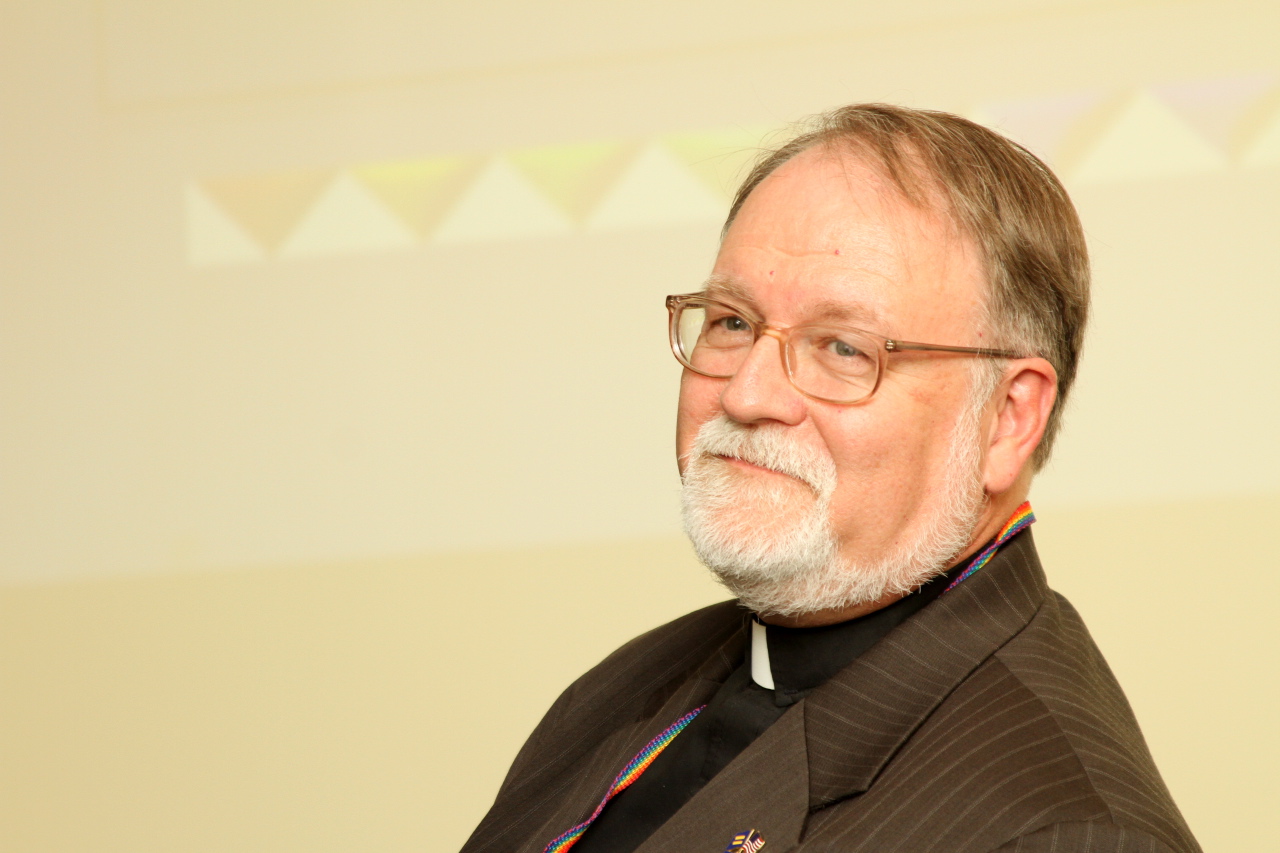
Dr. Stephen V. Sprinkle (Keith Tew photo).
Stephen V. Sprinkle is Director of Field Education and Supervised Ministry, and Professor of Practical Theology at Brite Divinity School, Fort Worth, Texas, a post he has held since 1994. An ordained Baptist minister, he is the first open and out Gay scholar in the history of the Divinity School, and the first open and out LGBTQ person to be tenured there. Read More…
Recent Social Justice Advocacy Activity By Dr. Sprinkle
 Summer 2009 – Dr. Sprinkle responded to the Fort Worth Police Department and Texas Alcoholic Beverage Commission Raid on the Rainbow Lounge, Fort Worth’s newest gay bar, on June 28, 2009, the exact 40th Anniversary of the Stonewall Rebellion. Dr. Sprinkle was invited to speak at three protest events sponsored by Queer LiberAction of Dallas. Here, he is keynoting the Rainbow Lounge Protest at the Tarrant County Courthouse on July 12, 2009. Read More…
Contact Us
Communicate with the Unfinished Lives project team:
info@unfinishedlivesblog.com


Schedule a Presentation
Dr. Sprinkle will gladly present his acclaimed presentation to your organization. To arrange an Unfinished Lives presentation for your organization or group, please contact us.
Dr. Sprinkle has given his Unfinished Lives presentation to these and other community groups and organizations. Read More…
-

Where are our readers?
Publisher: Steve Sprinkle (Project Director)
Steve Sprinkle
Unfinished Lives: Remembering LGBT Hate Crime VictimsBrite Divinity School/Texas Christian UniversityFort Worth TXprofessor, minister, author, blogger, LGBTQ advocate


Follow Unfinished Lives on Facebook
 Box Turtle Bulletin
- An error has occurred; the feed is probably down. Try again later.
- HRC Back Story
- Know About The Gender Identity Movement
- Why Is There A Need For Human Rights?
- Kinds Of Human Rights
- Human Rights Purposes And Violations
- Human Rights For Every Human Incident
- 8 Reasons Human Rights Are Important
- Everything About Human Rights
- Human Rights Issues Education & Law
- We Need To Stand Up For Our Rights And Those Of Others
- Coca-Cola Receives Perfect Score On Human Rights
- The Advocate: Daily News
- Remorseless Seattle man sentenced in hate crime beating of trans woman
- State Department visa rule sets stage for ICE scrutiny of transgender immigrants
- About four in ten Americans still view homosexuality as immoral, survey finds
- Donald Trump attacks trans women in Women’s History Month proclamation
- Ric Grenell to step down as Kennedy Center president after controversial tenure
- Los Angeles Marathon nonbinary champion receives no prize money
- The rainbow Pride pin James Talarico encouraged me to wear
- Gay asylum seeker files claim for damages over Trump deportations to CECOT torture prison
- Breaking newsletter: NYC office 3/13/26
- Iowa bans cities and towns from protecting transgender citizens’ civil rights
- Dallas Voice: Instant Tea
- An error has occurred; the feed is probably down. Try again later.

 Unfinished Lives
Suspect 3rd Century Women Put to Death in Arena: Ancient Hate Crime?
Share this:
March 7, 2011 Posted by unfinishedlives | Africa, anti-LGBT hate crime murder, Bisexual persons, Carthage, Execution, Hate Crimes, Heterosexism and homophobia, Lesbian women, Martyrdom as State-Sanctioned Hate Crime, Perpetrators of Hate Crime, Perpetua and Felicity, Public Theology, religious intolerance, Remembrances, Roman North Africa, Special Comments, women | Africa, anti-LGBT hate crime murder, Bisexual persons, Carthage, Hate Crimes, Lesbians, Martyrdom as State-Sponsored Hate Crime, perpetrators, Perpetua and Felicity, public theology, religious intolerance, Remembrances, Roman North Africa, Special Comment, women | Comments Off on Suspect 3rd Century Women Put to Death in Arena: Ancient Hate Crime?