Another Horrific Trans Murder in Puerto Rico: Anti-Trans Violence Epidemic Continues

Corpse of slain transwoman transported to coroner (Primera Hora photo/ David Villafañe)
Caguas, Puerto Rico – In less than two months, police in Puerto Rico are investigating the savage murder of another transgender woman. Angie González Oquendo, 38, was found strangled to death with an electrical cord in her home in Caguas. Police have not yet designated the murder as a hate crime, but LGBT activists familiar with the outbreak of anti-LGBT violence in Puerto Rico are calling for a full hate crime investigation. EDGE Boston reports that the last time Ms. González Oquendo was seen alive was May 20. Investigators believe she was murdered later that same day. El Nuevo Día reports that the body of the slain transgender woman was found when neighbors reported a repugnant odor coming from her apartment. Though Ms. González Oquendo’s father believes that her boyfriend murdered his daughter, Pedro Julio Serrano of the National Gay and Lesbian Task Force said to reporters that a hate crime investigation must be launched nonetheless. Speaking to EDGE, Serrano said, “At the very least, I suspect that a crime could have been committed by prejudice against the victim’s sexual orientation or gender identity. The authorities have an obligation under the law to investigate this hate angle.” Angie González Oquendo is the most recent in a grim series of anti-LGBT hate murders in the United States Territory. Five weeks ago, police discovered the body of Ashley Santiago Ocasio who had been stabbed to death in her home in Corozal. In November of last year, Jorge Steven López Mercado’s decapitated, dismembered and partially immolated body was found on a lonely rode outside Caguas. His murderer, Juan Martínez Matos, was sentenced to 99 years in prison after pleading guilty to the Silence-of-the-Lambs-style killing. The transgender community in Puerto Rico is understandably on edge as this latest news of murder sweeps through the population. Transgender people are among the most vulnerable citizens of the island paradise, and transphobic murder is emerging as a substantial indicator that such violence is reaching epidemic proportions. EDGE reports that Guillermo Chacon, president of the Latino Commission on AIDS, issued a statement just as the story of Ms. González Oquendo’s brutal murder broke in the press. In part, Mr. Chacon said, “I urge the Latino community to be united as one voice and with our personal actions reject any type of homophobia, transphobia and discrimination. We are one family; we must pursue the well-being of all our members. We must address homophobia and transphobia by putting a stop to the jokes, slurs, discrimination and hatred faced by our LGBT brothers and sisters, not just in Puerto Rico but across the entire country. Hatred and violence is never the answer.”
Ball Bat Attackers Immune from Hate Crimes Charges?: Authorities Backpedal on Anti-Gay Violence

Big Stick Combat photo
Dallas, TX – What does a midnight assault on two Dallas gay men Friday have in common with a December 2008 fatal attack on two Latinos mistaken as gay in Brooklyn, New York? Two things: first, both attacks were carried out by homophobes yelling anti-gay slurs as they swung baseball bats at the heads of their victims; and second, police in both cases classified neither assault as an anti-hate crime. What gives? What does it take to get officers of the law to prosecute hate crimes under existing hate crime statutes? While Dallas and Brooklyn are 1370 miles distant from each other and worlds apart culturally, they both have law enforcement resistant to investigate crimes against gay men as bias-motivated. The 2008 Brooklyn murder of José Sucuzhañay serves as an eerily familiar backdrop to the current Dallas attack on Kyle Steven Wear and his friend Alex. Like Dallasites Kyle and Alex, the Ecuadoran immigrant brothers José and Romel were walking together down the street in the wee hours of the night. The Brooklyn crime was carried out by two assailants swinging a broken beer bottle and an aluminum baseball bat, yelling anti-gay and anti-hispanic epithets. Trials in the Sucuzhañay case are proceeding right now in Brooklyn, where Hakim Scott has just been convicted of first-degree manslaughter, and his accomplice, Keith Phoenix, awaits an new court date since the New York judge dismissed all hate crimes charges and declared a mistrial because of a juror in the first Phoenix trial who refused to participate any further. The Brooklyn ball bat attack left José lingering five days in a coma from a broken skull before he died. The consensus of the supporters of Sucuzhañay family, outraged city officials, and the metropolitan New York media is that this ugly, brutal attack took place because Scott and Phoenix targeted two Hispanic men whom they mistook for gay because they didn’t like the way they looked. Wear and his friend Alex (last name still unreleased) were much more fortunate. As they walked along in the southwestern part of the Cedar Springs gay entertainment district in Dallas, “the gayborhood,” headed for the bars, four assailants only identified as Latinos wearing white tee-shirts, blindsided the pair shouting “Faggots, give us your fucking wallets!” according to WFAA News. Wear told WFAA on camera that he was knocked unconscious and his jaw was broken by one of the attackers swinging a ball bat. His friend, Alex, reported that he feared for his life as the homophobes forced him to the ground. The Dallas Police are refusing to classify the case as a hate crime, contending instead that the motive was to rob the gay men. But Alex isn’t buying it. He told Jonathan Betz of WFAA, “I still feel like that was why we were targeted in the first place, because we are gay. It was like it was funny to them.” John Wright of the Dallas Voice is outraged that the authorities have resisted investigating the Dallas ball bat assault as an anti-gay bias crime. In a May 16 post for the Dallas Voice blog, Instant Tea, he writes, “Despite the fact that the suspects yelled anti-gay slurs as they beat the victims with baseball bats, Dallas police have not classified the incident as a hate crime, which is an outrage.” Wright points out that Jimmy Lee Dean was nearly beaten and stomped to death in the same general neighborhood by two homophobic attackers in July 2008. Wright then shows that regardless of the refusal of Dallas law authorities to enforce Texas hate crimes law, federal hate crimes protections should kick in. The James Byrd, Jr. and Matthew Shepard Hate Crimes Prevention Act of 2009 classifies a hate crime as motivated in whole or in part by anti-LGBT bias. One major determining criterion of an anti-gay hate crime for the FBI is the use of epithets as the perpetrators carried out the crime. Anti-LGBT hate crimes are like the rest of life: seldom pure and simple. Other motives often accompany hate violence against gays, lesbians, and transgender persons: robbery, drugs, racism and sexism, to name a few. But homophobia and heterosexism, like a sinister bass line in a libretto, thread throughout all anti-LGBT hate crimes cases, targeting people who are assumed to be inferior, impure, and abominable because of their perceived sexuality. In Dallas and in Brooklyn, it seems baseball bats and anti-gay epithets are not enough to launch hate crimes prosecutions. Are anti-gay sluggers simply immune in Texas and New York? Again we ask, What does it take to get officers of the law to prosecute hate crimes under existing hate crime statutes? It takes an outcry from LGBT people and their allies so that law enforcement will not be permitted to backpedal on hate crimes against members of the sexual minority without a stink being raised to high heaven. If police and prosecutors are unfamiliar with what LGBT bias crimes are, they are responsible to educate themselves. If they are being intentionally obstructionist, then the mayor and the city council need to replace them with officials who will carry out the law.
Transphobic Attacker Slashes “IT” into Chest of Victim
 Long Beach, CA – A Cal State Long Beach graduate student who identifies as a transgender man was forced into a campus toilet stall on April 15 and had the word “IT” carved into his chest with a sharp instrument. The mystery attacker, depicted to the left in a police composite sketch, approached his mark in a men’s toilet on the west side of the campus at around 9:30 pm. He somehow knew his victim’s name, asking if his name was “Colle.” When Colle Carpenter, a 27-year-old F to M graduate student, said yes, the attacker pushed his target into the stall, forcing him against the stall door. He grabbed Carpenter by the T-shirt, yanking it up over his head and exposing his bare chest, as reported by the Long Beach Press-Telegram. After slashing Carpenter, the assailant rushed form the scene, leaving his victim bleeding, shaken, and terrorized. The suspect, described as a 5-foot-10-inch, thin white male with light complexion and dark hair, has neither been identified nor apprehended as of this writing. He was wearing a dark hooded sweatshirt and dark khaki shorts, according to Rick Gloady, a spokesperson for CSULB. As the investigation has proceeded, some community organizations have criticized the university for not immediately releasing information about the attack to the press. Carpenter, however, defended the school’s actions to the L.A.Times blog, L.A.Now, “I’m aware the university has come under some criticisms regarding communications and response, in general,” he said. “But again, I feel that the administration’s response has been focused on the investigation and my wellbeing.” Scores of concerned students and townspeople gathered in support of Carpenter and all victims of transphobia on campus this past Thursday for a “Take Back the Night” march and rally. Carpenter, still recovering from his injuries and leaning on a cane, told the crowd that his attacker was motivated by hatred. The word carved into the flesh of his chest was chosen to demean him as a human being, trying to make him feel “less than human.” But his foe ultimately failed. “I am not less than human,” he told his supporters, “I am not more than or less than anyone standing here today.” Carpenter went on to say, “I know this did not just happen to me. This happened to every member of the community. Those of us who are visibly queer are scared. I have been terrified to come back to campus.” He concluded his remarks, “Thank you for helping me get through this.” Campus officials said that the slashing attack was a one-of-a-kind incident, and do not expect there to be another like it. Meanwhile, the manhunt continues for the transphobic suspect who signs his bigotry in the flesh and blood of his victims.
Grief and Outrage Over Transgender Murder in Puerto Rico

Ashley Santiago's family learns of her murder; Israel González photo for Prima Hora
Corozal, Puerto Rico – The Washington Post reports that scores of sobbing mourners wearing tee shirts emblazoned with the likeness of Ashley Santiago Ocasio attended her funeral Friday in the central mountain town of Corozal. Her mother, Carmen Ocasio, told reporters from Prima Hora that her 31-year-old transgender daughter had no enemies she was aware of, no one she could imagine taking her life. “I lost my daughter,” she said. “I’m in shock. Why would someone kill Ashley, why?” Authorities are still searching for a lead in the case, but as the LGBT community in Puerto Rico has come to expect, authorities have not invoked the 2002 hate crime statute that would send a convicted killer to prison for life. Though the drumbeat of pressure is mounting for prosecutors to apply the unused hate crimes law to LGBT victims, prospects for doing so in this case do not look promising. Pedro Julio Serrano, spokesperson for the National Gay and Lesbian Task Force in Puerto Rico, points out that five recent crimes should have been designated terror-attacks against not only the victims, but the entire LGBT population. Hate crimes against members of the sexual minority are “message-crimes,” meant to drive the LGBT community into fear and hiding. As Serrano notes, one of the five recent cases was the November 2009 decapitation, dismemberment, and immolation of gay teen Jorge Steven López Mercado in Caguas. A charge of first-degree murder has been filed against the youth’s alleged killer, but the hate crime statute has not been invoked even in a slaughter so gruesome as this. In the Santiago case, police are speculating that robbery may have been a motive in the slaying of the popular, attractive beauty salon owner. Two evidentiary aspects of the investigation so far seem to argue against a robbery motive alone, however. First, Ms. Santiago’s home showed no signs of breaking and entering. Someone she knew probably carried out the murder. Even though her automobile was taken from the scene, as Pedro Serrano observed to the Post, “The law is very clear and we’re asking authorities to investigate without prejudice. Even if Ashley’s death was also a robbery, there could be the angle of hate. We need that to be investigated,” Serrano emphasized to the Post. The chief investigator has promised to used the Puerto Rican hate crimes law “if the evidence warrants it.” The second aspect of the murder that suggests Serrano is right, that hate against Ms. Santiago was probably a factor is the extreme nature of the crime scene. There was so much blood, so widely pooled and spattered, that police believed from the beginning of the investigation that the victim had been stabbed multiple times, hardly likely for a robbery alone. The overkill typical of anti-LGBT crimes is clearly present in the Santiago slaying. The community of Corozal is stunned in the wake of their most notorious murder. Ms. Santiago was well-liked in town, confident that her transition was the fulfillment of herself as a person. She had commenced hormone therapy, and had undergone breast surgery, according to Serrano. The usually neglected Transgender Community on the Caribbean island paradise is waiting for a break in the case, and firmly demanding justice for their sister Ashley.
Brutal Stabbing Death of Puerto Rican Transwoman Possible Hate Murder
 Corozal, Puerto Rico – Ashley Santiago’s mother pressed police to investigate why she had not heard from her daughter since Sunday, April 18. When law enforcement entered Santiago’s home on April 19 in Corozal, a municipality just 25 miles southwest of San Juan, they found her naked body in a large pool of blood collapsed on the kitchen floor. She had been stabbed 14 times, according to the report of authorities to El Nuevo Día. Police also reported that they could not find Santiago’s 2009 Toyota Corolla parked outside her home. EDGE Boston picked up the story overnight, and has flashed it across the United States’ LGBT blogosphere. Santiago, 31, was a popular hair stylist at a local salon. Echoes of the savage dismemberment-killing of gay teen Jorge Steven López Mercado in November 2009 still reverberate around the island. His alleged murderer, Juan A. Martínez Matos, has yet to stand trial for the beheading, butchery, and attempted immolation of his victim. After several postponements, Martínez Matos is docketed to stand trial for the murder of López Mercado in Caguas on May 3. While law enforcement officials have not yet designated Santiago’s murder as a hate crime due to the perceived sexual orientation or gender identity and expression of the victim, LGBT activists across the region are calling on police to invoke Puerto Rico’s seldom-used hate crimes statute which covers anti-LGBT hate crimes. Pedro Julio Serrano, noted San Juan activist who represents the National Gay and Lesbian Task Force in Puerto Rico, told EDGE, “The authorities have a legal obligation to investigate this hate angle. We urge the police and the prosecutor to appropriately investigate this murder; to determine whether it was motivated by prejudice and if there is enough evidence to classify it as a hate crime at this moment.” As Transrespect Versus Transphobia, a TVT monitoring agency in Europe reports, a transperson’s murder is reported every third day throughout the world, on average. for the last year and a half. Authorities acknowledge, however, the deep under-reporting of the actual number of transphobic murders.
Judge Rules Mistrial in Duanna Johnson Civil Rights Case: One Juror Hangs Federal Jury

Duanna Johnson, slain transwoman
Memphis, TN – A federal judge in Memphis has ruled for a mistrial in the case of former Memphis Police Officer Bridges McRae, on trial for violating Duanna Johnson’s civil rights. Memphis LGBT advocates are calling the decision “a failure of the justice system,” according to myeyewitnessnews.com. Johnson, a transgender woman of color, was repeatedly punched and beaten by McRae with handcuffs wrapped around his knuckles and pepper-sprayed as she was being processed for a prostitution charge at a Memphis police station on February 12, 2008. The beating was captured on a police surveillance tape, and reaction to the video prompted an immediate investigation resulting in the firing of McRae and a second officer, James Swain. Johnson had filed suit against the city on the basis of the videotape and the testimony of witnesses who declared that the brutal beating was unprovoked. Nine months later, as the New York Times reports, Duanna Johnson was shot to death with a bullet to the head on the night of November 9, 2008. Johnson’s murder, which remains unsolved, prompted intense scrutiny on the original beating case, and charges were filed in federal court for violation of the transwoman’s civil rights. Besides the controversial videotape of her beating, five witnesses testified in court that the attack on the 6’5″ 250 lb. Black transwoman was wanton, there being no reason for it in her behavior. Will Batts of the Memphis Gay and Lesbian Center, who had watched the surveillance tape repeatedly, said to myeyewitnessnews.com, “[The beating] looked to be unprovoked. It looked to be excessive on the part of the police officer. It looked to be just an attack on someone in a police station with other people standing around. And it was just incredibly violent.” McRae’s attorney argued that his client was simply exercising necessary force to subdue Johnson, blaming her for resisting arrest. Eleven jurors were convinced of McRae’s guilt. One was not, however, and after the jury deadlocked, the judge declared the mistrial. The Memphis LGBT community refused to take the news lying down. A rally in protest of the judge’s ruling will take place April 20 in front of the Federal Courthouse. “Would it have been different if Duanna were not transgendered,” Batts asked in a press interview. “If it were just an average person from the suburbs that happened to be sitting in that jail room on that day and had this kind of response from the police, would the decision be different?” Both the prosecution and the defense are to meet with the judge to determine a date for a new trial for McRae.
Transgender Woman Murdered in Queens
 Queens, NY – The last images we have of Amanda Gonzalez-Andujar are on a video capture at the entrance to her apartment building in the Ridgewood neighborhood of Queens with a tall man wearing a dark hoodie. Sometime late on Friday, March 26 or very early on Saturday, March 27, Ms. Gonzalez-Andujar, 29, was strangled to death in her home. Her body was not discovered until March 30, stripped of all her clothing except for her bra, lying across the bed in her ransacked apartment. Her Marilyn Monroe photos, part of a collection of Marilyn memorabilia her friends said was precious to her, were destroyed, frames smashed and images defaced. Police are continuing to investigate the apparent homicide, and have not yet issued a statement about the possible hate crime aspect of the case. It is difficult to believe that some form of transphobia or gender hatred did not motivate the murder to some degree, given the destruction of the Monroe photographs. The search is still on for the tall man who accompanied her into her home, a person authorities and friends presume to be Ms. Gonzalez-Andujar’s boyfriend. The New York Daily News, which broke the story, reports that a neighbor called police after becoming alarmed the evening of the 26th about the sound of a loud argument in the apartment. When the landlord beat loudly on the door, however, no one answered. One of the problems attendant to translife is a subtle form of isolation separating a transperson from getting to know neighbors in the usual way people relate in communities. This isolation probably contributed to the lag time between Ms. Gonzalez-Andujoar’s disappearance and the discovery of her body in a fully occupied apartment building. A laptop with potential evidence of the identity of her murderer was missing, perhaps stolen in an attempt to slow law enforcement from tracking him down. EDGE Boston reports that the Queens Pride House and the Transgender Legal Defense and Education Fund are expressing alarm at the continuing violence against transfolk in New York’s five boroughs. In a joint statement to the press, Pride House and TLDEF said, “As organizations serving the transgender community, we are very concerned about the safety of transgender women within our community. We condemn the violence against Amanda Gonzalez-Andujar and encourage swift action by law enforcement to apprehend suspects, and to fully investigate this brutal crime and bring all appropriate charges.” Commenting on the difficulty transgender women face in the United States, MtoF transwoman from Queens, Justine Valinotti writes in her blog, transwomantimes, “If we–that is to say, our souls–go anywhere after this life, I hope Amanda finds love and acceptance there.”
Phoenix Transperson’s Murder Still Unsolved After Four Years
 Phoenix, AZ – Maurice Dupree Green, known by friends in a gay support group as Melissa, was 22 when she was fatally shot in the back on the night of March 21, 2006. Now, four years since the brutal shooting, Green’s murderer remains at large with no promising leads. A candlelight vigil marking the anniversary of Green’s death was held Sunday in Phoenix, according to reports from ABC 15. When interviewed by a reporter for ABC, Arizona TransAlliance Co-Chair Erica Keppler said that Green’s murder highlighted the fear trans youth and adults face every day in the Grand Canyon State: “I want to move through the world as a citizen and feel safe like anybody else does, but I can never know that I’m safe,” she said. “I can never know that when I walk through a parking lot that I could be at risk of violence, of someone attacking me.” Green was in transition from male to female. According to a report filed near the date of her shooting, Melissa Green was wearing a long brown wig and women’s clothing as she walked alone in the neighborhood of an adult bookstore she sometimes frequented. AZCentral.com reported that a man approached her from behind and fired a single shot into her back with no warning just after midnight. She bled to death on the sidewalk before paramedics could reach her. Police were originally reluctant to label Green’s murder a hate crime, but members of the Arizona trans community, local politicians like openly gay Phoenix City Councilman Tom Simplot, and her youth support group friends have no doubt that hatred of LGBT people motivated the shooter. Simplot, who donated a considerable sum of money back in 2006 to reward anyone identifying the killer, comes to honor Green every year, and believes the annual vigil is important for youth in metro Phoenix. “This vigil every year is to tell our youth that the community does care about them, that we care what happens to them when they get kicked out of the house just for being gay,” Simplot said to ABC 15. Since the murder, Green’s mother Ceda has been inconsolable. She spoke to reporters at a previous vigil, confessing that her life could never be the same after the death of her child. Each year, vigil supporters hope that renewed interest in Green and the trans youth of Arizona will prompt someone to come forward with information leading to an arrest. Until then, the tenacious citizens of Phoenix will remember Melissa Green’s untimely, violent death, and work to improve the lot of the living.
Austin Rallies Against Downtown Anti-LGBT Hate Crime

Daily Texan photo
Austin, TX – The safety of LGBT folk in the Texas capital remains in question as University of Texas students and native Austinites struggle with the events of February 20. That night, two young gay men wearing Shady Ladies athletic jerseys were assaulted by four African American men shouting anti-gay slurs at them as the pair walked from one of Austin’s most popular gay bars to their car, parked near City Hall. The attack struck Emmanuel Winston and Matt Morgan from behind. They were brutally beaten and left on the sidewalk bleeding. News of the assault has shaken Austin, which prides itself with a progressive reputation in the Lone Star State. Though the investigation is ongoing, police are not yet able to label the attack a hate crime because of the peculiarity of Texas law. Until an arrest has been made and a defendant is prosecuted, a crime cannot be called a “hate crime” under state statutes. That is not stopping the supporters of the two gay men who were assaulted, however, according to News 8 Austin. Jeff Butler, a friend of the targeted men, said, “They were followed, attacked from behind, and brutally beaten by four men who uttered slurs. I don’t care how much lipstick you put on that pig. We will not allow you to cover this hate crime up.” Austin Police Chief Art Acevedo told reporters, “I think we have to finish the investigation first to see what the totality of the facts, evidence and circumstances are.” Acevedo then joined over 1,000 marchers as Winston and Morgan led the crowd from Oilcan Harry’s, the bar they visited that night, to the site of the attack. The Shady Ladies, an LGBT friendly softball team, wore their distinctive pink and blue jerseys and brandished a banner reading, “Austin March Against Hate.” The Daily Texan, UT’s student newspaper, reports that Glen Maxey, the first openly gay legislator in Texas history, expressed concern about the meaning of the attack. Though anti-LGBT hatred was widespread in Texas twenty years ago, for such an attack to occur on the streets of Austin in 2010 is alarming to the gay rights pioneer. “This is supposed to be behind us,” Maxey said. A low-resolution camera caught the suspects on video, but because of the condition of the images, they could not be identified. City officials are debating whether to increase the number of high-resolution surveillance cameras on city streets as a possible way to deter such crimes. City Councilman Mike Martinez told The Daily Texan that the city had applied for federal funds to place more anti-crime cameras on the streets, but the feds denied the request. Voicing his hope that the news of this crime will thaw up federal money, Martinez remains skeptical about stemming the tide of hate violence through technology alone. “A camera can only take a picture of ignorance,” Martinez said. “It’s not going to cure it.” For now, citizens of the Texas capital city are not so much concerned about “Keeping Austin Weird” as they are about keeping the streets of Austin safe.
Trans Community Demands Justice for Myra Ical
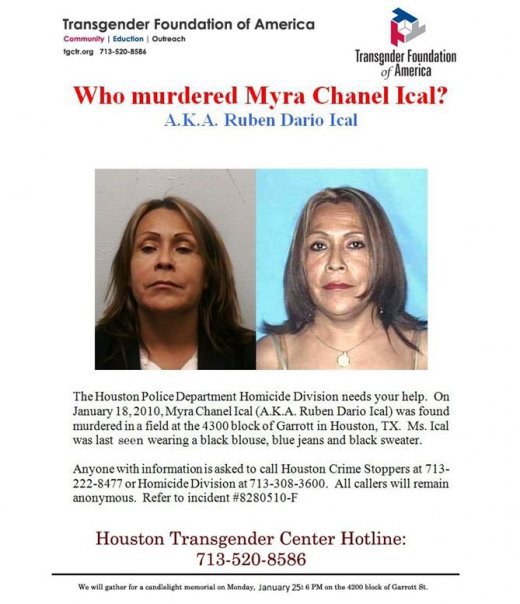
Houston, TX – Cristan Williams, Executive Director of the Transgender Foundation of America, takes the murder of Myra Ical personally. “She died struggling for her life…She went down fighting and she was literally beaten to death,” she said to reporters for KHOU 11 News. “It’s personal. I feel it on a personal level.” Hundreds agree with Williams. Myra Chanel Ical, 51, died in a Montrose area field a week ago, and Houston’s transgender community has rallied to her memory. Seven members of the transgender community have died violently in Houston in the last eleven years, and now the vigil organized to remember Ms. Ical on Monday night is being billed as the largest transgender event in Houston’s history. The vigil’s organizers intend to focus attention on the plight of transgender people in Harris County and Houston as they honor Ms. Ical’s memory and call for neighbors in Montrose to share any leads they may have on the unsolved murder with police investigators. While her slaying is not yet designated as a hate crime, police are certainly not ruling anything out. Sgt. Bobby Roberts, spokesperson for the Houston Police Department, told reporters, “It could have been anything at this point. We just don’t have any motive whatsoever on this case.” ABC News 13 reports that Ms. Ical’s body was covered in bruises and bore several defensive-type wounds that showed she was fighting back against her attacker(s). Harris County’s Medical Examiner ruled that she died from strangulation by some sort of ligature. Cristan Williams cannot get the horror of how Ms. Ical died out of her mind. “That in and of itself was just a horrific way to die. Her last moments of life were sheer terror.” Williams asks why none of the seven murders of Houston transgender people have been solved. Police told her they have no evidence in any of the cases, something Williams attributes to the way anti-transgender crimes went largely unreported in the recent past. Until the passage of the Matthew Shepard and James Byrd, Jr. Hate Crimes Prevention Act this past October, local and federal law enforcement agencies were not mandated to keep statistics on transgender hate crimes. Like the transgender population, these crimes were largely ignored. Human rights advocates for the LGBT community are watching closely to see if the election of Annise Parker, an open and out lesbian, as Mayor of Houston will make a difference in how law enforcement and the media approach violence against some of the most vulnerable citizens of America’s 4th largest city.
About
If you are a first-time visitor to the Unfinished Lives Project website, we invite you to read A Welcome Message introducing you to our project. We are truly grateful for your visit.
The Unfinished Lives Project website is a place of public discourse which remembers and honors LGBTQ hate crime victims, while also revealing the reality of unseen violence perpetrated against people whose only “offense” is their sexual orientation, gender identity, or gender presentation. LGBTQ people in the United States are suffering a slow-rolling decimation of terror and murder all across the country. Every locale and demographic of society are affected: First Nations, Anglo, Black, Latino and Latina, South and Southeast Asian, Transgender, Bisexuals, Gay men, Lesbians, disabled, young, and mature. Homophobia has a long, crooked arm, and it is reaching out to snatch the life away from women and men whose tragic stories are under-reported to begin with, and whose memories are swiftly forgotten.
The horror of these killings transcends the shock and bereavement of loved ones and friends. These are not typical homicides; they are not killings for money or drugs, incidents of domestic strife, or crimes of passion. The vicious nature of hate crimes against LGBTQ persons is extremely brutal, grotesquely violent, and egregiously hateful.
Each murder serves the LGBTQ population as a sobering warning about the actual level of danger in our communities. The message these killings send is that freedom and open life for LGBTQ people is a cruel dream. Every time we remember one of these victims, however, the intentions of their killers are frustrated. To remember these women and men is to begin the process of changing the culture that killed them.
Our Project Director
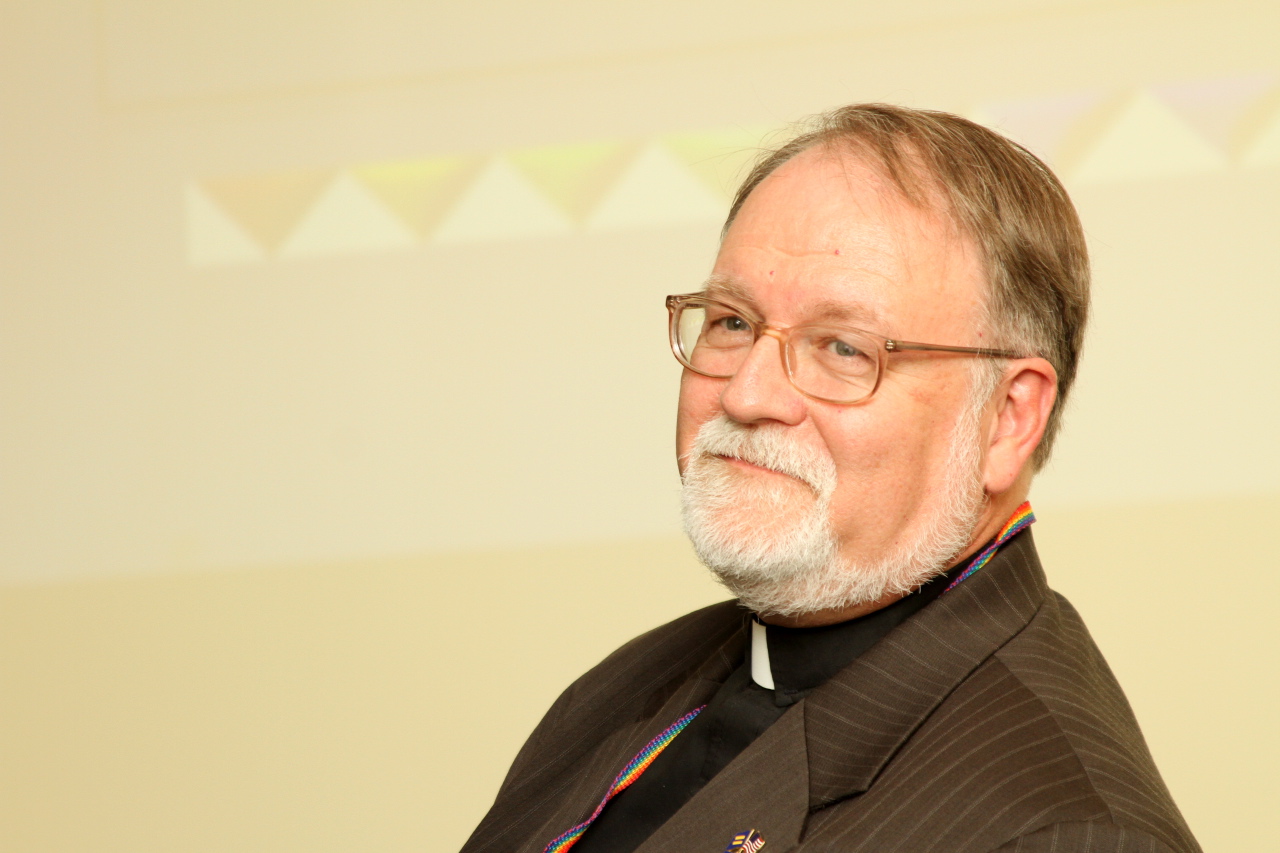
Dr. Stephen V. Sprinkle (Keith Tew photo).
Stephen V. Sprinkle is Director of Field Education and Supervised Ministry, and Professor of Practical Theology at Brite Divinity School, Fort Worth, Texas, a post he has held since 1994. An ordained Baptist minister, he is the first open and out Gay scholar in the history of the Divinity School, and the first open and out LGBTQ person to be tenured there. Read More…
Recent Social Justice Advocacy Activity By Dr. Sprinkle
 Summer 2009 – Dr. Sprinkle responded to the Fort Worth Police Department and Texas Alcoholic Beverage Commission Raid on the Rainbow Lounge, Fort Worth’s newest gay bar, on June 28, 2009, the exact 40th Anniversary of the Stonewall Rebellion. Dr. Sprinkle was invited to speak at three protest events sponsored by Queer LiberAction of Dallas. Here, he is keynoting the Rainbow Lounge Protest at the Tarrant County Courthouse on July 12, 2009. Read More…
Contact Us
Communicate with the Unfinished Lives project team:
info@unfinishedlivesblog.com


Schedule a Presentation
Dr. Sprinkle will gladly present his acclaimed presentation to your organization. To arrange an Unfinished Lives presentation for your organization or group, please contact us.
Dr. Sprinkle has given his Unfinished Lives presentation to these and other community groups and organizations. Read More…
-

Where are our readers?
Publisher: Steve Sprinkle (Project Director)
Steve Sprinkle
Unfinished Lives: Remembering LGBT Hate Crime VictimsBrite Divinity School/Texas Christian UniversityFort Worth TXprofessor, minister, author, blogger, LGBTQ advocate


Follow Unfinished Lives on Facebook
 Box Turtle Bulletin
- An error has occurred; the feed is probably down. Try again later.
- HRC Back Story
- Know About The Gender Identity Movement
- Why Is There A Need For Human Rights?
- Kinds Of Human Rights
- Human Rights Purposes And Violations
- Human Rights For Every Human Incident
- 8 Reasons Human Rights Are Important
- Everything About Human Rights
- Human Rights Issues Education & Law
- We Need To Stand Up For Our Rights And Those Of Others
- Coca-Cola Receives Perfect Score On Human Rights
- The Advocate: Daily News
- Advocate newsletter 4/10/26
- Beyond awareness: How youth leadership is reshaping the HIV response
- Day of Silence marks 30 years as anti-LGBTQ+ school battles intensify nationwide
- A federal judge is forcing the Trump administration to answer for Renee Good’s killing
- Nebraska lawmaker fails again to revive anti-trans bills after repeated attempts
- As Day of Silence turns 30, LGBTQ+ students are stuck in 1996
- How a Democrat's House win in Nebraska could erase the ‘blue dot’ & harm LGBTQ+ rights
- Maryland protects trans students. Stephen Miller’s group is coming for those protections
- Mississippi passes restrictive transgender driver’s license law
- Minnesota’s largest pediatric system restarts gender-affirming care for trans minors
- Dallas Voice: Instant Tea
- An error has occurred; the feed is probably down. Try again later.

 Unfinished Lives