Hanging Tough On Hate Crime Charge in Syracuse
 Onondaga County, NY – Lateisha Green, 22, an African American M-to-F transwoman, was shot to death in November 2008 with a .22 calibre rifle in Syracuse, NY. Her brother, Mark Cannon, 18, who was also shot, managed to drive their car home. Mark told reporters, “I was like oh my lord! This is not true!. This is not true, and Moses told me that he loved me on the way home.” Ms. Green, née Moses Cannon, died of what authorities called a hate crime, because the motive for the shooting allegedly was that she and her brother were “gay.” Dwight DeLee was arrested and charged. Subsequently, his attorney entered a plea of not guilty, and challenged the hate crime charge as unconstitutional, citing that the charge is too vague and general. The judge in the case entertained the motion on behalf of the defense, but made the determination that the charge will go forward as entered. If Mr. DeLee is found guilty, it will be the first time in Onondaga County history that the hate crime statute will have been successfully applied in a murder case. Based on evidence the state says it has, Ms. Green was selected for this fatal attack because of her sexual orientation. Her father, Albert Cannon, spoke to the press about his grief and anger: “I’m hurt. Angry. Upset. Am I mad at the kid? Yes. Mostly, I’m upset with society. How do we let our kids get this angry this young? This was hatred.” The trial is scheduled for mid-July of this year.
On Memorial Day, We Honor the Military Service of Our Gay Dead
 Since time immemorial, Gay and Lesbian people have served their country with distinction. LGBT Americans pause to remember and honor the service and sacrifice of all American service members, especially the ones who faced battle on two fronts: the battle for freedom and security for our country, and the battle against unreasoning homophobia. This Memorial Day, The Unfinished Lives Project pauses to give thanks for the lives of three gay men who served their country, and died because their countrymen could not accept their sexual orientation: Petty Officer Third Class Allen R. Schindler, Jr., Chicago Heights, IL, sailor on the U.S.S. Belleau Wood; Private First Class Barry Winchell, Kansas City, MO, soldier at Fort Campbell, KY; and U.S. Army Veteran Michael Scott Goucher of East Stroudsburg, PA.
 Schindler, who was mercilessly harassed on board his ship, was murdered in 1992 by shipmates in a public toilet while on leave in Sasebo, Nagasaki, Japan. His body was so ravaged by the attack that every major organ in his body was ruptured, his skull was crushed, and the medical examiner found sneaker tracks embedded in his chest and face. The only way his mother could identify her son’s body was by a tattoo he had inked into his upper arm. His main assailant, who openly declared that he was disgusted by homosexuals, said shortly after the murder, “I don’t regret it. I’d do it again. … He deserved it.” The Navy has never been forthcoming about the slaying, and has repeatedly refused to release the report of the Japanese police about the crime. Don’t Ask Don’t Tell (DADT) was officially enacted soon after Schindler’s murder by President Clinton. SLDN has continued to represent his mother in the courts.
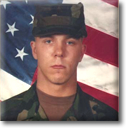 Winchell, who had been singled out for anti-gay ridicule by his barracks mates at Fort Campbell, was bludgeoned to death in 1999 by a fellow soldier wielding a baseball bat at his head and body while he was asleep. Ironically, he was killed after an Independence Day celebration on base. His hate crime murder and trial exposed one of the most notorious cover-ups of the Don’t Ask Don’t Tell (DADT) era. His parents and SLDN contend that the Army betrayed him by violating its own DADT policies, failing to follow the best traditions of the Army in order to shield the chain of command, and exposing other gay soldiers to danger and dishonorable discharge. The anti-gay climate of Fort Campbell was never sufficiently addressed in the wake of Winchell’s killing, and the base commander, General Robert T. Clark, was promoted despite the protests of SLDN and other LGBT advocacy organizations around the country. His killer is serving a life sentence for murder in a federal military prison facility.
 Goucher, who had been honorably discharged from the U.S. Army after a tour of duty in Alaska where he served in transport, was ambushed by two young men who stabbed him to death over 45 times according to autopsy records in 2009, arguably the first anti-LGBT hate crime murder victim of the year. After returning to East Stroudsburg, Goucher worked as a high school janitor, captained the Neighborhood Watch in his area, and served as assistant organist at a local church.
These three represent many more loyal Americans who happened to be LGBT and have been stigmatized, drummed out of the service, and in the cases of these faithful guardians of our country, were killed because of deep-seated bias against members of the sexual minority. They neither betrayed their country nor themselves. For that, and for justice-sake, we cannot forget them. At the request of SLDN, Servicemembers’ Legal Defense Network, Chan Lowe drew this provocative tribute to homosexual Americans who have paid the supreme price to wear our nation’s uniform. We offer it for your consideration on this Memorial Day 2009.

The Death and Life of Sean Kennedy: A Commemoration
 Sean Kennedy died from injuries sustained in an anti-LGBT hate crime attack outside a Greenville, SC bar on May 16, 2007. The facts of the case are not in dispute. At 3:45 a.m., Sean William Kennedy, 20, an out gay man, approached some young women who were talking with a car full of straight young men, among whom was Stephen Moller, 18. The women were distracted from speaking to the young studs by Kennedy, who inadvertently brushed his cigarette against Moller’s cheek, giving him a little burn. Another passenger in the car told Moller, “You know that dude is gay, right?” and “You probably have got AIDS from him!” Enraged, Moller rushed out of the car and hit Sean Kennedy in the face with his fist so hard that his facial bones broke. Kennedy fell back as a result of Moller’s blow with such force that when his head hit the concrete curb, his brain stem detached from his brain. Moller got back in the car, which sped away from the scene of the crime.
Sean Kennedy had no chance. In effect, he was dead from the moment his skull struck the curb. Elke Kennedy, his mother, has had to live with the horror of his murder ever since.
Moller, on the other hand, reveled in his macho moment. In a drunken phone call to one of Sean’s friends just fifteen minutes after the crime, Moller taunted Kennedy for his sexual orientation. Though it was taped and verified to be Moller’s voice, the call was never allowed into testimony at Moller’s trial:
“Hey. (laughter) Whoa stop. (laughter) Hey, I was just wondering how your boyfriend’s feeling right about now. (laughter) (??) knocked the f— out. (laughter). The f—— faggot. He ought to never stick his mother-f—— nose (??) Where are you going? Just a minute. (laughter). Yea boy, your boy is knocked out, man. The mother——-. Tell him he owes me $500.00 for breaking my god—- hand on his teeth that f—— bitch.”
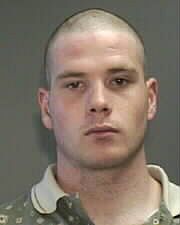
Moller's mug shot, SC Department of Corrections
Gay panic. AIDS terror. Homophobia. Macho bravado. A hands-on-attack in which the assailant feels the need to damage his target up close and personally. These are all the hallmarks of an anti-LGBT hate crime, as well as the response of the police on the scene who refused to take the hate crime dimension of the assault seriously enough to investigate it until later, and the reluctance of the District Attorney to bring sexual orientation into the case for fear of local heterosexist and homophobic prejudices. Local law enforcement reluctance to investigate or prosecute hate crimes against LGBT people is one of the prime reasons a federal hate crimes statute like the Matthew Shepard Act is so needed. Under the provisions of the Shepard Act, the Attorney General of the United States is enpowered to take over the investigation and prosecution of such a hate crime in situations like this one. No doubt, Moller’s homophobic braggadocio would have been taken into account, had the Shepard Act been on the books at the time of Sean Kennedy’s murder. Moller’s defense rested on two contentions that the court in Greenville bought, in the end: first, Moller didn’t even know Kennedy was gay until after the assault, the inadmissible taped phone conversation to the contrary, and second, nothing in this case rose to the level of murder. The D.A. settled for a charge of manslaughter which carries a penalty of 0-5 years in South Carolina. Moller got three years with credit for time served, and sympathy for his need to support a baby he sired while in the custody of the state. An attempt to lessen his prison time failed, thanks to the efforts of Sean Kennedy’s mother, stepfather, and hundreds of concerned people from around the country who petitioned the parole board in Columbia to deny Moller’s petition for early release. In the end, Moller will serve about a year and a half of actual time, with probation for the hate crime murder of an innocent gay man. Moller is due to be set free, his debt to society paid in full, in July 2009.
Sean’s death still tortures his loved ones. His mother said, “My son was violently murdered because of hate and as his mother I wanted justice. My family will never be the same, a big part of our lives has been ripped out of our hearts.” For too many hate crimes victims, that would be the end of it–injustice, anguish, and the eventual amnesia of a society that would rather just not think about such things. But not for Sean.
 Elke and her husband Jim Parker have rallied hundreds to the cause of remembering Sean and advocating for LGBT human rights. They established Sean’s Last Wish, a foundation that perpetuates Sean Kennedy’s desire that everyone be treated equally, www.seanslastwish.org. Sean’s parents have become lions in the struggle for South Carolina and the rest of the nation to have the tools needed to investigate and prosecute violence and intimidation motivated by bias against persons regardless of race, religion, national origin, ancestry, age, disability, gender, sexual orientation, gender expression or gender identity of the victim. Sean’s death has, in effect, given birth to a new and effective way for his memory to be preserved and honored: in the lives of all those spared and enriched to live fully as who they are, free of fear and violence.
The struggle for justice for Sean continues. Elke Kennedy recently said, “No mother should lose a child to hate. No mother should have to fight for justice for their child. To parents who reject their children for their orientation, what would you do if you got a call at three in the morning telling you your child had been murdered?” And Sean’s new life past his death, in memory, in advocacy, and as a cherished story that shall not be forgotten goes on and on. As Sean himself wrote, “So who knows what’s around the corner or down the street. I’m just gonna live life and find out.”

~~ Stephen V. Sprinkle, Director of the Unfinished Lives Project
Gay Man Gunned Down in His Florida Driveway
 Mark Scott Harriss, 30, looked forward to moving to Canada to get married to his fiancé, Ross Salvosa. Instead, he was shot to death around 8:30 pm in his Delray Beach, Florida driveway on Monday, May 11, 2009. Was it a hate crime? He had multiple gunshot wounds, and there was no evidence of robbery, according to investigators. Though authorities have not yet made the determination that his murder was a hate crime, friends of Harriss think it was likely. Professor Earl Fox from the University of Miami School of Medicine knew him well, and the neighborhood where he lived. Fox noted to the Palm Beach Post that another friend of his who lives in the same area as Harriss had a Nazi swastika painted on her car earlier this year because she is Jewish. “If somebody is shot multiple times and nobody takes anything, that is just strange,” Fox told reporters.
Police told WPBF television, an ABC affiliate, that Harris was shot 12 times at close range in a manner resembling an “assassination.” Homophobia is under consideration as a motive for the murder, officers said.
Harriss grew up in Fredericksburg, Texas, in the Hill Country. He was an enthusiastic water skier, and loved gardening, according to his high school classmate, Theresa Valenzuela, of Austin. He had moved to Florida in 2007 to take a job with Best Western Motels. Salvosa, a classical piano student, lived with him until his student visa expired, at which time he returned to his native home in Vancouver, British Columbia. Harriss was tying up loose ends as quickly as he could in Delray Beach, so that he could find a job in Canada, go to live there in early summer, and marry his beloved.
Now Salvosa is returning to Florida to mourn Harriss and to oversee his memorial service. Harriss wished to be cremated, and to have his ashes interred back in New Braunfels, Texas, a city between Austin and San Antonio.
Investigations into Harriss’ savage murder continue, and the Delray Police Department vow to follow all leads until the tragic mystery of this killing is resolved.
Clergy Call for Passage of Matthew Shepard Hate Crimes Act on Capitol Hill
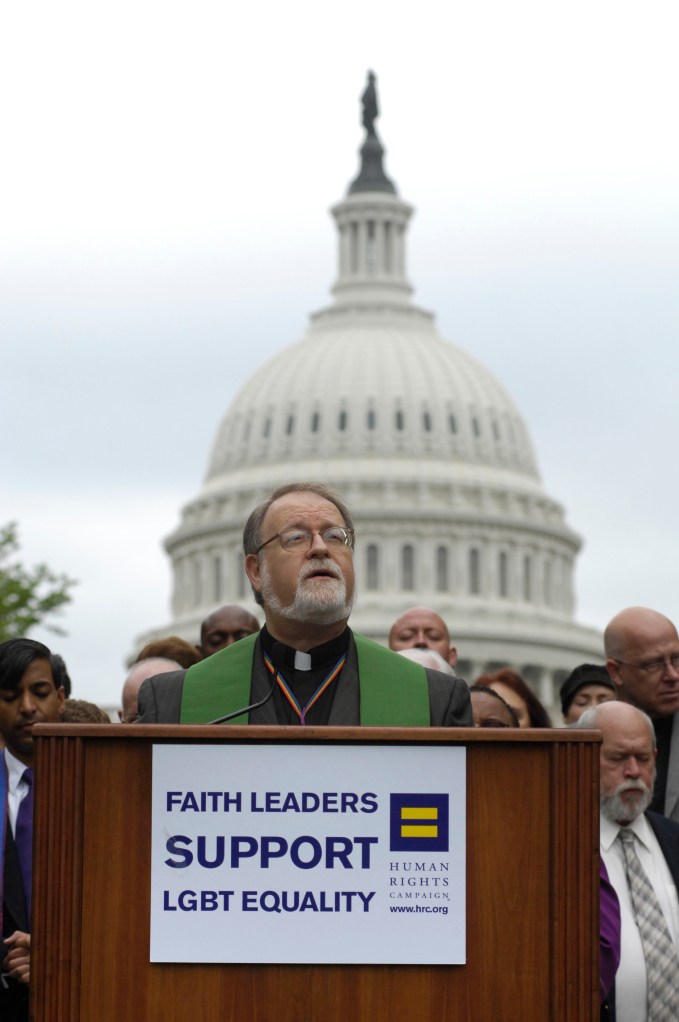
Unfinished Lives Project Director, Dr. Stephen Sprinkle, delivers the Opening Prayer at Clergy Call 2009
More than 300 LGBT Clergy and Allies hit Capitol Hill to pray and lobby for the passage of the Matthew Shepard Act and a fully trans-inclusive Employment Non-Descrimination Act. A new breeze seemed to be blowing in the halls of government. The Human Rights Campaign Religion and Faith Program, directed by Harry Knox and Sharon Groves, coordinated three days of events, May 4-6, 2009. Among the speakers for the Press Conference were Dr. Tony Campolo, noted evangelical leader, and Dr. Jo Hudson, Rector and Senior Pastor of Cathedral of Hope in Dallas. Clergy from all 50 states attended. The Matthew Shepard Act awaits the action of Senate Majority Leader Harry Reid and chief sponsor Senator Ted Kennedy in order to bring the legislation (which has already passed the House of Representatives by a healthy margin) to the floor of the Senate. President Obama has publicly indicated that he would sign the bill into law when it reaches his desk. Federal Hate Crimes legislation was first introduced in Congress 17 years ago. So much has happened since, and so many have needlessly died. With the Hebrew Prophets, the ministers, rabbis, and priests meeting for Clergy Call 2009 cry out, “How long, O Lord?”
The gathering of large contingents of LGBT Clergy and Allies to lobby for passage of fully inclusive hate crimes federal legislation, first in 2007 and now, has done much to persuade fence-sitting members of Congress that the radical right does not own the religious vote on this issue.
Mother of Sean Kennedy, Slain South Carolina Gay Man, Lobbies Congress for Matthew Shepard Act
Elke Kennedy, here with Unfinished Lives Project Director, Dr. Stephen Sprinkle, lobbies Congress for the passage of the Matthew Shepard Hate Crimes Act, May 5, 2009. For more information on the advocacy done in Sean’s name, be sure to visit Sean’s Last Wish on the web,http://www.seanslastwish.org/.
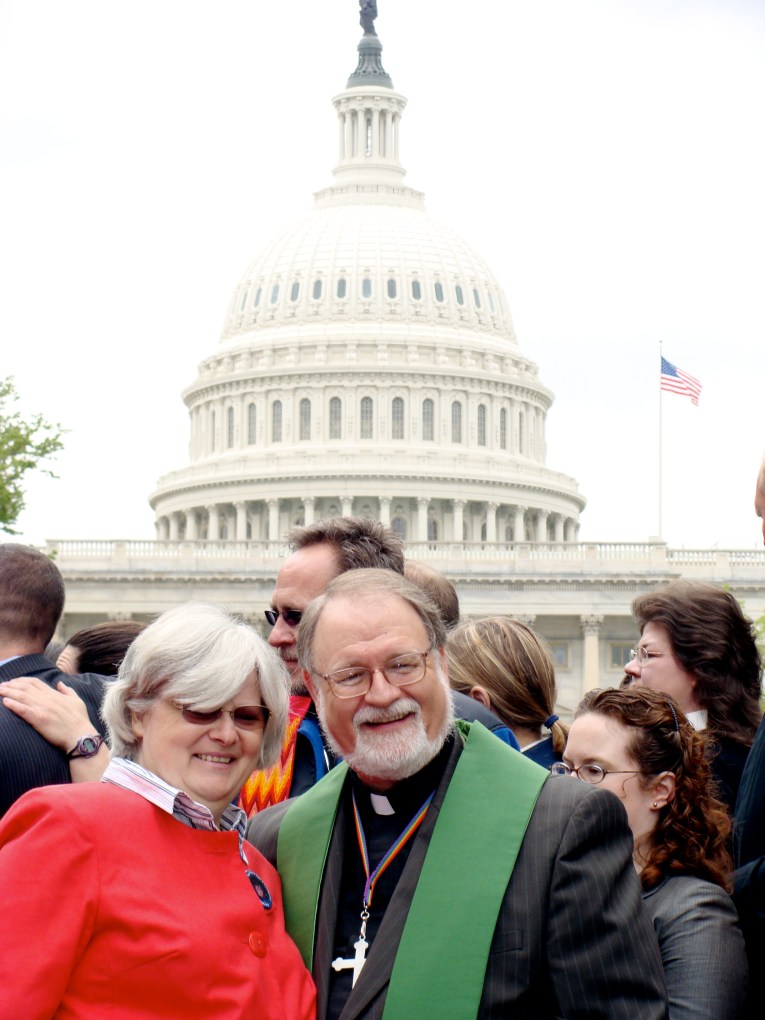
Elke Kennedy and Steve Sprinkle on Capitol Hill for HRC Clergy Call 2009
Michael Scott Goucher and the Deadly Web of Homophobia

Michael Scott Goucher
Michael Scott Goucher, 21, thought he was meeting Shawn “Skippy” Freemore, 19, for a second tryst when he left his Stroudsburg, PA, apartment on the night of February 3, 2009 (see Towleroad, “Internet Tryst Leads to Murder of Pennsylvania Army Veteran, 2/13/2009”). Instead, Goucher was being set up for murder. Goucher met Freemore online. According to his MySpace page, Freemore identified as bisexual, but more interested in men. After the initial meet up in January, Freemore enlisted his friend, Ian Seagraves, 17, to ambush Goucher.
Goucher followed Freemore out of his car in a wooded area off of Snow Hill Road in Price Township. Seagraves, who was hiding under a nearby bridge, surprised Goucher, stabbing him in the neck. During the attack, his two assailants stabbed Goucher “45 to 50 times” according to police affadavits. They rifled his pockets, taking credit cards, his ID, and a cell phone. A DVD belonging to Goucher was later confiscated at Seagraves’ home. They covered his body with snow, and drove his car away.

Ian Seagraves & Shawn Freemore, courtesy of Pocono Record
When he was arrested, Freemore contended that he had acted alone and used the “gay panic” defense, saying that he resisted Goucher’s sexual advances in the car, and only after Goucher pursued him outside, stabbed him in the neck and stomach “about 20 times.” On February 11, 2009, Freemore showed police the location of Goucher’s body. Detectives secured a knife and a meat cleaver near the body, and a roll of duct tape with Seagraves’ fingerprint under the bridge. Seagraves, who apparently celebrated his part in the murder by changing his MySpace moniker to “ThrOwt Stabba,” was soon arrested, and the pair is now charged with premeditated murder.
This is one murder the FBI will surely miss in its Hate Crimes Statistics. The murky details of online hookups, closeted gayness, and bisexuality mingle with drug and alcohol addiction (on Freemore’s part at least), theft, and the involvement of the teenage men in a violence-exalting subculture called “the Juggaloes.” Anti-gay hate murder has been facilitated online before, as the story of Michael J. Sandy showed in 2006, as well as the role that homosexual self-loathing plays in the psychological makeup of some attackers. But this was a brutal, homophobia-instigated and motivated hate crime.

Michael Goucher at the Zion UCC organ
Goucher, a U.S. Army veteran, was a contributing member of his community. He worked for the local school system, and volunteered as the assistant organist of the Zion United Church of Christ in Stroudsburg, where he had impressed the pastor and the membership with his talent, sincerity, and friendliness. He was captain of the East Stroudsburg Crime Watch. He was a gay man. Though he came out to his family as early as 14, according to his uncle, William Searfoss, Goucher did keep his orientation from his Army superiors.
His killers will be judged according to the evidence. Allegedly, they own the guilt for this terrible crime. But Freemore and Seagraves are, in their own ways, victims of American-style homophobia, too. They were products of the same school system as Michael Goucher. They loathed gay men enough to turn a consensual sexual encounter into a bloodbath, with all the marks of homophobic overkill. They victimized Michael Goucher, giving way to their own self-loathing.
UPDATE: Following a Supreme Court ruling that juveniles cannot be sentenced to life without parole, Ian Seagraves was given a new hearing in hopes of securing a lesser sentence. His attorney filed a petition to the court based on the Supreme Court decision. But the judge was unmoved by the arguments, and after hearing the profanity laced lyrics of Seagraves’ song about the Goucher murder, reaffirmed the sentence Seagraves was serving. Goucher’s uncle, William Searfoss, said to PA Homepage, that the focus of the story can now return to Michael Goucher: “This isn’t about [Seagraves]. This is about Mike.”
Ten Years Later: Remembering Matthew Shepard

Sunday, October 12 marks the tenth anniversary of Matthew Shepard’s death. In honor of this important day, I offer an excerpt of a chapter in my forthcoming book, Unfinished Lives: Reviving the Memories of LGBT Hate Crimes Murder Victims. The chapter is entitled, “The Second Death of Matthew Shepard.”
Another Mother’s Day came and went. Another Father’s Day, too. Matt Shepard’s chair is empty in the Shepard home in Casper, Wyoming: no card from him, or roses for his mom; no tie or set of slippers for his dad–for over ten years. His parents, Judy and Dennis Shepard, and his younger brother, Logan, miss him everyday.
At the center of advocacy for LGBT freedom remains the enigmatic memory of the young, blond man trussed to a buck fence in Laramie, Wyoming. He has become the symbol for the hurts and hopes of lesbians, gay men, bisexual people, and transgender folk, both here and abroad. Curiosity or outrage at what happened to him usually begins the change in heart and attitude about hate crimes for the millions who hear his story. That alone is reason enough to tell and retell Matt’s story, and the stories of so many other LGBT people who have died so brutally. But are we any closer to understanding the real person, or is that person locked away behind the closed door of a decade of myth-making and amnesia? For most Americans, other than his family and his closest friends, the only way we come to know him is through the veil of the savagery that cut his life short. He suffered the dying, but we deal with the effects of his death.
There may be no way to recover who Matt Shepard was: the complicated young man who comes to life when his mother talks about his passionate opinions, his flashing temper, his generosity to a fault, his love of politics, his hopes of becoming a human rights advocate… and, we must add, his disturbing naïveté. The person he might have been is long gone. Like Beth Loffreda says, what we have left is the “whiplash” of his memory, haunting Laramie and haunting us, luring and stinging the conscience of our violent American society. Forgetfulness seems not to work. We can neither forget him, nor should we. In telling and retelling how his life ended lies the hope that a grace of transformation may seize us. Justice may yet be done, and hatred may change gradually into acceptance: of LGBT people by others and by themselves, of those who strike out against persons they fear and do not understand, and ultimately, of the need to grant each other room to live and let live.
Rest in peace, brother. We who survive you cannot, yet. We have much work to do.
Stephen V. Sprinkle
Director
The Unfinished Lives Project
Remembering Satendar Singh

July 21 marks the birthday of Satendar Singh, the victim of a 2007 anti-gay hate crime in Lake Natoma State Park in California. Russian evangelical Christians mobbed Satendar, shouted homophobic slurs, and beat him severely enough to cause a fatal brain injury. What began as a day to picnic and dance with friends is now a day of mourning for the LGBT community.
On Satendar’s birthday, we remember and celebrate his life. Singh would have been 28 years old today.
This “Being Gay Today” video describes the events leading to Satendar Singh’s death:
About

If you are a first-time visitor to the Unfinished Lives Project website, we invite you to read A Welcome Message introducing you to our project. We are truly grateful for your visit.
The Unfinished Lives Project website is a place of public discourse which remembers and honors LGBTQ hate crime victims, while also revealing the reality of unseen violence perpetrated against people whose only “offense” is their sexual orientation, gender identity, or gender presentation. LGBTQ people in the United States are suffering a slow-rolling decimation of terror and murder all across the country. Every locale and demographic of society are affected: First Nations, Anglo, Black, Latino and Latina, South and Southeast Asian, Transgender, Bisexuals, Gay men, Lesbians, disabled, young, and mature. Homophobia has a long, crooked arm, and it is reaching out to snatch the life away from women and men whose tragic stories are under-reported to begin with, and whose memories are swiftly forgotten.
The horror of these killings transcends the shock and bereavement of loved ones and friends. These are not typical homicides; they are not killings for money or drugs, incidents of domestic strife, or crimes of passion. The vicious nature of hate crimes against LGBTQ persons is extremely brutal, grotesquely violent, and egregiously hateful.
Each murder serves the LGBTQ population as a sobering warning about the actual level of danger in our communities. The message these killings send is that freedom and open life for LGBTQ people is a cruel dream. Every time we remember one of these victims, however, the intentions of their killers are frustrated. To remember these women and men is to begin the process of changing the culture that killed them.
Our Project Director
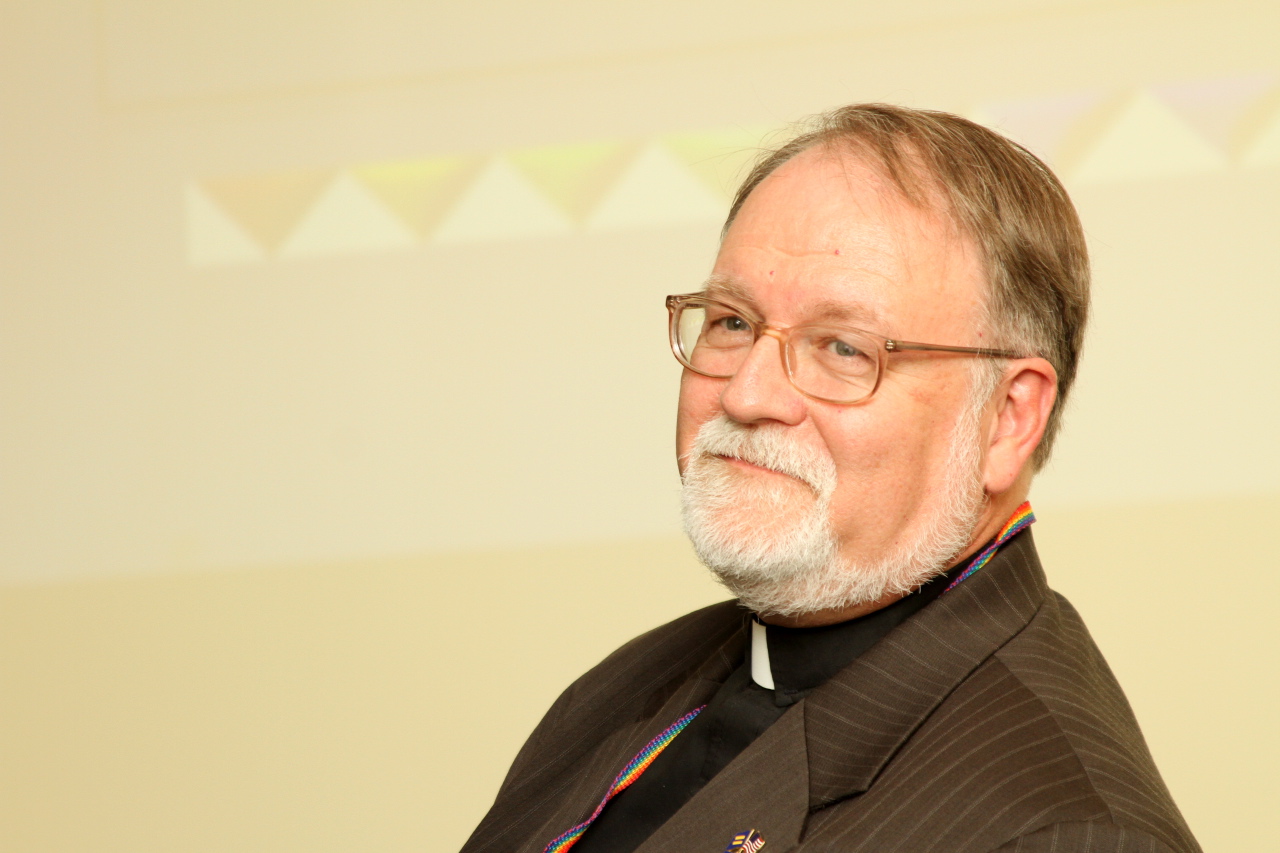
Dr. Stephen V. Sprinkle (Keith Tew photo).
Stephen V. Sprinkle is Director of Field Education and Supervised Ministry, and Professor of Practical Theology at Brite Divinity School, Fort Worth, Texas, a post he has held since 1994. An ordained Baptist minister, he is the first open and out Gay scholar in the history of the Divinity School, and the first open and out LGBTQ person to be tenured there. Read More…
Recent Social Justice Advocacy Activity By Dr. Sprinkle
 Summer 2009 – Dr. Sprinkle responded to the Fort Worth Police Department and Texas Alcoholic Beverage Commission Raid on the Rainbow Lounge, Fort Worth’s newest gay bar, on June 28, 2009, the exact 40th Anniversary of the Stonewall Rebellion. Dr. Sprinkle was invited to speak at three protest events sponsored by Queer LiberAction of Dallas. Here, he is keynoting the Rainbow Lounge Protest at the Tarrant County Courthouse on July 12, 2009. Read More…
Contact Us
Communicate with the Unfinished Lives project team:
info@unfinishedlivesblog.com


Schedule a Presentation
Dr. Sprinkle will gladly present his acclaimed presentation to your organization. To arrange an Unfinished Lives presentation for your organization or group, please contact us.
Dr. Sprinkle has given his Unfinished Lives presentation to these and other community groups and organizations. Read More…
-

Where are our readers?
Publisher: Steve Sprinkle (Project Director)
Steve Sprinkle
Unfinished Lives: Remembering LGBT Hate Crime VictimsBrite Divinity School/Texas Christian UniversityFort Worth TXprofessor, minister, author, blogger, LGBTQ advocate


Follow Unfinished Lives on Facebook
 Box Turtle Bulletin
- An error has occurred; the feed is probably down. Try again later.
- HRC Back Story
- Know About The Gender Identity Movement
- Why Is There A Need For Human Rights?
- Kinds Of Human Rights
- Human Rights Purposes And Violations
- Human Rights For Every Human Incident
- 8 Reasons Human Rights Are Important
- Everything About Human Rights
- Human Rights Issues Education & Law
- We Need To Stand Up For Our Rights And Those Of Others
- Coca-Cola Receives Perfect Score On Human Rights
- The Advocate: Daily News
- Treasury secretary urges ‘a little empathy’ for Trump, who delighted in Robert Mueller’s death
- Want to support LGBTQ+ businesses? There's an app for that
- Senate blocks Trump-backed trans sports ban in Republican voting bill
- Officials say it’s ‘disgusting’ that Donald Trump is celebrating Robert Mueller’s death
- Donald Trump cheers former special counsel Robert Mueller’s death
- Robert Mueller, who investigated Trump and tested limits of presidential power, dies at 81
- Christian ‘Black Nazi’ Mark Robinson admits to porn obsession he denied while campaigning
- ‘I will not comply’: Tennessee librarian refuses to move LGBTQ+ books
- Fewer young Americans support LGBTQ+ protections, survey finds
- Tennessee bill could create public registry of trans residents’ medical info
- Dallas Voice: Instant Tea
- An error has occurred; the feed is probably down. Try again later.

 Unfinished Lives
Triangle of Terror: Gays On Their Guard
Police in body armor outside US Holocaust Museum (Shawn Thew/European Pressphoto)
Steven Domer murdered by white supremacist
Steven Domer of Edmonton, Oklahoma, was brutally murdered in October 2007 by Darrell Madden, a white supremacist recently released from prison. Madden, a member of the Aryan Brotherhood, garroted Domer with a wire clothes hanger after binding him with duct tape. Domer’s body was found in a ravine in McClain County. Investigators believe that Madden’s motive was to earn his “patch” from the Aryan Brotherhood, a sign of distinction awarded to a member who murders a Jew, a black, a homosexual, or anyone deemed to be an “enemy” by the group. In October 2008, Madden was found guilty of first degree murder and abduction, and sentenced to four consecutive life terms. The Domer murder and others like it offer a warning to the LGBT community in a time when hostility is clearly on the rise against same-sex marriage, the Matthew Shepard Act, ENDA, and the proposed repeal of both DOMA and DADT. Hate crime statistics demonstrate an upward spiral of violence in Michigan, Tennessee, Minnesota, and California. LGBT Americans share the vulnerability of other targeted groups, and decry the violence perpetrated by religious bigotry, misguided nationalism, racial hatred, and misogyny. The need for the passage of a sexual orientation, gender identity and gender expression hate crimes law has never been greater, given the rising tide of bias-related hate crimes chilling whole segments of the American population. Fear may isolate and paralyze people. Resolve to face hate and fear with justice and hope can unite people, as well. Now is the time for coalition building, rejection of irrational hatred wherever it arises, and a mutual commitment to the health and safety of all Americans. Gays, lesbians, bisexuals and transgender people already know how important vigilance and solidarity in the face of terror are. So do women, Jews, and Blacks, all of whom have been affected by these deplorable killings in recent weeks. Perhaps this time those targeted by the radical right will learn how to stand together, and rally the country to repudiate these senseless acts of violence. We at The Unfinished Lives Project devoutly hope so.
Share this:
June 11, 2009 Posted by unfinishedlives | anti-LGBT hate crime murder, Anti-Semitism, Arkansas, California, Kansas, Racism, religious intolerance, Social Justice Advocacy, Special Comments, Strangulation, Tennessee, Washington, D.C. | African Americans, Anglo Americans, Don't Ask Don't Tell (DADT), gay men, gun violence, Hate Crimes, hate crimes legislation, Matthew Shepard Act, military, Neo-Nazis and White Supremacy | 3 Comments