Outrageous Verdict in the Sucuzhañay Hate Murder Case; Con Escapes Life Sentence
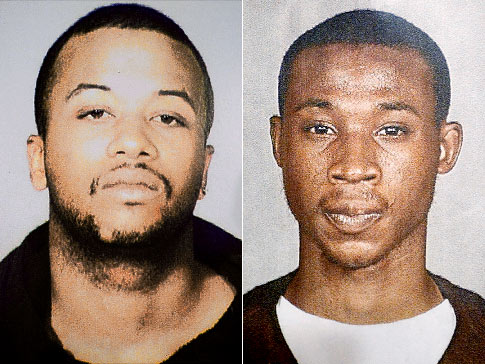
Keith Phoenix (l) and Hakim Scott (r) - NYPD mugshots
Brooklyn, NY – Testimony in Brooklyn’s Supreme Court corroborated Romel Sucuzhañay’s contention, that two young men attacked him and his brother, José Sucuzhañay, wielding a broken beer bottle and an aluminum base ball bat, screaming anti-Latino and anti-gay slurs. The assault left José with a broken skull. The Ecuadoran immigrant, 31 years old, living in the Bushwick section of Brooklyn, lingered in a coma for five days, dying just before his mother got to his bedside from Ecuador. Any reasonable person would call that a hate crime. Not the Brooklyn jury, however. They bought the defense line, that Hakim Scott, 26, was caught up in an unfortunate “escalating fight.” It did not seem to matter that a the prosecution established that Scott, who broke his beer bottle over José’s head before menacing Romel with the jagged glass, had dazed José to the point that his accomplice, Keith Phoenix, had an easy target as he lethally swung his bat. On May 6, the jury found Scott guilty, not of first or second degree murder and hate crime, but first degree manslaughter, allowing him to escape a life sentence for snuffing out an innocent man’s life. Scott and Phoenix didn’t like the Sucuzhañay brothers because they were Hispanic, and they appeared to be gay. While Scott will face a possible 40 years in prison for his manslaughter conviction when he is sentenced on June 9, it is hard not to say that there was a travesty of justice in this case. Now, because a juror refused to hear any more testimony in the Phoenix case, Judge Patricia Dimango has declared a mistrial, and the Sucuzhañay family and their supporters will have to wait further agonizing weeks to learn whether the 31-year-old ball bat perp will escape the full force of the law, too. Latinos, especially Ecuadorans, are outraged by the verdict. So are LGBT people. And justice has not been done for José Sucuzhañay. It seems that living at the intersection of two discriminations is very dangerous place to be in America.
Slain Ecuadoran’s Supporters Denounce One Brooklyn Verdict; Await Another
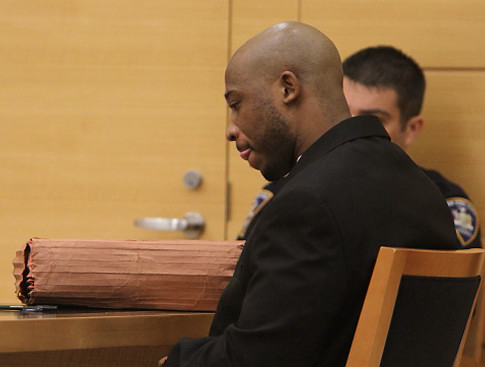
Hakim Scott listens to closing arguments in his trial for the murder of José Sucuzhañay (Ward photo for the Daily News)
Brooklyn, NY – Hakim Scott, 26, killer of Ecuadoran Immigrant José Sucuzhañay, escaped conviction for murder, but was convicted of manslaughter by a jury in Brooklyn Supreme Court on Thursday. No hate charge was sustained against Scott for the brutal slaying of the 31-year-old Sucuzhañay, who along with his brother Romel was mistaken as a gay man. The brothers were walking arm-in-arm against the cold early on December 7, 2008 in the Bushwick section of Brooklyn when Hakim and Keith Phoenix, hurling anti-gay and anti-hispanic epithets, attacked them with a beer bottle, their heavily shod feet, and an aluminum baseball bat. Family and friends of the victim swiftly denounced the verdict as soft and wrong-headed, according to several news sources. The New York Daily News reports that José’s brother Diego, vigorously maligned the verdict, saying, “There was testimony that these words of hate were used. We believe right now would have been a perfect time to send a message against hate, intolerism [sic] and racism.” On Friday, the Columbus, IN Republic interviewed Christine Quinn, speaker of the New York City Council, as she stood with Sucuzhañay’s three brothers outside the courthouse, “Look, two brothers were walking home. They weren’t bothering anybody. All of a sudden two guys jump out of a car and beat José and leave him for dead, calling him anti-gay and anti-immigrant names? That’s a hate crime,” she said. The Latin American Herald Tribune reported that Quinn further defined what kind of hate crime Sucuzhañay suffered: “Jose Sucuzhañay was murdered because Hakim Scott and Keith Phoenix did not like who he is and who they thought he was,” Quinn said. “And they attacked him, by all accounts, for no other reason than their hatred of the LGBT (lesbian-gay-bisexual-transgender) community and their hatred of Latinos and immigrants. That’s what killed Jose Sucuzhañay.” Quinn, Brooklyn Congresswoman Nydia Velazquez, and a number of other elected officials believe that the manslaughter verdict, which may entail a 25-year prison term for Scott, to be too lenient for such a savage killing. Diego, speaking for the Sucuzhañays on the courthouse steps during a Friday press conference, said, “The judicial system has failed to send a clear message. Our family still can’t understand how the jury has come to the conclusion that the attack on my brothers and the murder of José was not motivated by hate,” according to the LAHT. The trial of Keith Phoenix, who allegedly swung the bat so hard that it burst his victim’s skull, is still proceeding. The 30-year-old African American is being tried before a second jury seated in the same courtroom as the jury that convicted Scott of manslaughter. Phoenix is charged with murder and murder as a hate crime in the case. Members of the Scott jury who were willing to speak to the press speculated that Phoenix may likely be convicted of a hate crime for his part in the grisly bludgeoning of the Ecuadoran businessman. A verdict in his trial is expected sometime next week. As supporters await the Phoenix verdict, Walter Sinche, Director of the international Ecuadoran Alliance told a reporter for the Daily News, “Someday maybe we’ll get justice. Hopefully, these types of attacks will stop.”
The Long Ordeal of Craig Cohen
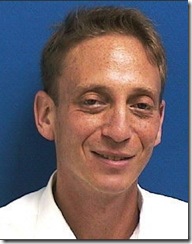 Fort Lauderdale. Florida – Over a year ago, Craig Cohen, 47, “the little guy with a big heart,” lost his life to a gay-bashing. He died October 7, 2009 in a coma from complications suffered from the fatal attack that crushed his skull in Oak Park on April 6. Since the night of his assault, Cohen never regained consciousness. Surrounded by his human family and friends, and the rescue animals who were his beloved “kids,” gentle Craig breathed his last in a hospice room. Six brain surgeries failed. The awful vigil by his bedside had come to a close. But the Ordeal of Craig Cohen is far from over. The four young men accused of attacking him, Pargu Leandro, 25, Victor Gonzalez, 21, Brandon Edwards, 19, and Chad Olah, 18, are still in the Broward Sheriff’s Main Jail, charged with first-degree murder. The courts, according to fresh reports on the Facebook honor site, “Love for Craig Cohen,” are moving at a glacial pace, plagued by motions to postpone hearings. Nothing can be resolved until two things are finally accomplished: First, the trials must bring to light the facts and the motives that prompted these four suspects to target Cohen and a second victim, David Villanova, and brutally beat these two gay men who were each alone and vulnerable on a dark street. The quartet are charged with stomping in Cohen’s face and skull, crushing his facial bones, blinding him, leaving him paralyzed and severely brain damaged. Reports suggest that the suspects took turns kicking him, laughing about what they were doing to the little man. The Broward Sheriff’s Office has considered this attack a robbery, and has investigated it that way, although the alleged robbers never stole a thing from Cohen. His Facebook friends write, “when Craig was found and taken to Broward General, he had his wallet, credit cards, cash and his watch.” Apparently one of the attackers kicked his cell phone out of his hand as he was trying to call 911. According to a report given to the Broward Palm Beach New Times, one of the bashers lifted the phone and gave it to a homeless man down the street. As the informant said to BPBT, that “doesn’t sound like a robbery to me.” From the beginning, his friends have firmly believed that their beloved Craig was killed because he was gay. Second, the cause Craig Cohen dedicated his life to must be supported: his determination to provide shelter and a home for animals who lost their human parents due to illness or sudden death. Craig was a long-time senior employee of the school board. He had barely a year to go before he could retire with 25 years under his belt, and open the shelter of his dreams. Since he was a boy, Craig had loved and rescued animals. He had purchased a tract of land out in the country in northern Florida for his animal sanctuary. Craig left behind his dog Eddie and his five indoor cats, orphaned by his death, just as the many pets left behind after the deaths of other human parents had been. Eddie was adopted by close friends. The cats, some of them 14 years old, were harder to place. The Craig Cohen Animal Advocacy Project (CCAAP), http://www.petprojectforpets.org, has been founded in Craig’s memory to find new parents for orphaned animals, in fulfillment of this gentle gay man’s dream. The LGBT community of Wilton Manors and Fort Lauderdale miss Craig Cohen. So do the food banks, the homeless shelters, and the animal protection agencies he worked so tirelessly to support. Craig will have his day in court, many days to come, it seems. Craig’s cause has found and will continue to find support among those who loved him, and those of us who have come to admire the “little guy with the big heart.” But his ordeal will not be over until senseless attacks against LGBT people in Florida and around the nation finally cease, and in their place we finally learn to treat each other at least as mammals, and not as things.
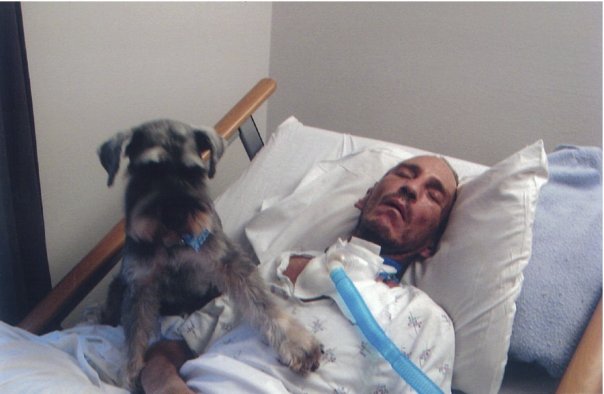
In the hospice, with his beloved Eddie
Transphobic Attacker Slashes “IT” into Chest of Victim
 Long Beach, CA – A Cal State Long Beach graduate student who identifies as a transgender man was forced into a campus toilet stall on April 15 and had the word “IT” carved into his chest with a sharp instrument. The mystery attacker, depicted to the left in a police composite sketch, approached his mark in a men’s toilet on the west side of the campus at around 9:30 pm. He somehow knew his victim’s name, asking if his name was “Colle.” When Colle Carpenter, a 27-year-old F to M graduate student, said yes, the attacker pushed his target into the stall, forcing him against the stall door. He grabbed Carpenter by the T-shirt, yanking it up over his head and exposing his bare chest, as reported by the Long Beach Press-Telegram. After slashing Carpenter, the assailant rushed form the scene, leaving his victim bleeding, shaken, and terrorized. The suspect, described as a 5-foot-10-inch, thin white male with light complexion and dark hair, has neither been identified nor apprehended as of this writing. He was wearing a dark hooded sweatshirt and dark khaki shorts, according to Rick Gloady, a spokesperson for CSULB. As the investigation has proceeded, some community organizations have criticized the university for not immediately releasing information about the attack to the press. Carpenter, however, defended the school’s actions to the L.A.Times blog, L.A.Now, “I’m aware the university has come under some criticisms regarding communications and response, in general,” he said. “But again, I feel that the administration’s response has been focused on the investigation and my wellbeing.” Scores of concerned students and townspeople gathered in support of Carpenter and all victims of transphobia on campus this past Thursday for a “Take Back the Night” march and rally. Carpenter, still recovering from his injuries and leaning on a cane, told the crowd that his attacker was motivated by hatred. The word carved into the flesh of his chest was chosen to demean him as a human being, trying to make him feel “less than human.” But his foe ultimately failed. “I am not less than human,” he told his supporters, “I am not more than or less than anyone standing here today.” Carpenter went on to say, “I know this did not just happen to me. This happened to every member of the community. Those of us who are visibly queer are scared. I have been terrified to come back to campus.” He concluded his remarks, “Thank you for helping me get through this.” Campus officials said that the slashing attack was a one-of-a-kind incident, and do not expect there to be another like it. Meanwhile, the manhunt continues for the transphobic suspect who signs his bigotry in the flesh and blood of his victims.
Anti-Gay, Anti-Latino Murder Trial in Brooklyn; Assailants “Didn’t Like the Way They Looked”

José Sucuzhañay
Brooklyn, New York – After a year and a half, a murdered Ecuadoran immigrant mistaken as gay may get some justice. José Sucuzhañay, 31, a native of Ecuador with a real estate brokerage in New York, was savagely dispatched with a beer bottle, kicks and stomps, and an aluminum baseball bat, according to testimony reported by media throughout the Five Boroughs of New York. The trials of Hakim Scott, 26, and Keith Phoenix, 30, got underway in Brooklyn Supreme Court on April 10 for the 2008 murder of Sucuzhañay. Charges against the pair include second-degree murder, manslaughter, assault, and murder as a hate crime. If convicted, the alleged killers could face sentences of 78-years-to-life imprisonment. The defendants are being tried simultaneously before separate juries in a precisely choreographed judicial drama. At times, both juries are seated to hear the same testimony. At other times, dictated by the presentation of evidence, only one jury is present in the courtroom. As reported by the New York Times, José Sucuzhañay and his brother, Romel, visiting from Ecuador, were attacked at 3 a.m. on December 7, 2008 in the Bushwick section of Brooklyn because Scott and Phoenix “didn’t like the way they looked.” Prosecutor Josh Hanshaft, referring to Phoenix who allegedly wielded the bat, told the juries, “He didn’t like that they were Hispanic. From his eyes, it appeared they were a gay couple, a way of life he didn’t like and wasn’t going to tolerate.” In reality, both men were heterosexual. The Latino brothers had been drinking at parties in the neighborhood and were tipsy enough that they uninhibitedly hugged each other for support and warmth on a bitterly old night as they walked along. The attackers, who had also been partying that night, set upon them, yelling “faggot ass niggers” and “fucking Spanish,” from Phoenix’s red SUV. The prosecution believe that both assailants acted in concert to effect their victim’s death. Scott, Hanshaft said, emerged from the auto and smashed a beer bottle over José’s head. He then charged Romel with the deadly shards of broken glass, slashing at his neck. Phoenix took the bat, swinging it “high above his head,” and struck Sucuzhañay “over and over and over again,” Hanshaft said. “He came back with the bat and hit him two to three times on the head, cracking his skull wide open.” A Brooklyn cabbie at the scene witnessed the attack well enough to capture the license plate of the red SUV, but then had to cover his eyes with his hands, unable to watch the coup de grâce delivered by Phoenix. As reported by Chelsea Now, taxi driver Davi Almonte, speaking through an interpreter, told the court, “I didn’t want to see the head explode when it was hit. I could hear the impact [of the bat crushing his skull].” According to NY1, in testimony on the trial’s second day, Demetrius Nathaniels, cousin of Keith Phoenix, heard the bones cracking as Phoenix bludgeoned Sucuzhañay with the bat on his head, back, side and ribs. A coroner’s report confirmed that José died of a fractured skull from blunt force trauma. Romel, only superficially injured by Scott’s assault, was left stunned, nearly catatonic by the body of his brother who lay in a massive pool of blood, and had to be led away by police responding to the alarm raised by witnesses. The alleged killers sped from the scene. A toll booth video capture of the red SUV on the Triborough Bridge clearly shows Phoenix laughing and smiling barely 19 minutes after the fatal attack. Sucuzhañay was left brain dead, and placed on a ventilator at Elmhurst Hospital in Queens where he finally succumbed on December 12. An outpouring of grief and rage followed news of the murder, both in New York and in Sucuzhañay’s native Ecuador where the slain immigrant was given a near-state funeral attended by hundreds. New York Gay and Latino advocacy groups organized protests and vigils, while city officials roundly condemned the brutal killing. Philip J. Smallman, attorney for Phoenix, summed up the consensus of all concerned with events of December 7: “Does anything good happen at 3 o’clock on a Sunday morning in 30-degree weather, with people with bellies full of booze?” he asked. The Brooklyn trial is expected to last for a number of weeks.
Gay College Student Beaten by Homophobes, Ignored by Oklahoma Police
 Claremore, OK – A 24-year-old gay college student was beaten late last month by three men screaming anti-gay slurs as he took out the trash at his apartment complex. Phillip Nelson, an out and open gay man, was jumped and thrashed in the quiet town of Claremore, approximately a half hour drive north of Tulsa. Investigators have basically blown off the incident, leaving Nelson emotionally wounded in addition to his physical injuries (see photo at left). EDGE reports that Nelson is struggling to cope with the combination of brutal attack and police indifference to a hate crime against him. “I keep calling them and leaving voice mails but I never hear anything back,” Nelson said during an EDGE interview. “No one ever returns my calls, which has me wondering if they’re kind of trying to let this thing die out and go away, or if they are going to do anything about it.” Media coverage outside the gay blogosphere has been sparce. Besides the EDGE report, which according to Michael Lavers grew from a tip given by one of their readers, only one other story has appeared in the news media. Oklahoma lawmakers aver that laws protecting LGBT people are not needed in their state, and in a notorious move by State Senator Steve Russell, legislation has been introduced to circumvent the James Bryd, Jr. and Matthew Shepard Hate Crimes Prevention Act, signed into law by President Obama in October 2009. The Oklahoma House of Representatives has not yet voted on the bill, which passed the State Senate last month. Nelson’s case is a clear reason why protection statutes for LGBT Oklahomans is urgently needed. Nelson’s three attackers who remain unapprehended by local police as of this writing, assaulted him while screaming “You are going to die!” and “Faggot!” leaving him with multiple bruises and cuts on his face and over his body. Days later, his antagonists broke into Nelson’s apartment and scrawled “Fag” on the walls. Though Nelson reported the beating to Claremore police, no police report of the attack was filed until Nelson called in law enforcement for the break-in. Then, in what may have been an attempt to cover their tracks, the police insisted that Nelson file separate reports on both crimes. The whole ordeal has shaken Nelson, but as he told EDGE, he has had to face homophobia all his young life. “I’ve been called names all my life, even by my family members; and after a while I learned to get numb from it,” he said. “I just got numb from a lot of things. I’m happy with myself and that’s all that matters.” LGBT Oklahomans grow tough in the Sooner State. They have to.
Florida Lesbian Murdered by Girlfriend’s Father

Jerry Lee Seger, accused of the murder of his daughter's lesbian lover
Lakeland, FL – A man has been arrested Saturday for the murder of his daughter’s lesbian lover whose lifeless body was found in a foreclosed home. Real estate agents discovered the body of 24-year-old Courtney Bright last Thursday as they opened the property to show it to a prospective buyer. The Polk County Coroner reports that the victim had been strangled to death on Tuesday or Wednesday. Jerry Lee Seger, 40, has been charged with first-degree murder and is being held in the Polk County jail without bond, according to My Fox Tampa Bay. Bright had been in a romantic relationship with Seger’s 23-year-old daughter, Ashley Dunn, for approximately three years. Dunn had been arrested Tuesday of last week for dealing in stolen property on a Jackson County warrant. As has been the case in other Polk County LGBT murders, notably the brutal slaying of Ryan Keith Skipper in 2007, the Polk County Sheriff’s Department is constructing a non-gay-related scenario for the crime. Polk County, a largely rural locale situated between Tampa and Orlando in the center of the state, is notorious for poor treatment of its LGBT residents. Revenge against Bright for his daughter’s arrest is the story being floated to the press. Bright’s friend, Bobbi Johnson, however, isn’t buying the Sheriff’s theory. Johnson told My Fox Tampa reporter Alcides Segui, that Bright was like a daughter to her. “She was a sweetheart. She would do anything in the world for you,” she said. “I know [Seger] was upset because Ashely was arrested,” Johnson said. “That’s not why he killed her. He killed her because they were lesbians.” The Sheriff’s Department theory relies on hearsay from a friend of Seger’s, much like their 2007 theory that Skipper was killed on a lonely Wahneta, FL road because of hearsay reports about drugs and a check-kiting scheme that was later totally debunked, but too late to keep the young man’s character from being besmirched in the press, and also too late to prevent the story from going national. Skipper’s murderers, Joseph “Smiley” Bearden and William “Bill Bill” Brown were found guilty and are serving their sentences with no hope of parole. Veteran Florida LGBT activists and allies familiar with the Skipper case are watching the Bright murder case closely for signs of the same anti-gay spin from the local authorities. Scott Hall, founder of the South Florida-based Gay American Heroes Foundation, says, “We must hold those who attack and murder us responsible and call it what it is… a hate crime!”
Grief and Outrage Over Transgender Murder in Puerto Rico

Ashley Santiago's family learns of her murder; Israel González photo for Prima Hora
Corozal, Puerto Rico – The Washington Post reports that scores of sobbing mourners wearing tee shirts emblazoned with the likeness of Ashley Santiago Ocasio attended her funeral Friday in the central mountain town of Corozal. Her mother, Carmen Ocasio, told reporters from Prima Hora that her 31-year-old transgender daughter had no enemies she was aware of, no one she could imagine taking her life. “I lost my daughter,” she said. “I’m in shock. Why would someone kill Ashley, why?” Authorities are still searching for a lead in the case, but as the LGBT community in Puerto Rico has come to expect, authorities have not invoked the 2002 hate crime statute that would send a convicted killer to prison for life. Though the drumbeat of pressure is mounting for prosecutors to apply the unused hate crimes law to LGBT victims, prospects for doing so in this case do not look promising. Pedro Julio Serrano, spokesperson for the National Gay and Lesbian Task Force in Puerto Rico, points out that five recent crimes should have been designated terror-attacks against not only the victims, but the entire LGBT population. Hate crimes against members of the sexual minority are “message-crimes,” meant to drive the LGBT community into fear and hiding. As Serrano notes, one of the five recent cases was the November 2009 decapitation, dismemberment, and immolation of gay teen Jorge Steven López Mercado in Caguas. A charge of first-degree murder has been filed against the youth’s alleged killer, but the hate crime statute has not been invoked even in a slaughter so gruesome as this. In the Santiago case, police are speculating that robbery may have been a motive in the slaying of the popular, attractive beauty salon owner. Two evidentiary aspects of the investigation so far seem to argue against a robbery motive alone, however. First, Ms. Santiago’s home showed no signs of breaking and entering. Someone she knew probably carried out the murder. Even though her automobile was taken from the scene, as Pedro Serrano observed to the Post, “The law is very clear and we’re asking authorities to investigate without prejudice. Even if Ashley’s death was also a robbery, there could be the angle of hate. We need that to be investigated,” Serrano emphasized to the Post. The chief investigator has promised to used the Puerto Rican hate crimes law “if the evidence warrants it.” The second aspect of the murder that suggests Serrano is right, that hate against Ms. Santiago was probably a factor is the extreme nature of the crime scene. There was so much blood, so widely pooled and spattered, that police believed from the beginning of the investigation that the victim had been stabbed multiple times, hardly likely for a robbery alone. The overkill typical of anti-LGBT crimes is clearly present in the Santiago slaying. The community of Corozal is stunned in the wake of their most notorious murder. Ms. Santiago was well-liked in town, confident that her transition was the fulfillment of herself as a person. She had commenced hormone therapy, and had undergone breast surgery, according to Serrano. The usually neglected Transgender Community on the Caribbean island paradise is waiting for a break in the case, and firmly demanding justice for their sister Ashley.
Brutal Stabbing Death of Puerto Rican Transwoman Possible Hate Murder
 Corozal, Puerto Rico – Ashley Santiago’s mother pressed police to investigate why she had not heard from her daughter since Sunday, April 18. When law enforcement entered Santiago’s home on April 19 in Corozal, a municipality just 25 miles southwest of San Juan, they found her naked body in a large pool of blood collapsed on the kitchen floor. She had been stabbed 14 times, according to the report of authorities to El Nuevo Día. Police also reported that they could not find Santiago’s 2009 Toyota Corolla parked outside her home. EDGE Boston picked up the story overnight, and has flashed it across the United States’ LGBT blogosphere. Santiago, 31, was a popular hair stylist at a local salon. Echoes of the savage dismemberment-killing of gay teen Jorge Steven López Mercado in November 2009 still reverberate around the island. His alleged murderer, Juan A. Martínez Matos, has yet to stand trial for the beheading, butchery, and attempted immolation of his victim. After several postponements, Martínez Matos is docketed to stand trial for the murder of López Mercado in Caguas on May 3. While law enforcement officials have not yet designated Santiago’s murder as a hate crime due to the perceived sexual orientation or gender identity and expression of the victim, LGBT activists across the region are calling on police to invoke Puerto Rico’s seldom-used hate crimes statute which covers anti-LGBT hate crimes. Pedro Julio Serrano, noted San Juan activist who represents the National Gay and Lesbian Task Force in Puerto Rico, told EDGE, “The authorities have a legal obligation to investigate this hate angle. We urge the police and the prosecutor to appropriately investigate this murder; to determine whether it was motivated by prejudice and if there is enough evidence to classify it as a hate crime at this moment.” As Transrespect Versus Transphobia, a TVT monitoring agency in Europe reports, a transperson’s murder is reported every third day throughout the world, on average. for the last year and a half. Authorities acknowledge, however, the deep under-reporting of the actual number of transphobic murders.
Judge Rules Mistrial in Duanna Johnson Civil Rights Case: One Juror Hangs Federal Jury

Duanna Johnson, slain transwoman
Memphis, TN – A federal judge in Memphis has ruled for a mistrial in the case of former Memphis Police Officer Bridges McRae, on trial for violating Duanna Johnson’s civil rights. Memphis LGBT advocates are calling the decision “a failure of the justice system,” according to myeyewitnessnews.com. Johnson, a transgender woman of color, was repeatedly punched and beaten by McRae with handcuffs wrapped around his knuckles and pepper-sprayed as she was being processed for a prostitution charge at a Memphis police station on February 12, 2008. The beating was captured on a police surveillance tape, and reaction to the video prompted an immediate investigation resulting in the firing of McRae and a second officer, James Swain. Johnson had filed suit against the city on the basis of the videotape and the testimony of witnesses who declared that the brutal beating was unprovoked. Nine months later, as the New York Times reports, Duanna Johnson was shot to death with a bullet to the head on the night of November 9, 2008. Johnson’s murder, which remains unsolved, prompted intense scrutiny on the original beating case, and charges were filed in federal court for violation of the transwoman’s civil rights. Besides the controversial videotape of her beating, five witnesses testified in court that the attack on the 6’5″ 250 lb. Black transwoman was wanton, there being no reason for it in her behavior. Will Batts of the Memphis Gay and Lesbian Center, who had watched the surveillance tape repeatedly, said to myeyewitnessnews.com, “[The beating] looked to be unprovoked. It looked to be excessive on the part of the police officer. It looked to be just an attack on someone in a police station with other people standing around. And it was just incredibly violent.” McRae’s attorney argued that his client was simply exercising necessary force to subdue Johnson, blaming her for resisting arrest. Eleven jurors were convinced of McRae’s guilt. One was not, however, and after the jury deadlocked, the judge declared the mistrial. The Memphis LGBT community refused to take the news lying down. A rally in protest of the judge’s ruling will take place April 20 in front of the Federal Courthouse. “Would it have been different if Duanna were not transgendered,” Batts asked in a press interview. “If it were just an average person from the suburbs that happened to be sitting in that jail room on that day and had this kind of response from the police, would the decision be different?” Both the prosecution and the defense are to meet with the judge to determine a date for a new trial for McRae.
About

If you are a first-time visitor to the Unfinished Lives Project website, we invite you to read A Welcome Message introducing you to our project. We are truly grateful for your visit.
The Unfinished Lives Project website is a place of public discourse which remembers and honors LGBTQ hate crime victims, while also revealing the reality of unseen violence perpetrated against people whose only “offense” is their sexual orientation, gender identity, or gender presentation. LGBTQ people in the United States are suffering a slow-rolling decimation of terror and murder all across the country. Every locale and demographic of society are affected: First Nations, Anglo, Black, Latino and Latina, South and Southeast Asian, Transgender, Bisexuals, Gay men, Lesbians, disabled, young, and mature. Homophobia has a long, crooked arm, and it is reaching out to snatch the life away from women and men whose tragic stories are under-reported to begin with, and whose memories are swiftly forgotten.
The horror of these killings transcends the shock and bereavement of loved ones and friends. These are not typical homicides; they are not killings for money or drugs, incidents of domestic strife, or crimes of passion. The vicious nature of hate crimes against LGBTQ persons is extremely brutal, grotesquely violent, and egregiously hateful.
Each murder serves the LGBTQ population as a sobering warning about the actual level of danger in our communities. The message these killings send is that freedom and open life for LGBTQ people is a cruel dream. Every time we remember one of these victims, however, the intentions of their killers are frustrated. To remember these women and men is to begin the process of changing the culture that killed them.
Our Project Director
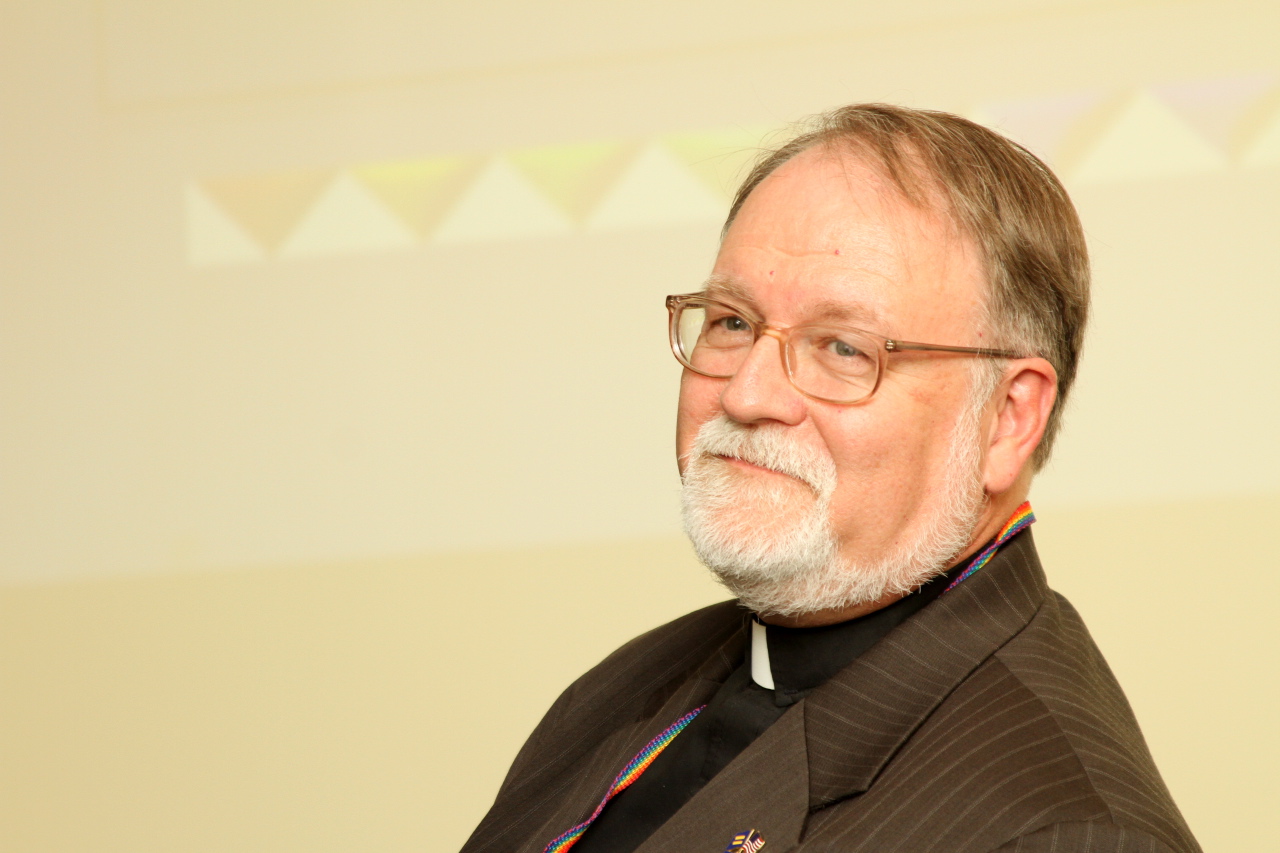
Dr. Stephen V. Sprinkle (Keith Tew photo).
Stephen V. Sprinkle is Director of Field Education and Supervised Ministry, and Professor of Practical Theology at Brite Divinity School, Fort Worth, Texas, a post he has held since 1994. An ordained Baptist minister, he is the first open and out Gay scholar in the history of the Divinity School, and the first open and out LGBTQ person to be tenured there. Read More…
Recent Social Justice Advocacy Activity By Dr. Sprinkle
 Summer 2009 – Dr. Sprinkle responded to the Fort Worth Police Department and Texas Alcoholic Beverage Commission Raid on the Rainbow Lounge, Fort Worth’s newest gay bar, on June 28, 2009, the exact 40th Anniversary of the Stonewall Rebellion. Dr. Sprinkle was invited to speak at three protest events sponsored by Queer LiberAction of Dallas. Here, he is keynoting the Rainbow Lounge Protest at the Tarrant County Courthouse on July 12, 2009. Read More…
Contact Us
Communicate with the Unfinished Lives project team:
info@unfinishedlivesblog.com


Schedule a Presentation
Dr. Sprinkle will gladly present his acclaimed presentation to your organization. To arrange an Unfinished Lives presentation for your organization or group, please contact us.
Dr. Sprinkle has given his Unfinished Lives presentation to these and other community groups and organizations. Read More…
-

Where are our readers?
Publisher: Steve Sprinkle (Project Director)
Steve Sprinkle
Unfinished Lives: Remembering LGBT Hate Crime VictimsBrite Divinity School/Texas Christian UniversityFort Worth TXprofessor, minister, author, blogger, LGBTQ advocate


Follow Unfinished Lives on Facebook
 Box Turtle Bulletin
- An error has occurred; the feed is probably down. Try again later.
- HRC Back Story
- Know About The Gender Identity Movement
- Why Is There A Need For Human Rights?
- Kinds Of Human Rights
- Human Rights Purposes And Violations
- Human Rights For Every Human Incident
- 8 Reasons Human Rights Are Important
- Everything About Human Rights
- Human Rights Issues Education & Law
- We Need To Stand Up For Our Rights And Those Of Others
- Coca-Cola Receives Perfect Score On Human Rights
- The Advocate: Daily News
- Backlash grows after Pete Hegseth alters military general promotions list
- South Carolina Senate passes bill restricting transgender students’ bathroom use
- Breaking newsletter: Idaho bathroom bill
- Idaho Senate Republicans send extreme anti-transgender bathroom bill with felony penalties to governor
- Tennessee House passes de facto transgender registry bill
- Democrat Chris Pappas in dead heat with John Sununu in New Hampshire Senate race
- Cities in Texas and Florida install new rainbow walkways as Republicans crack down on Pride crosswalks
- This gay economist running for Congress in California makes his case on the economy
- While claiming Iran’s new leader is gay, Trump says ‘YMCA’ won him the gay vote. It didn’t
- Idaho Senate Republicans rush toward passing transgender bathroom criminalization bill
- Dallas Voice: Instant Tea
- An error has occurred; the feed is probably down. Try again later.

 Unfinished Lives