Ricky Martin Criticizes Move to Drop Gay Protections from Puerto Rico Law
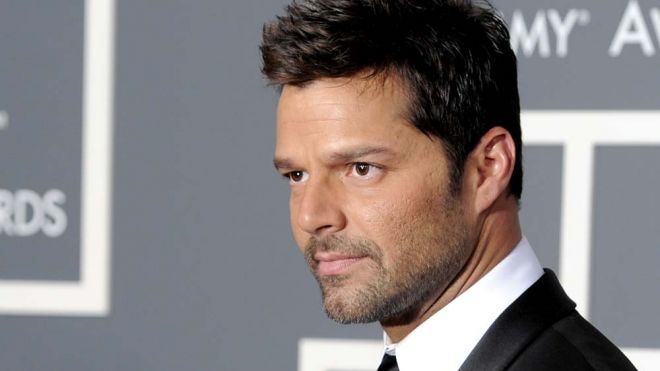
Ricky Martin speaks out against change in Puerto Rican penal code (AP photo).
Ricky Martin, Latino Superstar, blasted politicians in his home commonwealth of Puerto Rico for seeking to remove gay people from legal protection from bias-motivated hate crimes, according to Fox News Latino. Martin posted a strong statement on his website blog denouncing the move. In part, he said:
“I am very saddened by the turn the discussion on criminal law has taken in Puerto Rico that proposes to eliminate the aggravating in cases where crimes are committed by prejudice against the victim.” Martin went on to say, “They ought to do their homework and review the Universal Declaration of Human Rights a bit…which says that everyone – all citizens – are equal before the law and have, without distinction, the right to equal protection under the law.”
Martin’s opposition to the change in Puerto Rico’s hate crimes law comes at a time when the numbers of anti-gay and transgender hate crimes are reaching epidemic proportions. His voice will help amplify the protests of local LGBT and Dominican activists who are fighting the passage of the amendment in the legislature. In March 2010, Martin came out openly as a gay man, ending years of speculation by the public. On his website, he said, “I am proud to say that I am a fortunate homosexual man. I am very blessed to be who I am.” After years of declining to comment on his sexual orientation, Martin said, “These years in silence and reflection made me stronger and reminded me that acceptance has to come from within, and that this kind of truth gives me the power to conquer emotions I didn’t even know existed.” Now the father of two young sons , Matteo and Valentino, who were born of a surrogate mother in 2008, Martin took citizenship in Spain in 2011, where he intends to marry his lover. Though he could be married in certain states in the U.S., he has said he wishes to marry in Spain to acknowledge the work of LGBT rights advocates and Prime Minister Zapatero there.
One of the motivators Martin says moved him to come out publicly as a gay man was the gruesome murder of Jorge Steven López Mercado in 2009. The gay teen was abducted, dismembered, beheaded, and his remains were left burning along a rural road in central Puerto Rico. The savagery of the killing awoke the consciences of many on the Island besides Martin, though the numbers of violent attacks against LGBT Puerto Ricans has continued to rise. López Mercado’s murderer has been convicted, and is serving a 99-year sentence.
Hillary Clinton to the World: “Gay Rights are Human Rights”

Graphic from beingliberal.org on Facebook
Geneva, Switzerland – U.S. Secretary of State Hillary Clinton declared to the leaders of the world that LGBT rights must be a priority for the world community. As reported by the BBC, Secretary Clinton said in a speech to international diplomats at the Palais des Nations on International Human Rights Day, “Being gay is not a Western invention, it is a human reality.” In a powerful declaration of the full humanity of LGBT people, she refused to excuse discrimination against gay people because of religious beliefs or social mores: “Like being a woman, like being a racial, religious, tribal, or ethnic minority,” Clinton said to the U.N. audience, “being LGBT does not make you less human. And that is why gay rights are human rights, and human rights are gay rights.” Clinton reflects the policy power of the United States government, making it clear that, despite difficulties with allies who discriminate willfully against LGBT people, the Obama Administration will combat discrimination against gays, lesbians, bisexual people, and transgender people using foreign aid and diplomacy to promote change.
On violence against queer people around the world, Secretary Clinton acknowledged that there was still much to be done at home in the United States, where LGBT people were unindicted felons in 14 states as late as 2003 (when the Supreme Court in a 6-3 ruling struck down sodomy laws in Lawrence v. Texas), and many face attacks and all manner of bullying even today. Still, Clinton argued, “It is violation of human rights when people are beaten or killed because of their sexual orientation, or because they do not conform to cultural norms about how men and women should look or behave. It is a violation of human rights when governments declare it illegal to be gay, or allow those who harm gay people to go unpunished. It is a violation of human rights when lesbian or transgendered women are subjected to so-called corrective rape, or forcibly subjected to hormone treatments, or when people are murdered after public calls for violence toward gays, or when they are forced to flee their nations and seek asylum in other lands to save their lives.” The effect of these words on the continuing physical violence against LGBT people in the U.S. and throughout the world remains to be seen, but the results could be inestimable, according to Unfinished Lives Project Director, Dr. Stephen Sprinkle. “Today, Secretary Clinton served notice on all who perpetrate violence to terrorize LGBTQ people anywhere in the world that harm against this marginalized population will not be tolerated by civilized people. Cloaking anti-LGBT bigotry in religious or moral special rights is coming to a close,” Sprinkle, an ordained gay Baptist minister, said. “We are reaching the tipping point in the culture wars in this country, and the scales are falling in favor of security and justice for members of the gender variant and sexual minority. United States foreign and domestic policy has entered into a new era of advocacy for LGBTQ people on a par with racial/ethnic minority people, religious minorities, and women.”
Known for her advocacy for women and children, this speech indicates that the rights of LGBT people, always part of Mrs. Clinton’s public agenda, now has moved to a front-and-center priority for the most prominent woman in American politics. The speech was sweeping in scope, announcing that, in words redolent of the U.S. Declaration of Independence, gay rights are “inalienable.”
In the moving conclusion to her remarks, Secretary Clinton spoke directly to all gay people who find themselves persecuted and in fear of harm (and, by indirection, to their persecutors, as well): “And finally, to LGBT men and women worldwide, let me say this: Wherever you live and whatever the circumstances of your life, whether you are connected to a network of support or feel isolated and vulnerable, please know that you are not alone. People around the globe are working hard to support you and to bring an end to the injustices and dangers you face. That is certainly true for my country. And you have an ally in the United States of America and you have millions of friends among the American people.”
The full text of Secretary Clinton’s speech may be found on the State Department website by clicking here. A link to the full text of the speech, and video of Secretary Clinton delivering it, may be accessed on Huffington Post here.
High School Students Suspended for Roles in Rodenmeyer Bully-cide

Jamey Rodenmeyer,14, bullied by high school classmates
Williamsburg School District, New York – An unspecified number of North High School students have been suspended for bullying Jamey Rodenmeyer, who killed himself in September following unrelenting anti-gay harassment. The Advocate reports that the suspensions resulted from information shared by police after the Rodenmeyer case was closed. Though Amherst law enforcement authorities declined to bring charges against students in the case, they identified at least five incidents of anti-gay bullying aimed at Rodenmeyer, a 14-year-old freshman. The boy’s parents and school officers were not informed of the bullying incidents in question until it was too late.
School officials would not say the number of students suspended, but indicated that each of them faced a “minimum suspension” of at least five days. Longer term suspensions may have been invoked, as well, though expulsion from school is not permitted for youths of this age. These suspensions mark the second round of actions taken by the school system since Rodenmeyer’s death. A female student who said she was “glad he was dead” was suspended soon after the suicide. Rodenmeyer, whose “It Gets Better” YouTube video gained wide circulation and the attention of Lady Gaga, took his life by hanging on September 18.
Gay Hate Crimes in Puerto Rico? Not Any More?
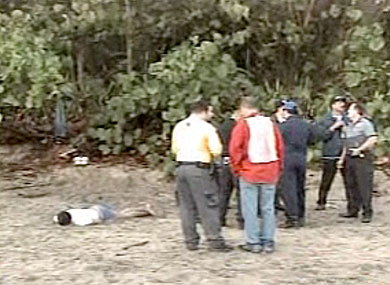
Police view the corpse of murdered gay Puerto Rican, Ezequiel Crespo Hernández, in April 2011 (EDGE photo).
San Juan, Puerto Rico – Puerto Rico’s lawmakers are poised to remove LGBT people from hate crimes protection status with the stroke of a pen. Although at least 18 LGBT Puerto Ricans have been murdered in hate crimes since 2009, Edge Boston reports that the territory’s Senate passed a bill last month removing LGBT people from protected categories under the hate crimes law that has been on the books since 2004. The exclusion effort now goes on to the House of Representatives for a vote this week in a special legislative session called by Gov. Luis Fortuño.
Outraged by the increasing number of anti-gay hate crimes, local LGBT activists demanded investigations in June. The Advocate reports that the grisly murder and dismemberment of Jorge Steven López Mercado, a gay teen, ignited the protests that officials were not investigating anti-gay violence under the territory’s hate crimes law. Recently, the strangulation of gay Ezequiel Crespo Hernández, 22, on a public beach in Camuy, and a gas station assault on transgender woman Francheska González so brutal that it punctured her breast implant, intensified the call for justice to be done. Three more LGBT Puerto Ricans, Alejandro Torres Torres, Karlota Gómez Sánchez and Ramón “Moncho” Salgado, were also found dead within a three-day period in June. “It seems they have declared open hunting season against lesbian, gay, bisexual, transgender and transsexual people,” Pedro Julio Serrano, founder of the gay rights group Puerto Rico for Everyone, said to the Associated Press. In response to rising criticism, Puerto Rico’s Attorney General directed an investigation into the application of the hate crimes law. Opponents of the LGBT community responded by quietly acting to remove queer folk from the penal code’s protection.
The penal code revision is drawing criticism from legislators and activists alike. The Advocate says Representative Héctor Ferrer and Sen. Eduardo Bhatia are among the most outspoken critics of the change. Ferrer, speaking at a press conference on Sunday, said, “To eliminate these groups as protected categories is to invite the commission of hate crimes in Puerto Rico. It is a setback in the country’s public policy.” Bhatia added his voice, saying, “In an advanced society, this is dangerous for society.” After the proposed amendment removing LGBTs from hate crimes protection, the only categories of persons who would be protected by the law in Puerto Rico would be political affiliation, age, and disability.
Activist Serrano told EDGE, “Basically they took out the communities hardest hit by hate crimes in Puerto Rico out of the hate crimes statute,” Serrano told EDGE, referring the LGBT community and Dominicans who come to the island for work. “It’s an outrage and now we’re calling upon the House to restore this to where it should be.” Protests and marches against the provision are planned this week throughout island. Serrano, referring to adversaries of the LGBT community, added, “They’re trying to do it under the radar and that’s how it went for a while. Under our watch, we’re not going to let this happen.”
Alleged Butcher of Richard Hernandez Wins Mistrial for Meds Excuse

Seth Winder
Denton, Texas – For the second time in a history of delays and postponements, Richard Hernandez’s alleged murderer was ruled “incompetent to stand trial” on November 18 by a Denton County judge. Seth Winder, 31, was ruled unable to assist in his own defense by District Judge Bruce McFarling after an examination finding him either unmedicated for his diagnosed mental impairment, or insufficiently dosed, according to the Crime Blog of the Dallas Morning News. Winder exhibited nearly catatonic behavior during the third day of the trial–evidencing that he had received none of his prescribed drugs for his schizophrenia, or that he had been spitting out and hiding his nighttime dosages, perhaps for weeks before the trial began. No explanation was given for how Winder could have been considered fit for trial on November 16, but zombie-like two days later. Neither was there an explanation of how jailers and med staff at the Denton County Jail could have so woefully neglected to make sure their smart-though-impaired inmate took his meds as directed and actually swallowed them.
Instead of completing the trial process for the gruesome murder and dismemberment of the openly gay Dallasite, Winder was sent to the North Texas State Hospital in Vernon for treatment. The Dallas Observer speculates that Winder may not ever face trial again for the Silence-0f-the-Lambs-style butchery of 38-year-old Hernandez, whose body was never found–save for his internal organs left in the bathtub of his Far North Dallas apartment in September 2008. This marks a second instance that Winder was found unfit to stand trial because of mental issues, the first being in May 2009. Observer reporter Brantley Hargrove found legal opinion divided on whether the Colony resident will have another day in court. Winder’s Defense Attorney, Derek Adame, says he seriously doubts another trial will take place. Denton County Assistant District Attorney Cary Piel, however, believes Winder will face judge and jury again, probably in April 2012.
Winder stands accused of murdering Hernandez in the gay man’s apartment, though the reasons for their relationship remain murky. Both the Morning News and the Observer repeated the unproven allegation that the victim and his supposed killer were gay lovers. Hernandez’s best friend, Rudy Araiza, has staunchly denied the possibility that Winder and Hernandez were ever “lovers,” and makes that point again in a blog response to the Dallas Morning News allegation. “Richard and Seth were ‘Never’ boyfriends!” Araiza said. “I’m not sure why this newspaper is making that statement, I knew Richard for 22 years, I would know!” It may be another instance in which a grisly anti-gay hate crime is toned down for public consumption by partially blaming the victim for his own demise. Media around the country have a notorious record for succumbing to this sensationalist temptation. Investigators said they found pornographic pictures of Winder on the cell phone he lifted from the Hernandez apartment, though no proof has been offered of who took the images, or what they actually depict.
Although the murder weapon was never found, police did retrieve a sword stained with Hernandez’s blood in the tent where Winder was living. Detectives say that Winder used the sword to cut up the gay man’s body. The dismembered parts of the victim were probably disposed of in a nearby dumpster, and then buried under tons of garbage in a landfill, making the body impossible to locate. Winder’s use of Hernandez’s credit cards led police to arrest him. Witnesses placed Winder in Hernandez’s apartment complex at or near the time of the gay man’s disappearance. Forensics found that the blood stains on Winder’s clothing and shoes were a genetic match to the victim.
So, Seth Winder, either crazy like a fox, or a neglected patient (or both), has avoided the jury again. Meanwhile, Richard Hernandez, who in death cannot answer the innuendo against his character, receives no justice. The eerie quiet throughout North Texas surrounding this latest trial development in one of the most heinous crime cases in Dallas history seems to confirm that many have an investment in hushing the whole thing up. Which would not be the first time such a thing has happened in Texas when it comes to violence against the LGBTQ community.
Gay Baptist Preacher Calls on Churches to Repent of Anti-Gay Attitudes

Rev. Dr. Stephen Sprinkle speaking to a rally at the University of Toledo (Toledo Blade Photo).
Toledo, Ohio – An ordained gay Baptist minister has called upon churches to change their anti-gay attitudes and language. Dallas Baptist preacher and theologian, Dr. Stephen Sprinkle, speaking to a packed house at the University of Toledo last month, said that the notion Christianity and the Bible are considered irreconcilably anti-gay by many in contemporary churches is simply wrong. Citing Dr. Peter Gomes, the late chaplain of Harvard, Sprinkle said that the biblical teachings on hospitality to those who have been deliberately excluded by society, “the poor, the discriminated against, people of color, women, homosexuals, and all persons beyond the conventional definition of Western civilization,” is far more significant than the few misinterpreted Bible texts used to condemn LGBTQ people. Sprinkle went on to note that Christianity arose in the cosmopolitan world of the Greeks and the Romans, who in the main were tolerant of same-gender-loving people for much of the classical age. When taken as a whole, the early churches exhibited very little concern about what we today call “homosexuality.” “Homosexuality,” Sprinkle said, “is not mentioned in the Top Ten [Commandments], and is not in the message of any of the Prophets.”
The Republic reports that Sprinkle was invited to speak at a rally sponsored by Equality Toledo in response to the so-called “billboard wars” over LGBTQ acceptance in the Toledo church community. A progressive United Methodist congregation put up a large billboard on a well-traveled street in April proclaiming that “Gays Are a Gift From God.” An evangelical mega church responded by buying up space on nine huge billboards around the city rebutting the Methodist claim with the slogan “Gays Are NOT a Gift From God.” Sprinkle, a professor at Brite Divinity School in Fort Worth, and Theologian in Residence at Cathedral of Hope United Church of Christ, the largest LGBTQ predominant congregation in the world located in Dallas, is a widely-sought speaker and teacher. His most recent book, Unfinished Lives: Reviving the Memories of LGBTQ Hate Crimes Victims (Resource Publications, 2011), is an anthology of stories of people murdered for their sexual orientation and gender identity, most of whom were killed by people who claimed justification from the Bible and church teachings. He is the founder of the Unfinished Lives Project, and the web master of http://unfinishedlivesblog.com, a blog seeking to remember the victims of hate crimes violence in the United States.
McInerney Pleads Guilty to 2nd-Degree Murder for Executing Larry King

Brandon McInerney executed his gay classmate in February 2008.
Ventura County, California – The teen killer of a gay classmate has pleaded guilty second-degree murder. Brandon McInerney, 17, 14-years-old at the time he pulled the trigger, shot gay 15-year-old Larry King in the back of the head execution-style at E.O Green Middle School in Oxnard, California in February 2008 before the eyes of his first-period classmates. The facts of the case are undisputed. Rising behind his victim, McInerney pumped two rounds into the back of Larry King’s skull, fulfilling a threat he made to a girlfriend at school the day before. McInerney will receive a 21-year sentence for a crime that many say bears all the hallmarks of a pre-meditated, first-degree hate crime murder.
In September of this year, a mistrial was declared after two months of testimony, due to the inability of the jury to come to a decision about the guilt of young McInerney. Prosecutors had argued for first-degree murder, based on the established pre-meditation and the heinous nature of the crime. Under California law, a 14-year-old may be tried as an adult, and McInerney, who confessed to the murder seemed to fit the statute’s requirements. Prosecutors claimed that because of McInerney’s antipathy toward King’s sexual orientation and gender expression, and because of white supremacist loyalties the killer clearly embraced, the murder was a clear-cut case of anti-LGBT hate crime. Defense turned the tables on the prosecution, putting the dead victim on trial instead of their client. They resurrected the infamous “gay panic/trans panic” defense, drumming their contention into the jurors’ minds that King was the prime aggressor, pressing his flamboyant sexuality toward McInerney until he “snapped.” Enough of the jury bought the ploy that the jury hung. Had the first-degree charge been upheld, the defendant would have received 53 years for his crime.
The Advocate reports that formal sentencing will take place for McInerney on December 19. Twenty-one years in prison is a long time for McInerney to consider that every day he lives is another he stole from a gay classmate because of his discomfort with a person who was different. For the LGBTQ community, the specter of the “gay panic defense,” like a hungry ghost, lingers on, given new energy by this plea deal.
Gay Men and Trans People in the Cross Hairs: Behind the FBI’s 2010 Hate Crimes Statistics
 Washington, D.C. – Hate crimes statistics for 2010 are out from the Federal Bureau of Investigation. The good news is that, overall, the numbers of reported hate crimes last year held steady. The FBI report, accessible here, documents 6,624 single-bias incidents, which range from acts of vandalism to cold blooded murder. Four more incidents encompassed multiple-biases, making for a grand total of 6,628 incidents reflecting 7,699 offenses as reported voluntarily by law enforcement agencies around the nation. These data represent a serious undercount of the actual number of hate crimes perpetrated against Americans during the last year, since 1) reportage by local law enforcement is sheerly voluntary with no funding from the federal government to aid small jurisdictions to report, and 2) local law enforcement officials are often loathe to classify an incident as a hate crime because of a variety of reasons, such as how the community regards social groups and racial/sexual minorities.
Behind the statistics are the stories of flesh-and-blood victims and their families, and the news here is disturbing. 1,528 victims were targeted because of animus against sexual orientation. Of these, 57.3 percent of victims were gay males, and 11.9 percent were lesbians. The numbers of violent attacks against transgender people are fragmentary at this point, since statistics of this particularly vulnerable group have only been recorded by the FBI since the Matthew Shepard-James Byrd Jr. Hate Crimes Prevention Act was signed into law by President Obama in October 2009. But the news of brutalities against transgender people, especially transgender women of color, is alarming. GLAAD reports that, of the people murdered for sexual orientation and gender identity and expression bias, 70 percent were persons of color, and 44 percent were transgender women [NCAVP figures]. Though suicides of LGBTQ teens due to homophobic and transphobic bullying in schools have captured the headlines repeatedly since 2010 began, no separate FBI statistical category yet exists for the collection of these data.
In the recent Civil Rights Conference on Hate Crimes at the University of Texas at Arlington, Assistant Attorney General Thomas Perez declared in his keynote address, “We are experiencing a headwind of hatred and intolerance in the United States.” FBI Special Agents appealed to local law enforcement, U.S. Attorney officials, and leaders from the North Texas LGBTQ community to co-operate in the reporting of hate crimes, underlining the difficulty feds are experiencing amassing accurate data. In its 2010 report, the National Coalition of Anti-Violence Programs (NCAVP), widely held to offer more accurate statistics on anti-LGBT hate crimes than the FBI, noted a 13 percent rise in homophobic and transphobic violence from 2009 to 2010, and a 23 percent rise in the murders of LGBTQ people.
Gay Murder/Dismemberment Trial Gets Underway Today in North Texas

Richard Hernandez, victim, and Seth Winder, the accused (l to r; Dallas Voice image)
Dallas, Texas – After three years of delays and postponements, the trial of the accused murderer of openly gay Richard Hernandez begins today. The Dallas Voice, doing great journalistic work on this difficult case, announced the story on November 10, quoting first assistant Denton County district attorney Jamie Beck on the trial delays, “Everybody wants a swifter and quicker justice, but you’ve got to do it right. Bottom line, we want justice, so if that means it takes a while, then so be it.”
The “Silence of the Lambs” style murder of 38-year-old Hernandez, an employee of Walmart, drew national press attention in September 2008 when the victim’s viscera but no body was discovered in an apartment in far North Dallas. When Hernandez, a conscientious employee, did not report for work, his friends prevailed on the apartment superintendent to open his residence, and what they found resembled a slaughterhouse. Copious amounts of blood spattered the walls. Hernandez’s body was never found, but tissue from it was left, dumped in the bathtub. Dallas Police acted quickly to track down the killer. True Crime reported that the DPD filed capital murder charges against Seth Winder, 29, a homeless man with a history of erratic behavior and mental illness, even though they did not have possession of a body in the case–only the third time in thirty years of police department history.
Winder was located because of credit card charges he made to Hernandez’s stolen cards after the murder date. Police apprehended Winder in a tent inThe Colony, where he was in possession of personal items of the victim and a bloody sword that may have been used in the dismemberment. The Dallas Voice reports the police conclusion that the killer disposed of the body in a trash dumpster which was emptied in a landfill, making Hernandez’s remains unrecoverable.
Winder’s competence to stand trial was hotly contested in the earlier days of the case. His father and stepmother told the press that their son was a schizophrenic who had once tried to strangle his own mother. Friends of Hernandez contended that Winder was just clever enough to play ill in order to avoid responsibility for the grisly murder. The whole stew was made nastier by the report of police investigators that they discovered a digital camera belonging to Hernandez with “pornographic images” of Winder. The victim’s friends and family vigorously denied the implication that Hernandez and Winder were in a sexual relationship. In the end, Winder was ruled incompetent to stand trial.
Hernandez’s mother will not be there today to see if justice will be done for her son. She died with the story unresolved, thanks in part to a strategy of delays put in place by Winder’s legal defense team, and to the untimely publication of a book on the murder authored by Winder’s own stepmother.
Now, after years of treatment, authorities say Seth Winder is able to face his day in court. Jury selection has begun, and barring other delays, three years of agonized waiting are about to conclude for Richard Hernandez’s friends and remaining family.
Texas Lesbian Gay Bashed in San Antonio
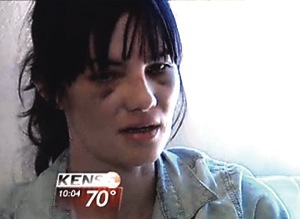
Kristen Cooper, Bashed for Being Lesbian (KENS 5 photo)
San Antonio, Texas – An out lesbian student from the University of Texas at San Antonio says that she was assaulted by two men calling her obscene, anti-LGBTQ epithets over Halloween weekend. Kristen Cooper told KENS 5 that the only thing the two men who attacked her knew about her prior to the assault was that she was a lesbian. “I just think it was a hate crime against me,” she sad, still shaken by the incident.
Cooper says she was waiting for a ride from a local Halloween Party when two men stopped their van, grabbed her, beat her while yelling slurs about her sexual orientation, and drove her some distance before they pushed her out and drove away. Cooper fought back against them, “full-fist,” probably putting up such resistance that her assailants decided it wasn’t worth the effort. She had no cell phone, so she walked a long distance before someone noticed her, stopped, and then called the police.
Cooper’s injuries were extensive: cuts, bruises, a contusion, a concussion, and whiplash. When asked how she was coping with the attack, Cooper said to KENS 5, “Just still in shock and I’m trying really hard not to cry, but nothing like this should happen to anybody.” The San Antonio Police are currently investigating the crime as an assault, with no word about whether they intend to classify the brutal beating as an anti-LGBTQ hate crime.
About
If you are a first-time visitor to the Unfinished Lives Project website, we invite you to read A Welcome Message introducing you to our project. We are truly grateful for your visit.
The Unfinished Lives Project website is a place of public discourse which remembers and honors LGBTQ hate crime victims, while also revealing the reality of unseen violence perpetrated against people whose only “offense” is their sexual orientation, gender identity, or gender presentation. LGBTQ people in the United States are suffering a slow-rolling decimation of terror and murder all across the country. Every locale and demographic of society are affected: First Nations, Anglo, Black, Latino and Latina, South and Southeast Asian, Transgender, Bisexuals, Gay men, Lesbians, disabled, young, and mature. Homophobia has a long, crooked arm, and it is reaching out to snatch the life away from women and men whose tragic stories are under-reported to begin with, and whose memories are swiftly forgotten.
The horror of these killings transcends the shock and bereavement of loved ones and friends. These are not typical homicides; they are not killings for money or drugs, incidents of domestic strife, or crimes of passion. The vicious nature of hate crimes against LGBTQ persons is extremely brutal, grotesquely violent, and egregiously hateful.
Each murder serves the LGBTQ population as a sobering warning about the actual level of danger in our communities. The message these killings send is that freedom and open life for LGBTQ people is a cruel dream. Every time we remember one of these victims, however, the intentions of their killers are frustrated. To remember these women and men is to begin the process of changing the culture that killed them.
Our Project Director
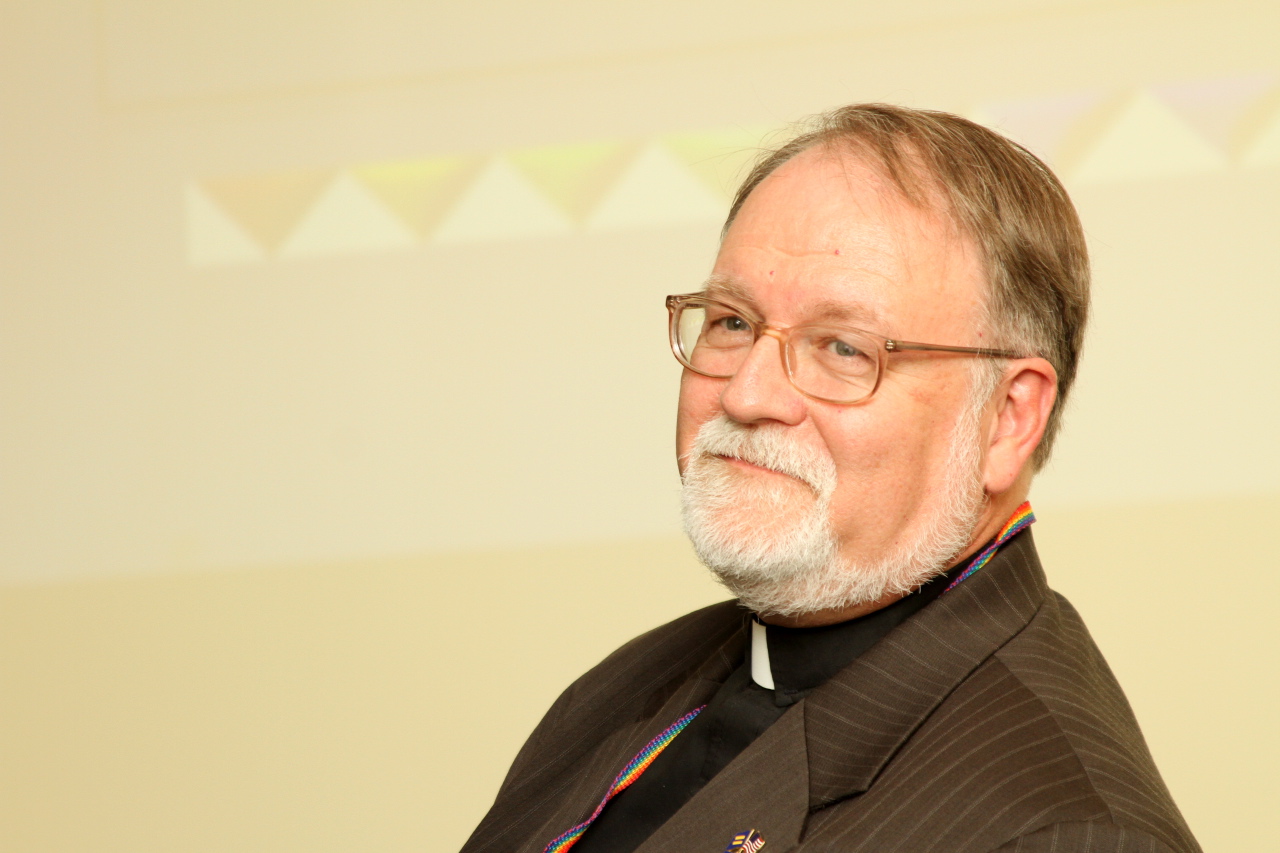
Dr. Stephen V. Sprinkle (Keith Tew photo).
Stephen V. Sprinkle is Director of Field Education and Supervised Ministry, and Professor of Practical Theology at Brite Divinity School, Fort Worth, Texas, a post he has held since 1994. An ordained Baptist minister, he is the first open and out Gay scholar in the history of the Divinity School, and the first open and out LGBTQ person to be tenured there. Read More…
Recent Social Justice Advocacy Activity By Dr. Sprinkle
 Summer 2009 – Dr. Sprinkle responded to the Fort Worth Police Department and Texas Alcoholic Beverage Commission Raid on the Rainbow Lounge, Fort Worth’s newest gay bar, on June 28, 2009, the exact 40th Anniversary of the Stonewall Rebellion. Dr. Sprinkle was invited to speak at three protest events sponsored by Queer LiberAction of Dallas. Here, he is keynoting the Rainbow Lounge Protest at the Tarrant County Courthouse on July 12, 2009. Read More…
Contact Us
Communicate with the Unfinished Lives project team:
info@unfinishedlivesblog.com


Schedule a Presentation
Dr. Sprinkle will gladly present his acclaimed presentation to your organization. To arrange an Unfinished Lives presentation for your organization or group, please contact us.
Dr. Sprinkle has given his Unfinished Lives presentation to these and other community groups and organizations. Read More…
-

Where are our readers?
Publisher: Steve Sprinkle (Project Director)
Steve Sprinkle
Unfinished Lives: Remembering LGBT Hate Crime VictimsBrite Divinity School/Texas Christian UniversityFort Worth TXprofessor, minister, author, blogger, LGBTQ advocate


Follow Unfinished Lives on Facebook
 Box Turtle Bulletin
- An error has occurred; the feed is probably down. Try again later.
- HRC Back Story
- Know About The Gender Identity Movement
- Why Is There A Need For Human Rights?
- Kinds Of Human Rights
- Human Rights Purposes And Violations
- Human Rights For Every Human Incident
- 8 Reasons Human Rights Are Important
- Everything About Human Rights
- Human Rights Issues Education & Law
- We Need To Stand Up For Our Rights And Those Of Others
- Coca-Cola Receives Perfect Score On Human Rights
- The Advocate: Daily News
- Arrested for repainting erased Dallas Pride crosswalks, Texas man says he’d do it again
- Kentucky city pays photographer $800,000 in same-sex wedding case
- IN PICTURES: ACT UP New York’s march and die-in outside Palantir
- Idaho’s bathroom bill leaves transgender men like me with an impossible choice: jail or violence
- Idaho Republicans advance bill to impose hefty fines on cities flying Pride flags
- He witnessed the Stonewall riots. Now he's a lifelong ally
- Advocate newsletter 3/25/26
- In Markwayne Mullin, Pete Hegseth has a competitor in bravado, masochism, and queer hate
- Trans tennis players in Las Vegas build their own league after being sidelined
- Ohio queer motorcycle club responds to anti-LGBTQ+ laws by teaching how to fire guns
- Dallas Voice: Instant Tea
- An error has occurred; the feed is probably down. Try again later.

 Unfinished Lives