Kobe Bryant Fined $100K For Anti-Gay Slur: A Special Comment
 Los Angeles, California – Kobe Bryant, controversial star of the Los Angeles Lakers, has been fined $100,000 for an anti-gay slur he mouthed on live television at a referee. As E! Online reports, the National Basketball Association (NBA) fined Bryant after investigating the incident. Bryant, angry at being given a technical foul by Referee Bennie Adams, called the ref a “fucking faggot” in such a way that it was captured live by the camera at last night’s Lakers game with the San Antonio Spurs. NBA Commissioner David Stern swiftly disciplined the five-time national champion guard, saying to Free Republic, ”Kobe Bryant’s comment during last night’s game was offensive and inexcusable. While I’m fully aware that basketball is an emotional game, such a distasteful term should never be tolerated. … Kobe and everyone associated with the NBA know that insensitive or derogatory comments are not acceptable and have no place in our game or society.” The action of the NBA drew praise from LGBTQ rights advocacy groups who had protested the use of the slur. In a statement Bryant issued through the L.A. Lakers organization, Bryant had tried to defuse the anger of gay rights groups by saying that he didn’t mean anything by it. “What I said last night should not be taken literally. My actions were out of frustration during the heat of the game, period,” Bryant averred. ”The words expressed do NOT reflect my feelings towards the gay and lesbian communities and were NOT meant to offend anyone.” Who does he think he’s fooling? The Human Rights Campaign said to TMZ Sports, “What a disgrace for Kobe Bryant to use such horribly offensive and distasteful language, especially when millions of people are watching.” The HRC has a point. Language has consequences. Words can ignite lethal acts. Especially for groups who face threats of physical, social, and spiritual violence daily, as LGBTQ people do. The people who say to queer folk, “Sticks and stones may break my bones, but words can never hurt me,” simply do not live in the same psycho-social universe that the rest of us do. The linkage between anti-gay slurs and epithets, and acts of bias-driven violence has been well-establshed by law enforcement. One of the unmistakable markers looked for by the Federal Bureau of Investigation to help determine if an assault should be investigated as a hate crime is the use of derogatory, anti-LGBTQ language during the committal of the crime. And the link between verbal attacks on queer folk and hate speech is clearly an organic one. Bryant’s disdain for gays and lesbians was openly on display for the world to see and hear, reinforcing cultural and religious bias against gender variant and same sex loving people. HRC went on to say, “Hopefully Mr. Bryant will recognize that as a person with such fame and influence, the use of such language not only offends millions of LGBT [lesbian, gay, bisexual, transgender] people around the world, but also perpetuates a culture of discrimination and hate that all of us, most notably Mr. Bryant, should be working to eradicate.” Youth worship NBA stars like Bryant. They model themselves after their heroes in fashion, prowess, and, pertinent for this inquiry, in opinion. The sports shoe industry has know that for a very long time. At the very least, Bryant’s verbal foul supports a culture of discrimination and intimidation that has kept gay and lesbian athletes deeply closeted for decades, making the sports closet arguably the most pernicious in American life today. One has only to reflect on the rarest of all queer celebrities: out professional sports figures. So, the Unfinished Lives Project Team stands with HRC President, Joe Solmonese when he said today, “We applaud Commissioner Stern and the NBA for not only fining Bryant but for recognizing that slurs and derogatory comments have no place on the basketball court or in society at large. We hope such swift and decisive action will send a strong and universal message that this kind of hateful outburst is simply inexcusable no matter what the context.” It is past time to require professional sports teams and coaching organizations to do sensitivity and diversity training inclusive of LGBTQ concerns. Kobe Bryant apparently doesn’t know better until he gets caught. The Lakers went on to win the game. Kobe lost, big time. We at Unfinished Lives believe in order for things to get better in the locker room and on the court, athletes must be taught what is at stake when they “foul” the air.
“It Gets Better” Makes Us All Stronger! A Special Comment by Dr. Stephen Sprinkle
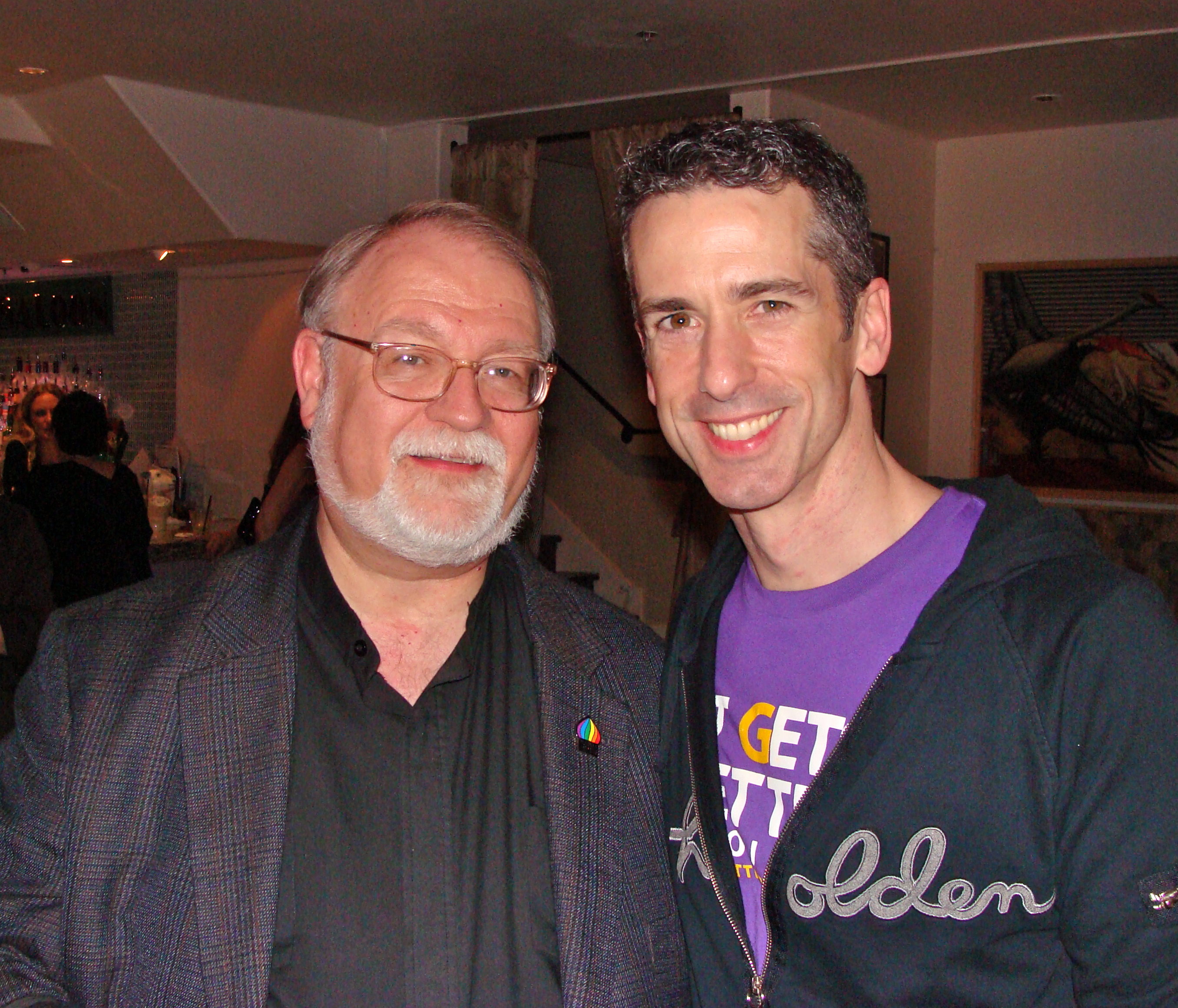
Dr. Stephen Sprinkle and Dan Savage (Unfinished Lives Project Director, Dr.Sprinkle, was an early contributor to the "It Gets Better Project").
When Dan Savage and Terry Miller conceived of the “It Gets Better Project,” the goal they had was a hundred videos. Now there are over 10,000 of them, and the videos have been viewed over 40,000,000 times to date—and growing! Dan has said that had there been 20 videos online, and one life saved, it would have been worth it. We know now that many, many teenage lives have been given new hope, and also that young lives by the hundreds have been saved by this visionary project. As the Jewish Talmud teaches, “Whoever destroys a soul, it is considered as if he destroyed an entire world. And whoever saves a life, it is considered as if he saved an entire world” (Mishnah Sanhedrin 4:5; Babylonian Talmud Tractate Sanhedrin 37a). The IGB Project, and now the New York Times bestselling book by the same name has already saved a galaxy of worlds by this rabbinic measure.
But the IGB project and book have gone one better than this, if such a thing might be possible. Dan, Terry, and the worldwide host of contributors to this positive effort have changed the world irrevocably, queer and straight alike. Here are two of the ways I see.
First, the “coming out story,” a staple of LGBTQ life, has been transformed into a declaration of how the queer community is overcoming shame, persecution, and victimhood—and coming on strong. For two generations since Stonewall, the coming out story has been a way LGBTQ people shared their struggles and established solidarity with each other. Most of these stories were accounts of struggle, hurt, and survival. Queer folk got to see they were not alone and isolated—we heard the battles others fought, and compared scars—and that was powerful for all parties, because these stories allowed us to see that there were others like us in this difficult world—that we resisted and lived on into a new life together, no longer alone. But IGB went a crucial step further: as thousands of us were empowered to speak directly to queer teenagers with a positive message of hope and power, “It really does get better, and this is how it got better for us,” we got to overhear ourselves rehearsing stories of strength and success—not just repetitions of woe and endurance. IGB powered up the queer community to tell the whole world how we are defeating opposition in fine style thousands of different ways everyday. The message is, “We are no one’s patsies anymore, thank you! And we are ready and able to make things improve for ourselves and our teens every day, until it gets better for all of us!” IGB changed the coming out story into the overcoming stories of a powerful queer people who will never settle for victimhood again. In my religious tradition, as a queer Baptist preacher, that makes me want to shout, Hallelujah!
Second, IGB empowered our straight allies to come out strong, too. From President Obama to Secretary of State Hillary Clinton. From Prime Minister David Cameron to Lutheran Presiding Bishop Mark Hanson. From moms and pops, school teachers who taught us, and straight employers who hired us. Our allies joined the queer community to make the message of zero tolerance for school bullying perfectly queer. I know the term “queer” rankles some genteel sentiments, but to see the way our straight allies have taken the term and wrapped themselves in it for our sakes should dispel the last reservations we have about the word and about how the LGBTQ movement for human rights and equal dignity will grow and eventually prevail. Straight queer allies by the hundreds of thousands are rising up against bullying, het privilege, and the culture of violence that imperils not only gender non-conforming youth, but all youth everywhere. By ourselves, LGBTQ people are not numerous enough to change the het world. But IGB shows youth and adults in our LGBTQ communities—out or closeted—that growing numbers of queerly empowered straight allies are joining us to transform the world we all share. This is no panacea, of course. My generation may not live to see it, especially in the churches, synagogues, temples, and mosques where old prejudices linger with desperate power. But even there, straight allies are queering religion with us. When the annals of these years are written, I believe the IGB Project will feature prominently in the story of how all us queers, LGBTQ and straight, overcame together. Like the Black Gospel refrain goes, “Over! Over! My soul looks back and wonders how I got over!”
So, Dan and Terry, and the tens of thousands who have rallied to the cause of a safer world for youth to grow up in, a salute to you! The children will rise up to call you “blessed.” And so does this mighty queer Baptist preacher from Texas, too! ~ Stephen V. Sprinkle, Brite Divinity School, and Unfinished Lives Project Director
Suspect 3rd Century Women Put to Death in Arena: Ancient Hate Crime?
 Carthage, North Africa Province – Roman authorities ordered the public execution of a young Roman noblewoman and a female slave in the arena of Carthage on this date, March 7, 203 CE (Common Era). Vibia Perpetua, 22, a young mother, and Felicitas, a slave of like age who was also a young mother, both North African Christians, joined their male counterparts as victims in what legitimately might be called a state-sanctioned hate crime for refusing to swear allegiance to the Emperor, Septimius Severus. Suspicion about the sexual orientation of the women has swirled around the story for centuries. Was the tie that bound these young women together faith alone, or was it something more? Perpetua, one of the first Christian women in history to author an account of her own life, wrote a “Prison Diary” that was edited after her execution by an anonymous narrator who opens with an short introduction and closes with what appears to be an eye-witness account of the life-and-death drama that took place in the amphitheater of Carthage. Nothing explicit is written concerning the possible desire of the two young women for each other in the account, entitled “The Passion of Saints Perpetua and Felicity.” But the lasting impression among gays and lesbians for the last two hundred years is that these North African Christian women were bound to each other with a mutuality that seems particularly “woman-centered” even for the outlawed early Christian communities of the late second and early third centuries, not to mention the strictly hierarchical and socially stratified world of the Roman provinces. Perpetua had given birth to a baby shortly before her condemnation, and Felicity who joined her in prison gave birth right on the eve of the execution. The motherhood of the women has been used to counter the suspicion of lesbianism or bisexuality, but as Yale gay historian John Boswell writes, “A young woman’s marriage in second- or third-century Rome did not necessarily indicate anything about the direction of her affections.” Others have argued that the Christian mission of the women made them comrades in martyrdom as they died for their faith, in refutation of any suggestion of lesbian affection between them. Mary Rose D’Angelo refuses this objection in her famous essay on women partners in the New Testament: “In the early Christian pairs, it is the women’s participation in the Christian mission that takes the foreground. But that should not obscure the recognition that their commitment to the mission can also be seen as the commitment to each other.” The witness-narrator of the execution watched as a crazed, wild heifer, especially chosen for its gender to shame the young women, was unleashed to gore them. The mad cow tossed Perpetua, ripping her dress. The cow then crushed Felicity to the ground before losing interest in the victims. There was nothing un-Roman about a young noblewoman reaching out her hand to help a slave up, as the narrator reports Perpetua does. But then something most un-Roman takes place. The Latin text (20.7) reads: Et ambae pariter steterunt, “And they both stood there together.” It is not only that these young women stood together, but that they did so when they were not expected to do so. Carolyn Osiek, the New Testament scholar from Brite Divinity School, writes of this dramatic moment: “But perhaps the author knew more than we suspect and was telling of a solidarity that had grown between the two women of unequal social status, who stood together as equals facing death.” In this moment of surprise, the curtain of nearly two thousand years is parted for an instant. Elizabeth Castelli writes that there are “moments of slippage, spaces where the self-evidency of gender conventions and relationships for which they were foundational might have been thought otherwise.” This surprising moment is one of them, when a coating of eroticism thinly glosses over two standing together, social unequals, equally facing death side-by-side. Perpetua and Felicity stand at the head of a long line of transgressive women who suffered gender hatred, suspect because of sexual outlaw status. At the very heart of Christian witness, two young women whose affection for each other was forged in a Roman prison hold onto love in the face of state-sanctioned hate crime. For this, we honor them.
Repeal and Remembrance: Gay Military Martyrs and the End of DADT

Fallen Military Servicemembers
Washington, DC – On a red letter day when lawmakers voted to end the most notorious anti-gay policy in the federal canon, LGBT servicemembers and veterans who have been murdered because of their sexual and gender non-conformity must not be forgotten during the celebrations over passage of repeal of DADT. In a historic vote in the history of the human rights movement, the U.S. Senate voted overwhelmingly to end the ban on LGBT patriots from serving openly in the armed services of the United States. Saturday afternoon, 65 Senators voted for repeal with 31 in opposition. A simple majority of 51 was all that was required for passage of the Senate bill, which is identical to the one passed earlier in the week by the House of Representatives. Eight GOP Senators joined their Democratic colleagues to pass the repeal of the 17-year-old discriminatory policy that ended the military careers of 13,500 women and men because of their sexual orientation. Joe Manchin, the freshman Senator for West Virginia, was the only Democrat not voting for passage. According to the New York Times, his office informed the public that he had a “family commitment” he could not break.The bill now goes to President Obama for his signature to set the repeal in motion. GOP opponents of the repeal criticized the Democratic leadership of the Senate for the vote in the lame duck session just before the Holiday recess. Senator Carl Levin, the chair of the Senate Armed Service Committee, disputed the Republican claims that Democrats were ramming legislation through just to please the so-called “gay lobby.” In remarks to the New York Times, Senator Levin (D-Michigan) said: “I’m not here for partisan reasons. I’m here because men and women wearing the uniform of the United States who are gay and lesbian have died for this country, because gay and lesbian men and women wearing the uniform of this country have their lives on the line right now.” Yet it is not only for the living that this vote is significant. Our military dead are honored by this historic vote to end anti-LGBT discrimination, among whom are far too many gay servicemembers who were killed because of their sexual orientation. Our gay military martyrs, murdered because of homophobia, heterosexism, and transphobia in the armed services loom large in the memory of the LGBTQ community today because they are both a sign of hope and caution. They are a sign of hope that no more women and men need lose their lives in the military because of their sexual orientation and gender presentation. They are a sign of caution, because the passage of DADT repeal in no way guarantees the end of anti-gay violence in the military. We must name our LGBT military dead until violence against queer servicemembers ceases forever: Seaman Allen Schindler was beaten to death by shipmates in a public toilet in Sasebo, Japan. PFC Barry Winchell was murdered with a baseball bat in the Army barracks at Fort Campbell, Kentucky. Seaman August Provost was shot to death on base in San Diego, and then his body was set afire in a guard shack in the vain attempt to destroy evidence of the murder. Army veteran Michael Scott Goucher was lured into a fatal ambush by local youths near his home in Pennsylvania. These four are representative of the many more slaughtered by ignorance and hate by fellow servicemembers and civilians. Pundits say that after President Obama signs the Repeal Act into law, it will still take at least sixty days for the military ban to be lifted for LGBT military personnel. Until that time, the current discriminatory law stays in effect. But the culture of violence that harasses and kills LGBT women and men who wear the uniform remains virulently poised to take more lives until the root of fear is eliminated in the armed services. To that end, the historic passage of the end of Don’t Ask, Don’t Tell is simply the beginning of a new campaign, in the name of our gay military martyrs, to replace the fear and loathing of the sexual minority with education and respect.
Hope for 2010: A New Year’s Special Comment
 As the old year passes, and with it the old decade, those of us who believe in Justice for LGBTQ people have memories to preserve, work to do, thanks to express, and hope to rekindle. The Unfinished Lives Project was conceived as a visual and verbal resource for the public to use in the on-going struggle for freedom from violence and fear that Lesbian, Gay, Bisexual, Transgender, and Queer folk face every day in the United States. Wordpress tallies show that as of this writing nearly 44,000 have visited this site since its first posting in June 2008: to educate themselves about the slow-rolling holocaust facing members of the sexual minority, to bring the stories of so many casualties of homophobia and heterosexism to light who would otherwise be forgotten, and to steel themselves for the long, difficult, painful work of changing the culture of violence against the different in which we must live. While countless hours of writing and research have gone into creating and maintaining this web site, that is nothing compared to the stress and loss faced by so many families and loved ones who have experienced the horrors of hate crime murder during these years. The backstory of this blog has been and continues to be the awe-inspiring courage of the bereaved mothers, fathers, lovers and friends who have been thrust into the harsh glare of activism on behalf of the LGBTQ community because they refuse to allow their loved ones to have died in vain. We owe them, and you, Dear Reader, our thanks and our continuing labor until Justice comes. It is to that end we at the Unfinished Lives Project keep telling these grim stories of real people who suffer in America for no other “crime” than being who they are. The past decade, especially the past year, has seen substantive change–not enough, nor comprehensive enough, to be sure–but real change nonetheless. Cultural, political, and religious attitudes toward LGBTQ people are changing in this country. The passage of the James Byrd, Jr. and Matthew Shepard Hate Crimes Prevention Act, the first comprehensive hate crimes law in federal history, is now law. Convictions under state and federal hate crimes statutes, something conservative law makers and law enforcement officers said would never happen, are occurring already in bellweather states like Colorado and New York. This trend will no doubt continue as the New Year dawns. The infamous “gay panic” defense, and its evil twin, the “trans panic” defense are increasingly discredited and ineffective in American courts of law. Religious attitudes have thawed slightly, but the progress is real, if spotty. Religion and Faith offices and activism, once thought to be the “third rail” of human rights politics, have been established in all the major advocacy organizations that lobby for change. LGBTQ lives and practices are no longer viewed as criminal by the religious leaders of conscience in the United States, and tolerance toward queer folk in congregational life and leadership is on the rise: the Episcopal Church, the Alliance of Baptists, the United Church of Christ, and the Evangelical Lutheran Church of America are cases in point. Homophobia in churches, synagogues, mosques and schools is not going unchallenged in American daily life, and that is encouraging. ENDA, DADT, and many other legislative initiatives are on the horizon for the new decade. Marriage Equality, which heretofore has been fought for state-by-state (often attended by an alarming hike in anti-LGBT hate crime violence where the issue is most hotly contested), and now advocates are re-evaluating the tactics and strategies of equality. There is nothing magic about the passage of the Shepard Act. Every day, in every region of the nation, LGBTQ people and those mistakenly assumed to be like us, are suffering violence and death, and from our researches at the Unfinished Lives Project, these statistics are increasing alarmingly. One more life lost is one too many. Fear is no way to live in the Land of the Free. So, we who believe in Justice will greet the New Year with resolve. An African American spiritual lyric testifies, “We Ain’t in No Wise Tired,” and that is providential. We cannot rest until Justice comes. And, we are glad to be in the fight for true “peace on earth, goodwill to all,” with you.
The End of the Beginning: How the Passage of the Matthew Shepard Act Transforms Us
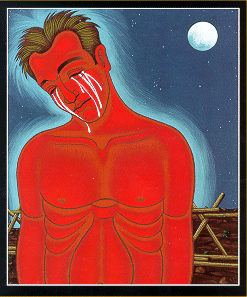 Researching LGBT hate crimes for four years has changed my life. Now that the passage of the Matthew Shepard Act is imminent, I feel another sort of change coming: to my work, to the LGBTQ community, and to my country. For decades, families, loved ones, law enforcement officers, and social justice advocates have prayed for, labored for, and agitated for a federal law extending protection to queer folk victimized by anti-LGBT violence. Tens of thousands of Americans, straight and gay, have labored tirelessly for this result. Our well-practiced shoulders are again set to the task, and with one more great heave, the first major expansion of legal protection against physical harm for vulnerable Americans in the 21st century will make it across the finish line. The end of the beginning has come at last. No more than that, and no less.
The dead are beyond further physical harm. So many hundreds have died at the hands of the ignorant, the malicious, and the sincerely bigoted. Gay Charlie Howard drowned in Bangor, Maine. Lesbian Talana Kreeger, manually disemboweled in Wilmington, North Carolina. Navajo Two-Spirit youth, F.C. Martinez, Jr., brained with a 25-pound rock in a blind canyon in Cortez, Colorado. African American transwoman, Duanna Johnson, shot down in a Memphis, Tennessee alley. Pfc. Barry Winchell, murdered by a fellow soldier with a baseball bat at Fort Campbell, Kentucky, on the suspicion that he was gay. And the archetype of them all, young Matthew Shepard, pistol-whipped into a coma and left to die, tied to the foot of a buck fence in Laramie, Wyoming. For every victim whose name is remembered, scores of anonymous others have died, their agonies unreported, their names forgotten.
What will change for all these victims of hate, once the Shepard Act becomes law? And, what about their families, lovers and spouses—what will change for them?
For the dead, the change will come subtly, like a gift of dignity. The Shepard Act is not only for the living. Those who have died at the hands of hatred will finally receive a measure of vindication. No longer will they be merely the debris of social history. Their stories will be told with renewed passion, and more and more people will want to know who they were. Their lives will take on a greater sense of meaning to the LGBTQ community, who will find encouragement to embrace these dead as their own—just as blacks, Jews, and other besieged peoples have embraced their fallen friends and family members. As these LGBTQ victims have become my teachers in my quest to recover their stories and the meaning of their lives, the queer community will find new strength for justice by remembering them.
For the families and loved ones of these victims, perhaps a measure of peace will come at last. Their loss, of course, is incalculable. Their pain is beyond reckoning. I have seen the furrows in their brows, the lingering sadness in their eyes. As Ryan Skipper’s mother Pat said to me, there is no closure for her and those like her. The change will come, I suspect, with a sense of honor, and a quiet assurance that their beloved will have not died in vain. When the Shepard Act finally passes, I will think first of all about the valiant witness of the mothers—women who never sought the spotlight, but who fought back tears to learn how to speak out for their children and for everyone else’s children. Signing day in President Obama’s office will be most of all for Judy Shepard, Pat Mulder, Elke Kennedy, Pauline Mitchell, Denise King, Kathy Jo Gaither and everyone else whose flesh and blood have consecrated the moment of passage.
Those who believe in justice will feel the change, too. The LGBTQ community will be challenged to mature and take their place among communities of survivors, witnesses who understand that it takes hard work to make hope become real for everyone. At the stroke of a pen, the entire LGBTQ community will experience the greatest lift since the Stonewall Rebellion forty years ago. But that will not be all. The America I know and love will encounter change on the day the Shepard Act becomes law, too. Summoned by the angel of justice, the American people will face the challenge to make the promise of the Constitution come true for their transgender, gay, bi, and lesbian neighbors and friends.
Passage and signing the Matthew Shepard Act into law will not magically stop the killing. Record numbers of LGBTQ Americans, especially young transgender people of color, are dying violently all across the land. But the high water mark of hatred will be scotched with the stroke of a pen on the day President Obama keeps his promise and signs the bill. The end of the beginning of full equality for my people will come. And we who believe in justice will not rest until it comes.
~ Stephen V. Sprinkle, Director of the Unfinished Lives Project
Protecting Wretches: Why Freedom of Speech Belongs to Fred Phelps, Too
 Richmond, VA – The 4th U.S. Circuit Court of Appeals threw out a $5 million verdict Thursday against protesters from Fred Phelps’ Westboro Baptist Church who picketed the Maryland funeral of a U.S. Marine who was killed in Iraq with signs bearing messages like “Thank God for IED’s,” and “Priests Rape Boys.” Surely the most offensive sign carried by the protesters at the funeral of Marine Lance Corporal Matthew Snyder of Westminster, MD, was “Thank God for Dead Soldiers.” A Baltimore jury had awarded Snyder’s father $5 million in damages from the Topeka, Kansas-based church for the emotional stress and invasion of privacy visited on the family by the protestors. The three-judge panel of the court of appeals ruled that the language employed by Phelps’ church members, equating the death of Lance Corporal Snyder with God’s judgement against the United States for laxity on homosexuality was “imaginative and hyperbolic rhetoric” that was protected by the First Amendment as freedom of speech. The messages the church group issued were meant to ignite debate and could not be understood as personally pertaining to the deceased, reasoned the court. Supporters of the family decried the decision, and predictably, the Phelps Clan at Westboro Baptist Church applauded it. Sean E. Summers, attorney for Mr. Snyder, vowed to appeal the decision to the U.S. Supreme Court. Shirley Phelps-Roper, daughter of Fred Phelps, welcomed the ruling. Speaking to the Associated Press, Phelps-Roper, who was one of the protestors named in the lawsuit, said, “They had no case but they were hoping the appellate court would not do their duty to follow the rule of law and the appellate court would not do that. They didn’t change God and they didn’t stop us. What they managed to do was give us a huge door, a global door of utterance. Our doctrine is all over the world because of what they did.” The Supreme Court will or will not hear the appeal the Snyder family says it will bring them, as the high court pleases. But the guarantee of freedom of speech belongs to wretches as well as the righteous, and as hard as it is to admit its protections for grave errors in judgment, taste, good order, and belief, such protection ensures that truth remains free to combat error in the marketplace of ideas, morals, and customs. As bitter as it sounds, the court of appeals decision was correct, both for the country, and for LGBT people and their supporters, in the end. No outfit in America has said more inflammatory things about LGBT people than Phelps and his church, comprised of mostly family members. The 1998 protest of Matthew Shepard’s funeral in Casper, WY, declaring that “Matt is in Hell!” and that when “Fags Die, God Laughs” is one of the more notorious examples of how wretched hate speech can be in the case of victims of anti-LGBT prejudice. Finding that their virulent anti-gay rhetoric was losing its public shock value, Phelps’ hate mongers moved on to besmirching the memories of American military servicemembers who had died in Iraq and Afghanistan. Phelps has not won at every turn. A public monument proclaiming Matthew Shepard’s damnation, to be put in a Kansas municipal park, was blocked by city officials. In the end, the defeat of anti-LGBT hate speech is the responsibility of everyone, gay and straight, who know that the Phelps message is morally, spiritually, and patriotically bankrupt. In Pompeii, buried by volcanic ash in CE 79, graffiti scrawled on a wall proclaims, “Samius to Cornelius: go hang yourself!” It is all but forgotten, as are Samius and Cornelius, and so will Phelps’ baseless rantings, as LGBT people and their allies continue to show themselves to be greater in character than their adversaries. Hate speech does incite some people to violence against queer folk. Too many cases exist of hateful, religious rhetoric being used to justify torture and murder of LGBT victims to ignore how wretches use God’s warrant to harm others. Any case of bias-generated violence against LGBT people must be prosecuted swiftly to the full extent of the law, and passage of the Matthew Shepard Act is necessary so that these prosecutions may be pursued vigorously and successfully. But freedom of speech means more to truth than it does to error. At every turn, LGBT folk and their allies may and must immediately and non-violently refute the falsehoods of bad religion so that justice may win out in American life, so that the better angels of the American spirit may rouse themselves to make protests like these seem as petty as scrawlings on an outhouse wall.
Tampa Bay Gay Publisher Admits Neglecting Ryan Skipper’s Hate Crime Murder “A Big Mistake”
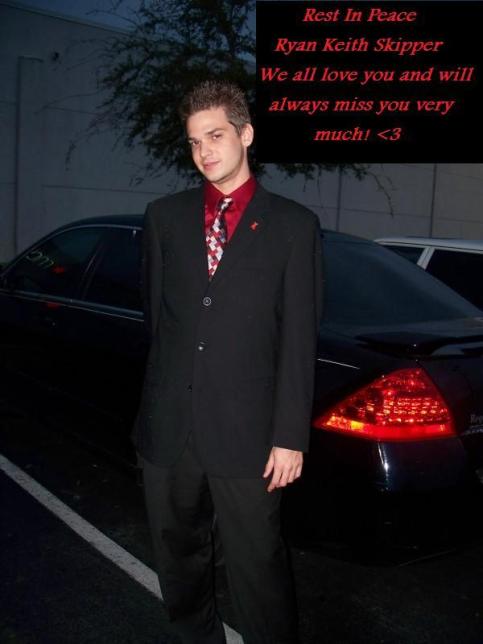 Tampa Bay, FL – Jon Ponder of the blog, Pensito Review, writes that Watermark publisher, Tom Dyer, counts missing the Ryan Skipper hate crime murder story the deepest regret of his publishing career. Watermark, a gay publication serving Tampa Bay and other metro Florida areas for 15 years, ran no stories on the Skipper case in 2007 even though it happened in nearby Polk County, between Tampa and Orlando. Pensito Review ran multiple stories from virtually the beginning of the case, staying in close touch with the Mulders, Ryan’s parents, and pressing for the office of Sheriff Grady Judd to come clean on the law enforcement bias against homosexuals that skewed press releases and unsupportable statements about Skipper’s character to the media. In Tom Dyer’s own words to a reporter from the Daily City, “We should have jumped on the Ryan Skipper story immediately. This young Polk County man’s murder just a few years ago was every bit as gruesome as Matthew Shepard’s, and every bit as telling about the persistence of violent homophobia in our area. There was almost no coverage in the mainstream press, and I let that influence my judgment. Big mistake, and I still regret it.” Skipper, a gay 25-year-old lifelong resident of Polk County, was brutally murdered by men who slashed him to death and dumped his body by the side of a lonely dirt road in rural Wahneta, Florida, just outside of Winter Haven. If the savagery of the murder were not enough in itself, Sheriff Judd suggested to the media that Skipper was somehow to blame for his own murder, that he was “cruising for sex” on the night of his murder, picked up “rough trade,” and agreed to participate in a drugs-related check forgery scheme with them. None of these allegations were supported by a shred of fact, but by taking the self-serving lies told by the alleged killers as his only source, Sheriff Judd accomplished two things: he pleased his right-wing religious base by removing known meth addicts from his jurisdiction (Skipper’s alleged killers), and besmirching the reputation of the victim himself, an openly gay man. While Joseph “Smiley” Bearden has already been found guilty, and William “Bill Bill” Brown will also in all likelihood, Judd remains unrepentant and unaccountable. Pensito Review calls Judd’s actions “egregious malpractice,” and makes this trenchant observation, “In the final analysis, Ryan Skipper was assaulted twice — first, fatally by his homophobic killers and then in the media by the homophobic sheriff of Polk County. Bearden has been held accountable, and it’s a dead cinch Brown will be too. But Grady Judd has not been forced to take responsibility for his role in assaulting Ryan’s memory. Unless and until the media holds him responsible for his actions, it’s likely he never will be.” LGBT hate crimes killings are horrible, and Ryan Skipper’s was one of the most disturbing in the recent history of the nation. Both the Gay American Heroes Foundation and the Unfinished Lives Project have been inspired and outraged by this case, and have moved to expose the way LGBT hate crimes are distorted and underreported. A first-rate documentary film, Accessory to Murder, produced by Mary Meeks and Vicki Nantz, details the role Judd’s politicized demolition of Skipper’s character robbed his family of comfort, and nearly robbed Florida of justice. A chapter dedicated to Ryan Skipper, entitled “Keeper of Hearts,” forthcoming in the book by Stephen Sprinkle, Unfinished Lives: Reviving the Memory of LGBT Hate Crimes Murder Victims. Dyer is to be commended for admitting his error. Too many times LGBT hate crimes are passed over because of distortion and misinformation, and it is refreshing to hear that he will not be making a mistake of this magnitude again. The editors and staff of Pensito Review demonstrate the significance of blog coverage of news stories dismissed by otherwise reputable publishers. We at Unfinished Lives applaud them.
Two Dead, Many Wounded in Tel Aviv Anti-LGBT Rampage: Special Comment
 The scope of this blog, LGBT hate crimes murders in the U.S. notwithstanding, the attack of a masked gunman on an LGBT youth nightclub in Tel Aviv, Israel, Saturday night merits special attention. The Unfinished Lives Project express our deepest sympathy to the family, friends, and entire LGBT community of Tel Aviv, and join all those outraged by this act of naked hatred and unreasoning prejudice against people because they are different. Like the United States, Israel has a heritage of cultural diversity, and values tolerance. This outbreak of raw anti-LGBT bias flies in the face of everything both countries stand for. Nitzan Horowitz, the only openly gay member of the Knesset, described the killings as a “hate crime.” Both Prime Minister Benjamin Netanyahu and President Shimon Peres have condemned the attack. Unfinished Lives supports the efforts to bring the gunman to justice, and prosecute him to the full extent of the law. We also support any efforts within the law to root out this lethal prejudice. Israel has had violent clashes over LGBT expression before. In 2005, a radical ultra-orthodox critic of a Jerusalem gay pride march attacked and stabbed three marchers. Incitement to violence prepared the way for both attacks, and though members of the ultra-orthodox Shas party have condemned the attack, their anti-gay hate rhetoric played a part in the toxic atmosphere that made a killer decide to act on prejudice. The Shas party, and all other purveyors of hate speech in the State of Israel, need to take a step back, refrain immediately from inciting rhetoric, and make amends to the LGBT community. But we at the Unfinished Lives Project are not holding our breath. Meanwhile, LGBT youth in Israel have received a message written in the blood of three murdered young people: you are not safe. It is up to the leaders and the people of the nation to insure that something like this will never happen in Israel again.
About
If you are a first-time visitor to the Unfinished Lives Project website, we invite you to read A Welcome Message introducing you to our project. We are truly grateful for your visit.
The Unfinished Lives Project website is a place of public discourse which remembers and honors LGBTQ hate crime victims, while also revealing the reality of unseen violence perpetrated against people whose only “offense” is their sexual orientation, gender identity, or gender presentation. LGBTQ people in the United States are suffering a slow-rolling decimation of terror and murder all across the country. Every locale and demographic of society are affected: First Nations, Anglo, Black, Latino and Latina, South and Southeast Asian, Transgender, Bisexuals, Gay men, Lesbians, disabled, young, and mature. Homophobia has a long, crooked arm, and it is reaching out to snatch the life away from women and men whose tragic stories are under-reported to begin with, and whose memories are swiftly forgotten.
The horror of these killings transcends the shock and bereavement of loved ones and friends. These are not typical homicides; they are not killings for money or drugs, incidents of domestic strife, or crimes of passion. The vicious nature of hate crimes against LGBTQ persons is extremely brutal, grotesquely violent, and egregiously hateful.
Each murder serves the LGBTQ population as a sobering warning about the actual level of danger in our communities. The message these killings send is that freedom and open life for LGBTQ people is a cruel dream. Every time we remember one of these victims, however, the intentions of their killers are frustrated. To remember these women and men is to begin the process of changing the culture that killed them.
Our Project Director
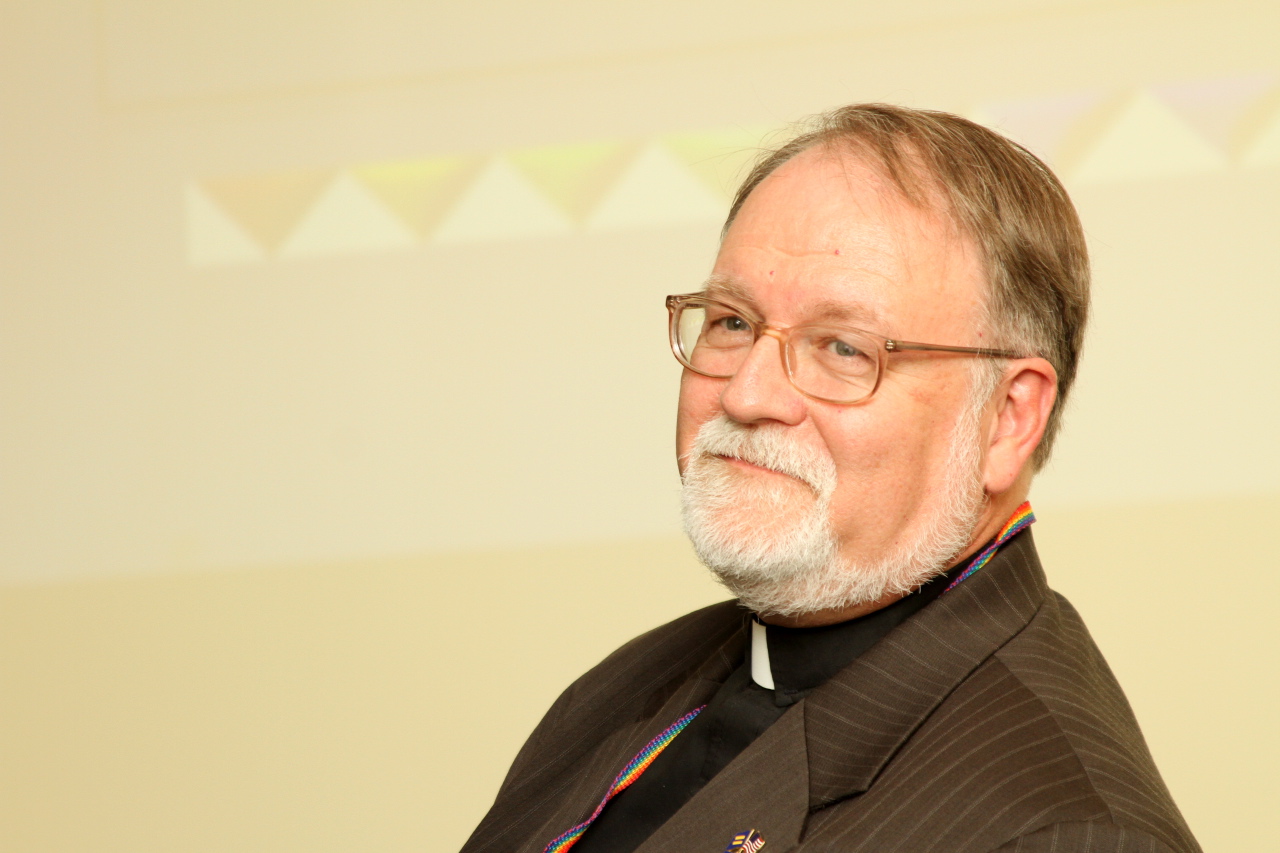
Dr. Stephen V. Sprinkle (Keith Tew photo).
Stephen V. Sprinkle is Director of Field Education and Supervised Ministry, and Professor of Practical Theology at Brite Divinity School, Fort Worth, Texas, a post he has held since 1994. An ordained Baptist minister, he is the first open and out Gay scholar in the history of the Divinity School, and the first open and out LGBTQ person to be tenured there. Read More…
Recent Social Justice Advocacy Activity By Dr. Sprinkle
 Summer 2009 – Dr. Sprinkle responded to the Fort Worth Police Department and Texas Alcoholic Beverage Commission Raid on the Rainbow Lounge, Fort Worth’s newest gay bar, on June 28, 2009, the exact 40th Anniversary of the Stonewall Rebellion. Dr. Sprinkle was invited to speak at three protest events sponsored by Queer LiberAction of Dallas. Here, he is keynoting the Rainbow Lounge Protest at the Tarrant County Courthouse on July 12, 2009. Read More…
Contact Us
Communicate with the Unfinished Lives project team:
info@unfinishedlivesblog.com


Schedule a Presentation
Dr. Sprinkle will gladly present his acclaimed presentation to your organization. To arrange an Unfinished Lives presentation for your organization or group, please contact us.
Dr. Sprinkle has given his Unfinished Lives presentation to these and other community groups and organizations. Read More…
-

Where are our readers?
Publisher: Steve Sprinkle (Project Director)
Steve Sprinkle
Unfinished Lives: Remembering LGBT Hate Crime VictimsBrite Divinity School/Texas Christian UniversityFort Worth TXprofessor, minister, author, blogger, LGBTQ advocate


Follow Unfinished Lives on Facebook
 Box Turtle Bulletin
- An error has occurred; the feed is probably down. Try again later.
- HRC Back Story
- Know About The Gender Identity Movement
- Why Is There A Need For Human Rights?
- Kinds Of Human Rights
- Human Rights Purposes And Violations
- Human Rights For Every Human Incident
- 8 Reasons Human Rights Are Important
- Everything About Human Rights
- Human Rights Issues Education & Law
- We Need To Stand Up For Our Rights And Those Of Others
- Coca-Cola Receives Perfect Score On Human Rights
- The Advocate: Daily News
- Journalist detained for booing Trump at Kennedy Center 'Chicago' performance
- Donald Trump telegraphs war crimes in profanity-filled Easter Sunday Iran threat
- NYC’s most powerful transgender official is fighting intensifying anti-LGBTQ+ federal pressure
- Maryland lawmakers advance broad school protections, including for trans students
- Fired for refusing to remove LGBTQ+ books, Tennessee librarian says she’d do it again
- Lawyers alarmed by immigration judge's 'atrocious' questions for gay asylum seekers
- What is the trans gaze? It's relief and recognition between strangers on a train
- Same-sex couples thrive in U.S. even as GOP support for marriage equality falls
- Did the FBI just post this propaganda video to save Kash Patel’s job?
- Over her short tenure as Trump’s attorney general, Pam Bondi terrorized LGBTQ+ Americans
- Dallas Voice: Instant Tea
- An error has occurred; the feed is probably down. Try again later.

 Unfinished Lives
DADT Repeal Certification Friday, July 22nd, But at What Cost to LGBTQ Americans? A Special Comment
Pfc. Barry Winchell's grave
Both CNN and the San Diego Union-Tribune are reporting tonight that final certification of DADT repeal will take place Friday in Washington, D.C. But our celebrations are sobered at the Unfinished Lives Project by the magnitude of the cost to the LGBTQ community in servicemembers’ lives and careers in order to get to this landmark moment. When Secretary Leon Panetta signs the documents of certification at the Pentagon, signifying that the chiefs of the Armed Services have previously reported to him that full and open service by gay, lesbian, and bisexual soldiers, sailors, marines, airwomen and airmen, national guardsmen and women, and coast guardsmen and women poses no threat or harm to the morale, unit cohesion, or mission readiness of the Armed Forces, a giant step toward full equality for LGBTQ people will be made. Seventeen years of the most oppressive and blatantly discriminatory anti-gay policy in contemporary memory will be over; but not before the incalculable cost of the lives of queer servicemembers who died before seeing this day dawn. At the Unfinished Lives Project, we have invoked the names and stories of some of them: Petty Officer Allen R. Schindler, U.S. Navy; Pfc. Barry Winchell, U.S. Army; Pfc. Michael Scott Goucher, U.S. Army Reserve; Seaman August Provost, U.S. Navy. May they and all the others they represent rest in peace! These patriots died outrageous deaths at the hands of hatred and unreasoning bias, enabled by a military culture that either encouraged violence against suspected LGB servicemembers, or at the very least turned a blind eye toward such violence. Celebration of repeal is in order, and celebrate we will. The dead are honored by this act of justice, signifying that they have not died in vain. But we will also be mindful that no stroke of a pen, even one so powerful as the one wielded by the Secretary of Defense, will eliminate homophobia and heterosexism in the Armed Services. Ships, barracks, and foreign fields of service will be haunted with the hatred that has been passed down from generation to generation of American military personnel. Backlash is in full swing, as we have seen most graphically among right-wing conservative military chaplains whose appeals to exempt their anti-LGBTQ rhetoric and teachings as freedom of religion served to be the last bastion of “homophobia-masquerading-as-liberty” in the armed services. Thankfully, as certification on Friday shows, the vast majority of servicemembers of all ranks reject discrimination for what it truly is: un-American. In memory of all our LGBTQ servicemembers (of all faiths and faith-free, as the case may be) who have died in part or in full because of the ravages of hate crimes, we dedicate a portion of Fr. Thomas Merton’s most famous poem, written in memory of his brother, John Paul, killed in action in World War II, entitled, “For My Brother, Reported Missing In Action, 1943” [The Collected Poems of Thomas Merton, New Directions, 1977, p. 35-36]:
:
When all the men of war are shot
And flags have fallen into dust,
Your cross and mine shall tell men still
Christ died on each for both of us.
For in the wreckage of your April Christ lies slain,
And Christ weeps in the ruins of my spring:
The money of Whose tears shall fall
Into your weak and friendless hand,
And buy you back to your own land:
The silence of Whose tears shall fall
Like bells upon your alien tomb.
Hear them and come: they call you home.
Share this:
July 22, 2011 Posted by unfinishedlives | African Americans, Anglo Americans, anti-LGBT hate crime murder, Asian Americans, Bisexual persons, Don't Ask Don't Tell (DADT), gay men, GLBTQ, Hate Crimes, Heterosexism and homophobia, Latino and Latina Americans, Legislation, Lesbian women, LGBTQ, military, Military Chaplaincy, National Guard, religious intolerance, Remembrances, Social Justice Advocacy, Special Comments, transgender persons, U.S. Air Force, U.S. Army, U.S. Coast Guard, U.S. Department of Defense, U.S. Marines, U.S. Navy, Vigils, Washington, D.C. | African Americans, Anglo Americans, anti-LGBT hate crime murder, Asian Americans, Bisexual persons, Don't Ask Don't Tell (DADT), gay men, GLBTQ, Hate Crimes, Heterosexism and homophobia, Lesbians, LGBTQ, military, Military Chaplaincy, National Guard, religious intolerance, Remembrances, Social Justice Advocacy, Special Comment, transgender persons, U.S. Air Force, U.S. Army, U.S. Coast Guard, U.S. Marines, U.S. Navy, Vigils, Washington D.C. | 1 Comment