Family of Bullying Victim Sues Joshua (TX) ISD

Jon Carmichael, 13-year-old bullying victim who was told "No one cares if you live or die."
Joshua, Texas – A year after their 13 year-old son, Jon Carmichael, succumbed to bullying and hanged himself in his family’s barn, Jon’s parents are suing the Joshua Independent School District in federal court. According to the Dallas Voice, the suit contends that R.C. Loflin Middle School officials covered up months of cruel bullying victimizing their son, targeting the youth because he was smaller than his classmates, and was perceived to be weak. The bullying Jon suffered got so far out of hand that just before he took his own life, he was forced to strip naked, was tied up, and was then crammed into a trash can. The attack was video taped, and put up on YouTube, but a school official ordered it to be taken down, and did not report the brutal bullying attack to anyone else, according to the allegations in the lawsuit. Other incidents included Jon being being tossed into a dumpster. On the day Jon took his life, the lawsuit alleges that he told a female classmate he was going home to kill himself, and she responded by saying that he should go ahead and do it, since no one cared whether he lived or died. The Fort Worth Star-Telegram reports that the complaintants’ attorney, Martin Cirkiel of Round Rock, accuses the school system of more than neglecting to enforce school policies like never leaving children unsupervised in gym class, but of “an actual practice and custom of looking the other way.” The suit is asking for damages compensation for young Carmichael’s estate and heirs. The Superintendent of the Joshua School District said that he would not comment on the suit, since he had not had the chance to read it yet. Carmichael’s family were among the many who converged on Austin last week to call upon the Legislature for a comprehensive state law banning bullying in Texas schools. Joshua is a town of 4,500 near Cleburne, Texas, south of the Dallas/Fort Worth Metroplex. The Joshua Independent School District has eight campuses, one of which is the Loflin Middle School.
Unfinished Lives Book Tour Stop @ Barton College

Barton College
The book tour is now scheduled to visit Barton College in Wilson, NC on Monday, April 11 from 4 – 5 pm in on campus at the Regan Writing Center. Dr. Joe Jones is primary host for a short lecture and the book signing. Many thanks to Rev. Phil Jones for all his help in working this out, too! Click Here For More Info.
Two Transgender Murders Bespeak Crisis of Violence

Marcal Camero Tye, 25, hate crime victim
Forrest City, Arkansas and Baltimore, Maryland – The brutal murders of two transgender women of color within the last month indicate the epidemic nature of transphobic and racist violence against the most vulnerable members of the LGBTQ community. No suspects have been identified yet in the murder of Tyra Trent, 25, who was found asphyxiated in a vacant building owned by the city in Baltimore on February 19. Ms. Trent had been reported missing days before the discovery of her body. Marcal Camero Tye, also 25, was murdered by dragging behind a vehicle for several hundred feet in Forrest City, Arkansas on March 8. The FBI has begun an investigation into the grisly murder of Ms. Tye, since Arkansas has not statute on the books protecting transgender people. No witnesses have come forward, and no suspects are being investigated in the Tye case as of yet. Transgender activists have filled the cyberworld with posts and articles about the two women, since regional and national media routinely ignore such stories, and the African American and LGBTQ press seem not to be much better when it comes to reporting these terrible acts of violence. Media chronically use male pronouns when referring to these women who gave so much in order to live life as they were born to be. Statements like “a man in a dress” sensationalize and demean the victims over and over again, even following their murders–thereby re-victimizing the victims. By definition, these murders are hate crimes perpetrated against a class of human beings who have remarkable hurdles to surmount in society. It is amazing to us at Unfinished Lives that Ms. Tye could live as a transgender woman in small town Arkansas. Ms. Trent faced similar problems in big town life. Local law enforcement authorities are reluctant to launch hate-crime investigations because of internalized bias against transgender persons. In the case of Ms. Tye, Arkansas LGBTQ activists were infuriated when Francis County Sheriff Bobby May asserted that her murder was a usual homicide and that the dragging death reports of he demise were “misleading.” The Little Rock-based Center for Artistic Revolution has issued statements of alarm and support for Ms. Tye since the initial reports of her slaying. As EDGE Boston reports: “The National Coalition of Anti-Violence Programs’ most recent report on anti-LGBT hate violence also indicated disproportionately high levels of anti-trans violence. Trans women-many of whom were of color-comprised half of the 22 reported anti-LGBT murders in 2009.” The situation has reached epidemic proportions across the nation. These two savage killings underscore the need for LGBTQ and racial/ethnic minority advocates to amplify the cries of the transgender community. The killings must stop.
Unfinished Lives Book Debuts in DC and Dallas
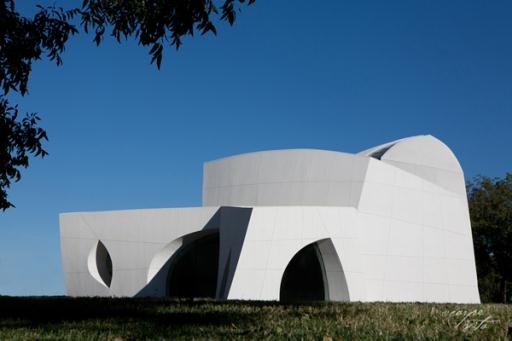
Interfaith Peace Chapel on the Campus of Cathedral of Hope, Dallas, Texas
Washington DC – Unfinished Lives: Reviving the Memories of LGBTQ Hate Crimes Victims, made its debut at the annual meeting of the Forum on the Military Chaplaincy this past Friday. Dr. Stephen Sprinkle will kick off a series of book signing events nationally, beginning with a lecture, panel discussion, book signing and reception at the Interfaith Peace Chapel on the campus of the Cathedral of Hope in Dallas, Texas, next Sunday, March 27. The Cathedral of Hope, a congregation of the United Church of Christ, is the world’s largest LGBTQ-predominant faith community. Members of the Forum on the Military Chaplaincy, meeting at the headquarters of the Human Rights Campaign in Washington, received the book with enthusiasm. Dr. Sprinkle was a guest at the 19th Annual Servicemembers Legal Defense Network Dinner, held at the National Building Museum on F Street. A stellar gathering of LGBTQ heroes and their allies celebrated the Repeal of Don’t Ask, Don’t Tell, and honored two mothers of gay servicemembers who were murdered because of their sexual orientation. Dorothy Hajdys-Clausen of Chicago Heights, Illinois, the mother of slain sailor Allen R. Schindler, and Pat Kuteles of Kansas City, Missouri, mother of murdered soldier Barry Winchell, were given a standing ovation. A chapter on Schindler, “Hell to Pay on the Belleau Wood,” is in Unfinished Lives, and Winchell has been featured in this blog repeatedly. A panel discussion is planned for the March 27th book signing event at the Interfaith Peace Chapel in response to a short lecture by Dr. Sprinkle. Dr. Keri Day, Assistant Professor of Theological Ethics and Director of Brite Divinity School’s Black Church Studies Program, Pastor Alex Byrd of Living Faith Covenant Church of Dallas, and Colonel Paul Dodd, U.S. Army Chaplain (Ret) of Austin will be on the panel. The event is scheduled from 3:30 until 5:30 pm. Dr. Sprinkle will be signing his book following the 9 am and the 11 am services at the Cathedral that morning in the Sources of Hope Bookstore. Cathedral of Hope is located at 5910 Cedar Springs Road in Dallas. For more information about the book signings on Sunday, March 27, contact Sue Schrader at sschrader@cathedralofhope.com, or Brian Parman at bparman@cathedralofhope.com.
Unfinished Lives 2011 Book Tour Comes to North Carolina

Duke University Chapel
DURHAM – Dr. Sprinkle is scheduled to appear at Duke University in Durham on Tuesday, April 12, at the Cokesbury Book Store, 12 noon till 2 p.m. outside the refectory at the Divinity School, for his signing books. Rebecca Turner, Cokesbury‘s manager can be reached at rturner@cokesbury.com for details.
WILMINGTON – The appearance and book signing in Wilmington is Sunday, April 10, 2011 from 3:00 to 4:00 pm. at Two Sisters Bookery in downtown Wilmington. Brooks Preik, (one of the stores owners) can be reached at bpreik@att.net. Dr. Sprinkle is also preaching that morning at St. Jude‘s Metropolitan Community Church on 19 North 26th Street, Wilmington, 28405 for both the 9 AM and 11 AM services. For more information, contact Rev. John A. McLaughlin at stjudes@bellsouth.net, or 910/762-5833.
RALEIGH – Dr. Steve Sprinkle will be speaking in Raleigh at a noon-brown-bag lunch event in Talley Student Center on the campus of NC State Univ., Monday, April 11, 2011 from 12:00–1:15 pm. He will sign books from 1:15-1:45 pm. Justine Hollingshead, Director of the GLBT Center at NC State is our contact person for this event. The public is invited. Continue reading
Brooklyn Man Brutally Gay Bashed

Williamsburg native, Barie Shortell, the day of the attack
Brooklyn, New York – Barie Shortell, 29, was beaten savagely by a gang of six teens who thought he was gay. On February 22, Shortell walked past the hooded teens in the Williamsburg neighborhood who insulted and hurled anti-gay epithets at him. At about 10:10 PM, Shortell told The Brooklyn Paper, one of the youths yelled, “Oh, shit, is that a guy or a girl?” Shortell let the insult pass, thinking it “juvenile,” but the gang pursued him as he tried to cross Wythe Avenue, slamming him into a wall and then pummeling him on the sidewalk with such force that it shattered his nose, his eye sockets, and broke his jaw in several places. Shortell thankfully has no recollection of the moments of the assault. He was sure, however, of the motive for the attack. “I feel pretty confident they perceived me as a gay man and attacked me, but I can’t understand why they did what they did,” he said to The Brooklyn Paper. “I looked horrible. Blood was everywhere.” Shortell was rushed to Woodhull Hospital where surgeons worked for better than ten hours to reset his jaw and insert three metal plates into his face and head. A spokesperson for the hospital told reporters that the force of impact the injuries represented was equivalent to a car wreck. At first, police dismissed the hate crime aspect of the case. Pressure from the New York Anti-Violence Program made them reconsider. Now the case is being investigated as an anti-gay hate crime, though there have still been no arrests made as of March 17. The costs of Shortell’s surgery has mounted to over $100,000, so friends have organized a benefit to raise money for him next week on March 23. Calling the event “Gay Bash: A Benefit for Barie Shortell,” the organizers are asking $35.00 admission to the Blackout Bar, 916 Manhattan Avenue at Kent Street in Greenpoint. Doors open at 7 PM.
Reverend Professor Peter J. Gomes, Eminent Gay Theologian, Dies at 68
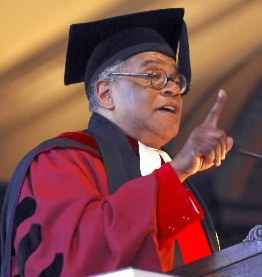
(Fred Field/Harvard News Office photo)
Plymouth, Massachusetts – One of America’s best-known preachers and theologians, and arguably the most famous out gay scholar in the nation, Peter J. Gomes died February 28 of a brain aneurysm and heart attack. He was 68 years old. For three and a half decades, Gomes was a member of the faculty of Harvard Divinity School, and served as Pusey Minister in the Memorial Church as well as Plummer Professor of Christian Morals. A New York Times Bestselling Author, Gomes will be remembered as the person who put the Bible’s teachings within reach of an intelligent, progressive secular audience with his widely acclaimed book, The Good Book: Reading the Bible with Mind and Heart (HarperOne: 2002). The son of a Cape Verdean father and a Bostonian mother, Gomes graduated from Bates College in 1965 and Harvard Divinity School in 1968. As he rose to prominence in Harvard, African Americans rejoiced to have a scholar and preacher so well situated in the academy. In recognition of the role he fulfilled in American black life, Henry Louis Gates featured Gomes in the Public Broadcasting System documentary,African American Lives 2. A life-long Republican until 2006 (having offered prayers at the inaugurations of Presidents George H.W. Bush and Ronald Reagan), Gomes became a registered Democrat in order to vote for Deval Patrick, the first African American Governor in Massachusetts history. In 1991, Gomes shocked the public by coming out openly as a gay man during a campus controversy over homosexuality–a story he tells eloquently inThe Good Book. Upon announcing his sexual orientation in order to support Harvard gay and lesbian students, Gomes was targeted by a hail of criticism. His defense of himself was forceful, measured, and laser-sharp: “Many of my critics, chiefly from within the religious community, asked if I read the same Bible they did, and if I did, how then could I possibly reconcile my position with that of scripture? When arguments failed, anathemas were hurled and damnations promised. The whole incident confirmed what had long been my suspicion. Fear was at the heart of homophobia, as it was at the heart of racism, and as with racism,religion—particularly the Protestant evangelical kind that had nourished me—was the moral fig leaf that covered naked prejudice” [The Good Book, p. 166]. Throughout the rest of his life, Gomes combatted fear and advocated for the equality of all people, regardless of their sexual orientation, gender identity, or gender expression. Among his other New York Times Bestselling books are The Good Life: Truths That Last in Times of Need (2003), and most recently The Scandalous Gospel of Jesus: What’s So Good About the Good News? (2007). Gomes suffered a stroke in December 2010, and was recently transferred to a rehabilitation center in his beloved hometown of Plymouth. News reports suggested that he was planning to return to Harvard this spring, and fulfill his career until his announced retirement in 2012. As the Harvard Crimson says, “He maintained a tremendous presence at Harvard as well as around the country.” More particularly for the LGBTQ community, Professor Gomes’s voice of faithful sanity and his incarnated presence as a person who was both black and gay will be sorely missed. Ave atque vale, Professor Gomes! “Hail and fare you well!”
Houston Churches Break Cycle of Gay Hate: “Bring Your Gay Teen to Church Sunday,” Feb. 20
 Houston, Texas – When school bullying drove 13-year-old Asher Brown to take his own life on September 23, the horror and despair of so many LGBTQ youth was laid bare for Houston to see. LGBTQ teen suicide, a crisis for any society, hit leaders of Houston’s gay-affirming religious communities particularly hard. Now, the Houston Chronicle and the Dallas Voice report that 22 area churches are doing their part to break the cycle of religion-based negativity toward homosexuality by inaugurating “Bring Your Gay Teen to Church Sunday” this week. On Sunday, February 20, churches from a broad range of traditions make it public that their doors and fellowships are fully open and affirming of LGBTQ youth, their families, and loved ones. The connection with the suicide of young Asher Brown is important, since at the time public rallies and memorials in his memory were taking place, the visual absence of churches, synagogues, temples, and mosques was telling. Surely hundreds of people from faith communities attended these public memorial events, but there was no organized presence on the part of religious communities–a glaring absence that communicated a message of neglect or disapproval that concerned religious leaders are eager to dispel. The Houston Chronicle details grim statistics about how religion is perceived to reinforce LGBTQ youth attitudes of alienation from faith communities. The Chronicle reports that a recent survey by the Public Research Institute showed that less than 20 percent of Americans believe faith communities do a “good job” on the issues of homosexuality and gender expression. Almost half of those surveyed said that the religious message on the topic was “negative,” and fully 40 percent said that the intolerant attitudes of religious communities contributed “a lot” to the disapproval and condemnation of LGBTQ people in this country. The most damning statistic associated with these issues referred to teen LGBTQ suicides: two out of three Americans in the survey said that religion contributed heavily to increasing rates of suicide among gender non-confroming, queer, and gay youth. Robert P. Jones, executive officer of the Public Research Institute, underlined the long history of anti-LGBTQ messages coming from America’s houses of faith: “Religious Americans historically have had negative attitudes about gays and lesbians.” In response to the crisis of teen despair in public and private schools in the metro area, the Houston Clergy Council devised “Bring Your Gay Teen to Church Sunday” as a means of getting out the word that God and the faith community do not hate, reject, or despise LGBTQ youth–quite to the contrary, these affirming churches welcome gender non-conforming people and their families every day. The masthead of the Facebook page announcing the project reads, “Is your teenager Gay, Lesbian, Bisexual, Transgender, a Questioning (GLBTQ) teen? Bring your teen to one of these affirming churches, and rest assured we won’t try to ‘fix’ them. We think they are awesome just the way they are!” The list of churches is impressive, including historic mainline denominations (Episcopal, United Church of Christ, Lutheran, and United Methodist), non-denominational communities, the Society of Friends (Quakers), Unitarians and Universalists, and the largest Metropolitan Community Church in the world. There is even a lone courageous Baptist church with an open and affirming stance. The struggle with religious intolerance and hate speech from pulpits in Houston and around the nation will go on for a long time. Thousands of congregations in the Houston metro area deny the acceptability of homosexuality and gender non-conformity, declaring queer youth sinful or worse. But a cadre of deeply committed faith leaders and their communities are determined to get out the word in America’s fourth largest city that sexual minority youth are acceptable to God, and most certainly to them. “Bring Your Gay Teen to Church Sunday” is tomorrow, February 20.
Fr. Matthew Kelty, OCSO, Passes Away: Out Gay Monk was Thomas Merton’s Confessor

Fr. Matthew Kelty, OCSO, Monk of Gethsemani (1915-2011)
Trappist, Kentucky – The most widely known and beloved monk of the Abbey of Our Lady of Gethsemani died peacefully among his brothers today in the Kentucky Hill Country. Fr. Matthew, né Charles Richard Kelty Jr., was born in South Boston, Massachusetts in 1915. Educated in the public schools of Milton, Massachusetts, he followed his vocation to the religious life, attended the seminary of the Society of the Divine Word in Techny, Illinois, and was ordained a Roman Catholic Priest in 1946. Fr. Matthew served as a writer for the magazine of the order, and became a Divine Word missionary in Papua, New Guinea from 1947 to 1951. Sensing all the while that his vocation was to the contemplative life, Fr. Matthew petitioned to enter the Abbey of Gethsemani in February 1960. “A natural love for the monastic life drew me to Gethsemani and fulfilled a lifelong dream,” he said. At Gethsemani, Fr. Matthew did many things. He once said, “Over the past decades, I have served in various capacities: master of the brothers, shoe shop, tailor shop, vocations office, and retreat house. Monastic life is everything I wanted, my happiness. All dreams fulfilled. But the fulfillment came slowly. Following your dreams and not giving up is my best recommendation.” Two interludes in his life are most worth mentioning. First, Fr. Matthew served as Prior of Holy Mother of God Monastery in Henderson, North Carolina, a small foundation near Oxford that the Trappists took over from Benedictines in the 1970s. In those days, when I first met Fr. Matthew, he was ebullient, funny, and a committed motorcycle driver. I can see him in my mind’s eye, zipping down the two-lane state roads, with his habit’s black scapular streaming behind him in the slip stream. I remember he loved and tended peacocks and pea hens that roosted in the pine trees bordering the chapel grounds, and he shared afternoon strolls with his dog and an obstreperous billy goat named “Philip Morris.” It was during this period that Fr. Matthew protested the war in Vietnam in a most monastic way: he and his dog walked for peace all the way from North Carolina to Washington, D.C. His journey was carried widely in the media. Standing on the banks of the Potomac River, looking over at the stately marble buildings of government, Fr. Matthew said that Washington looked to him like “frosting over so much burnt cake.” Second, Fr. Matthew received permission from Gethsemani to return to his beloved Papua, but this time as a hermit. He lived on the coast, loved the Papuans, and sewed clothes for his living as a tailor. During his hermitage, Fr. Matthew married Lady Poverty. Upon his re-entrance to Gethsemani, he wrote his spiritual autobiography, Flute Solo. It was in this book that he revealed his homosexuality as a celibate monk. Many years ago, I nervously came out to Fr. Matthew when I was on one of many retreats to the Abbey. He was so pastoral, loving, and understanding. He affirmed his own gayness, and mine, and advised me to live my dreams. He also helped change my life. “I will pray for you every day, Stephen,” he said, “as I say mass.” And I believe he did. Every day. Without fail. Fr. Matthew served as Thomas Merton’s confessor from the days of his entrance to the Abbey and Merton’s death in 1968. He always said Merton was the finest monk of Gethsemani, because he knew that in order for God to get a hearing, you had to have cunning enough to use other means to do it. Fr. Matthew must have taken those words to heart, for he will be best remembered and loved as the Guest House Chaplain and post-Compline preacher for years. His homilies are online for readers at the Abbey website. There are many ways God has of blessing the human race with gayness. Fr. Matthew was the queerest person I ever met, or am likely to meet. He hid nothing. He lived as a true child of his tradition, out in the open where God, the pea fowl, and the hierarchy could see. “Who wouldn’t want to live here?” he asked me one day when I was on a Fall retreat at the Abbey. “I am surrounded by good men, and get to wear beautiful clothes!” Now his transition is complete. He is with beloved Jesus, whom he loved as a consort and ascetic for 51 years. Not bad for an Irishman, eh?. Requiescat in pace, Padre. ~ Stephen Sprinkle, Unfinished Lives Project Team Member
How to Remember a Gay Hate Crimes Victim: 12 Years After Murder, Billy Jack Gaither’s Memory is Alive

Billy Jack Gaither
Montgomery, Alabama- Billy Jack Gaither’s memory will not die. A determined group of family, friends, and human rights advocates see to that annually, and on Sunday, February 2o, the 13th Annual Vigil for Victims of Hate and Violence will take place on the steps of the Alabama State Capital Building. Billy Jack, 39, died February 19, 1999 on the banks of Peckerwood Creek at the hands of two local men who hate him for being gay. Steven Mullins and Charles “Charlsey” Butler had no other motive for the grisly murder. They killed Billy Jack with a pick ax handle, and then burned his body on a pyre of old tire carcasses as an expression of their disdain for him and for all LGBTQ people as human beings. “Charlsey” and the “Skinhead” wanted this gentle, loving Alabamian from Sylacauga dead, immolated, and forgotten. But Billy’s family, especially sisters Kathy Jo and Vickie, and allies such as Dr. Beverly Hawk of the University of Alabama – Tuscaloosa and David Gary of Birmingham, have doggedly refused to let the killers win. They established the Billy Jack Gaither Humanitarian Award, to be presented annually at the Vigil to persons of outstanding social conscience and action. This year, the Vigil will commence at 3 p.m. with music by The Shouting Stones, and the Unitarian Universalist Fellowship Choir. Professor Gwen Thomas of Auburn University is the featured speaker. The Fourth Annual Billy Jack Humanitarian Award will be given to the Rev. and Mrs. Robert Graetz. Graetz was the white pastor of the predominantly black Trinity Lutheran Church in Montgomery during the historic Montgomery Bus Boycott in 1955. A personal friend of Rosa Parks, the Rev. Graetz was ostracized by whites for his support of the non-violent civil rights movement. His auto tires were slashed. The home he shared with his wife Jennie and their family was bombed three times, but thankfully the largest and last of the bombs was a dud, and did not go off. For Billy Jack to be remembered by awarding good works such as the courageous witness of the Rev. Graetz and his wife Jeanie is wonderful in itself. The award this year certainly embraces the LGBTQ and African American communities, and brings them into further dialogue as they struggle for justice together. But the planners and board members who refuse to forget Billy Jack are doing more than staging an event and presenting a named award–they are frustrating the intentions of hate crime killers like Mullins and Butler everywhere. They are bringing good people into an educational circle of hope and justice. They are sending a beam of light into the darkest regions of the human soul, the places where bigotry and hatred are incubated. So, once again, Billy Jack is remembered, celebrated, and beloved. Billy Jack’s memory is evergreen in Sweet Home Alabama. His killers languish forgotten serving life sentences in prison. Well done, Alabamians! [Billy Jack’s story, “Southern Gothic,” is told in the newly published Unfinished Lives: Reviving the Memories of LGBTQ Hate Crimes Victims. Follow this link for more information: http://www.amazon.com/Unfinished-Lives-Reviving-Memories-Victims/dp/1608998118/ref=sr_1_2?s=books&ie=UTF8&qid=1298017444&sr=1-2].
About
If you are a first-time visitor to the Unfinished Lives Project website, we invite you to read A Welcome Message introducing you to our project. We are truly grateful for your visit.
The Unfinished Lives Project website is a place of public discourse which remembers and honors LGBTQ hate crime victims, while also revealing the reality of unseen violence perpetrated against people whose only “offense” is their sexual orientation, gender identity, or gender presentation. LGBTQ people in the United States are suffering a slow-rolling decimation of terror and murder all across the country. Every locale and demographic of society are affected: First Nations, Anglo, Black, Latino and Latina, South and Southeast Asian, Transgender, Bisexuals, Gay men, Lesbians, disabled, young, and mature. Homophobia has a long, crooked arm, and it is reaching out to snatch the life away from women and men whose tragic stories are under-reported to begin with, and whose memories are swiftly forgotten.
The horror of these killings transcends the shock and bereavement of loved ones and friends. These are not typical homicides; they are not killings for money or drugs, incidents of domestic strife, or crimes of passion. The vicious nature of hate crimes against LGBTQ persons is extremely brutal, grotesquely violent, and egregiously hateful.
Each murder serves the LGBTQ population as a sobering warning about the actual level of danger in our communities. The message these killings send is that freedom and open life for LGBTQ people is a cruel dream. Every time we remember one of these victims, however, the intentions of their killers are frustrated. To remember these women and men is to begin the process of changing the culture that killed them.
Our Project Director
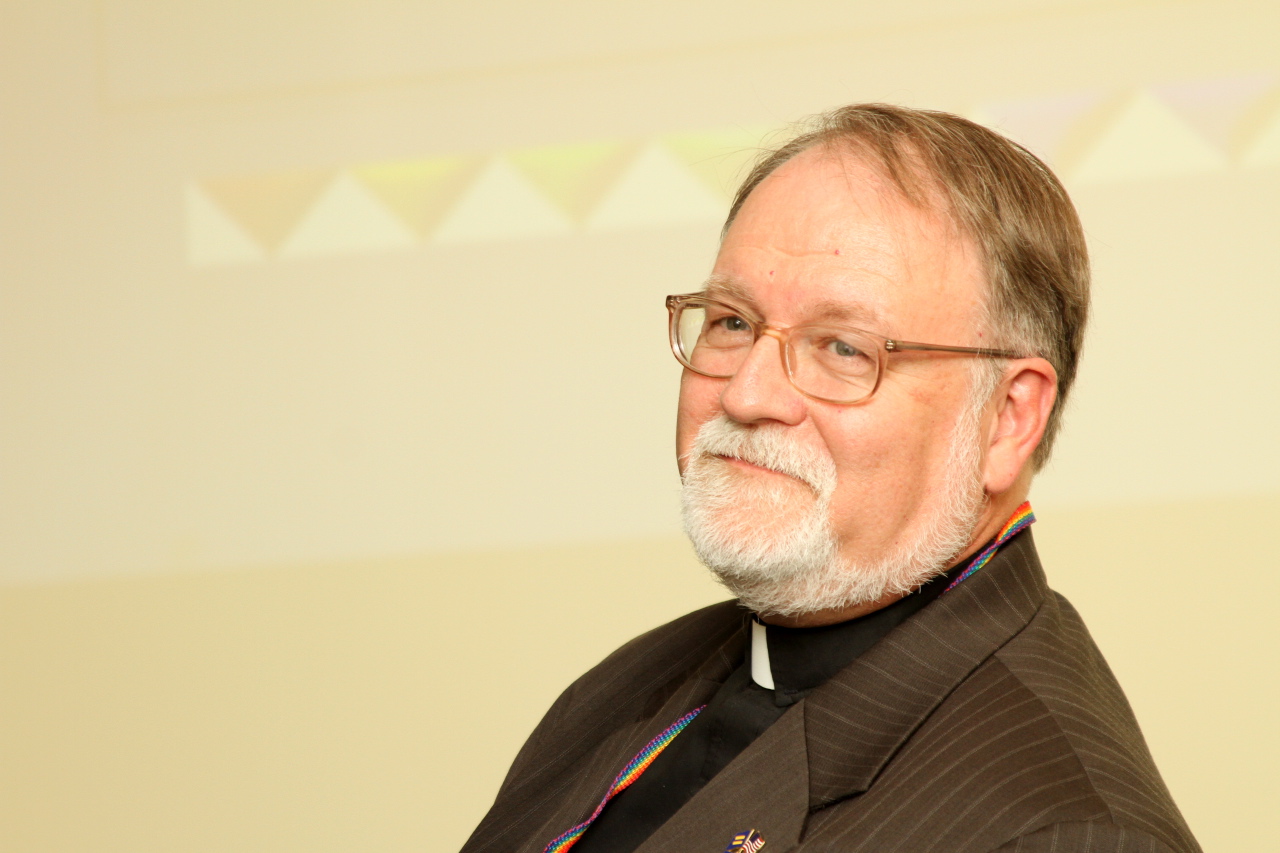
Dr. Stephen V. Sprinkle (Keith Tew photo).
Stephen V. Sprinkle is Director of Field Education and Supervised Ministry, and Professor of Practical Theology at Brite Divinity School, Fort Worth, Texas, a post he has held since 1994. An ordained Baptist minister, he is the first open and out Gay scholar in the history of the Divinity School, and the first open and out LGBTQ person to be tenured there. Read More…
Recent Social Justice Advocacy Activity By Dr. Sprinkle
 Summer 2009 – Dr. Sprinkle responded to the Fort Worth Police Department and Texas Alcoholic Beverage Commission Raid on the Rainbow Lounge, Fort Worth’s newest gay bar, on June 28, 2009, the exact 40th Anniversary of the Stonewall Rebellion. Dr. Sprinkle was invited to speak at three protest events sponsored by Queer LiberAction of Dallas. Here, he is keynoting the Rainbow Lounge Protest at the Tarrant County Courthouse on July 12, 2009. Read More…
Contact Us
Communicate with the Unfinished Lives project team:
info@unfinishedlivesblog.com


Schedule a Presentation
Dr. Sprinkle will gladly present his acclaimed presentation to your organization. To arrange an Unfinished Lives presentation for your organization or group, please contact us.
Dr. Sprinkle has given his Unfinished Lives presentation to these and other community groups and organizations. Read More…
-

Where are our readers?
Publisher: Steve Sprinkle (Project Director)
Steve Sprinkle
Unfinished Lives: Remembering LGBT Hate Crime VictimsBrite Divinity School/Texas Christian UniversityFort Worth TXprofessor, minister, author, blogger, LGBTQ advocate


Follow Unfinished Lives on Facebook
 Box Turtle Bulletin
- An error has occurred; the feed is probably down. Try again later.
- HRC Back Story
- Know About The Gender Identity Movement
- Why Is There A Need For Human Rights?
- Kinds Of Human Rights
- Human Rights Purposes And Violations
- Human Rights For Every Human Incident
- 8 Reasons Human Rights Are Important
- Everything About Human Rights
- Human Rights Issues Education & Law
- We Need To Stand Up For Our Rights And Those Of Others
- Coca-Cola Receives Perfect Score On Human Rights
- The Advocate: Daily News
- Eric Swalwell responds to sexual assault allegations in a to-camera video
- Eric Swalwell’s governor bid is collapsing as top Democrats turn on him
- What Melania Trump’s bizarre Jeffrey Epstein press event reveals about a White House in chaos
- New Bryon Noem bombshell puts Kristi Noem’s anti-trans politics under harsher spotlight
- Former Biden HHS leaders hail syphilis breakthrough as Trump dismantles the system behind it
- Advocate breaking news 4/10/26
- Pete Buttigieg hints at 2028 presidential run: ‘Save me a seat’
- Could Minneapolis welcome bathhouses back for the first time since the late 1980s?
- Donald Trump posts gruesome murder video to Truth Social
- Melania Trump blindsides White House aides with unexpected leap into Epstein scandal
- Dallas Voice: Instant Tea
- An error has occurred; the feed is probably down. Try again later.

 Unfinished Lives